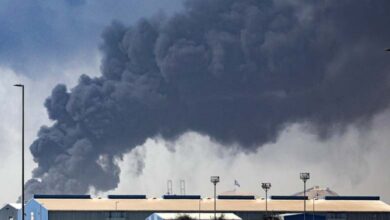
Gulf states intercept dozens of Iranian missiles and drones
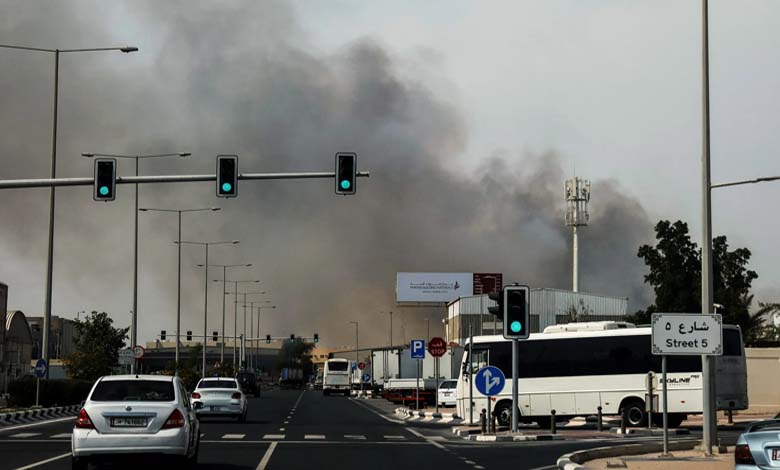
Iran’s offensive against Gulf countries aims to increase pressure on Washington to end the war.
Saudi Arabia, Bahrain, and Kuwait announced that they had intercepted dozens of missiles and drones in their airspace over the past hours, in the latest episode of regional escalation linked to the war involving Iran on one side and Israel and the United States on the other.
These developments come as attacks targeting several Arab countries have expanded since the end of February, while fears are rising that the conflict could evolve into a large-scale regional confrontation.
-
Washington doubts the seriousness of forming a naval alliance comprising Iran and Gulf states
-
Fatalities in airstrikes targeting the Popular Mobilization Forces and drone attacks on Erbil
The Saudi Ministry of Defense reported early Saturday that its air defense systems intercepted 17 drones and ballistic missiles launched toward targets inside the kingdom. In a statement posted on the platform X, it said that air defenses destroyed one drone east of the capital Riyadh, while 16 additional drones were intercepted and destroyed in the Rub’ al-Khali desert after attempting to target the Shaybah oil field located in the southeast of the country.
The ministry also stated that a ballistic missile had been launched toward Prince Sultan Air Base in Al-Kharj province southeast of Riyadh, but Saudi defenses managed to intercept and destroy it before it reached its target. Saudi authorities did not specify the source of these attacks, but their timing coincides with a wave of Iranian strikes targeting sites in several Arab countries in recent days.
-
Will Washington and Moscow strike a grand bargain: Iran in exchange for Ukraine?
-
Intense Iranian attacks on Gulf countries in the early hours of dawn
In Bahrain, the General Command of the Bahrain Defence Force announced that air defense systems had intercepted and destroyed 84 missiles and 147 drones targeting the kingdom since the start of the Iranian attacks on 28 February. In a statement, the command described the targeting of civilian facilities as a “flagrant violation of international humanitarian law” and a “direct threat to peace and stability in the region.”
The Bahraini Ministry of Interior also announced in two separate statements that warning sirens were activated across the country twice within about an hour as a precautionary measure following the detection of potential aerial threats.
-
Russia gains economic and geopolitical advantages from the war against Iran
-
Destination Iran: the United States withdraws thousands of smart bombs from South Korea
In Kuwait, the Ministry of Defense announced that 14 missiles and 12 drones were intercepted in the country’s airspace on Friday. According to the ministry, air defenses destroyed 12 drones in the northern and central parts of the country, while 14 missiles were intercepted in the southern regions. It added that debris from some projectiles caused limited material damage, without providing further details.
These attacks are part of a broader escalation involving eight Arab countries — Saudi Arabia, Kuwait, the United Arab Emirates, Qatar, Bahrain, Oman, Jordan, and Iraq — which have been targeted by a series of missile and drone attacks since 28 February.
-
Iran after Khamenei: a disoriented regime and a silent struggle over the Supreme Leader
-
Latest news of the war against Iran: Israel attacks 400 targets in 24 hours
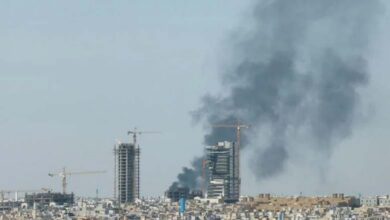
Iran says that these attacks target “American interests” in those countries as part of its response to military operations carried out by the United States and Israel inside Iranian territory. However, some of these attacks have struck civilian areas and caused damage to non-military infrastructure, including ports, economic facilities, and residential buildings, prompting regional and international condemnation.
Alongside attacks against countries in the region, Iran continues to launch missiles and drones toward Israel in response to US and Israeli strikes that began in late February. Reports indicate that those strikes resulted in the deaths of hundreds of people inside Iran, including Supreme Leader Ali Khamenei and several senior security officials.
-
Aircraft from the Vietnam War era: Iran’s air force as a strategic weakness
-
Between the palace and the hawks in Iran: a battle of attrition and power
Observers believe that the expansion of attacks to include a growing number of Gulf states reflects a new phase of the conflict, which is no longer confined to the direct confrontation between Iran and Israel. It also raises concerns about increasing risks to Gulf energy infrastructure, particularly following the attempted targeting of oil facilities such as Saudi Arabia’s Shaybah oil field.
Amid this escalation, international and regional calls are intensifying to contain the conflict and prevent it from sliding into an open regional war that could threaten global energy security and the stability of the entire region.
-
The sixth attack since midnight: Israel detects and intercepts an Iranian missile attack
-
Targeting military infrastructure: a new wave of Israeli airstrikes on Tehran and Isfahan