Iran after Khamenei: American red lines
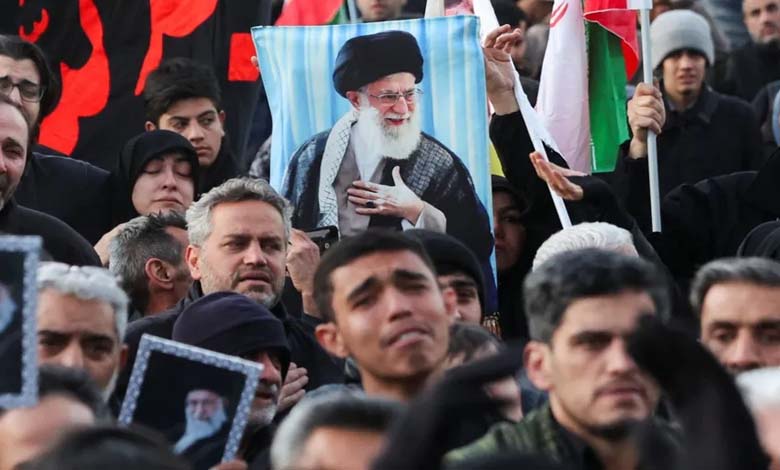
Following the death of Supreme Leader Ali Khamenei in the aftermath of a U.S.-Israeli attack, Iran has entered one of the most uncertain phases of political transition since 1979.
Within hours of the announcement, maps began circulating in Washington and through Iranian exile channels depicting a federal Iran with autonomous Kurdish, Arab, Baluch, and Azeri regions, a confederal Iran moving toward a soft partition, or even a cluster of small states emerging from the country’s collapse.
-
Sanctions on Iran and Aid to Israel… “American Representatives Swim Against the Biden Current”
-
After Iran… Trump identifies the next country
Now that Khamenei’s succession crisis has become a reality, the temptation to reshape Iran from the outside is likely to grow — a temptation the United States should resist, according to a report by the American outlet The National Interest.
With the regime’s leadership structure shaken and rival factions competing for control, the worst possible U.S. response would be to resort to a ready-made constitutional blueprint that could lead to a quagmire lasting generations.
-
Iran shuts the door on negotiations with the United States
-
After Strikes Targeting the Supreme Leader and the President: Key Pillars of the Iranian Regime
The report argues that whether Iran becomes a centralized state, a federal union, or a more flexible system, that decision must be made by Iranians themselves through internal consultation, not by American lawyers, think tank experts, or exiled politicians relying on pre-drawn maps.
According to The National Interest, the prudent role of the United States is to establish clear red lines and general preferences, then withdraw from direct involvement in the country’s internal affairs. The site outlines two such red lines.
-
A Major Strike Force: More Than a Dozen U.S. Warships Participate in the War on Iran
-
The War on Iran: One Operation, Two Names
Preventing the breakup of Iran
The United States must neither adopt, support, nor even hint at a strategy aimed at dismantling Iran. In the charged atmosphere following Khamenei’s assassination, any suggestion of a partition agenda would lend credibility to the regime’s longstanding narrative that the West seeks to fragment Iran.
Such a signal would encourage regional and global powers to treat Iranian regions as open arenas for competition. The breakup of Iran would not constitute a solution, but rather an invitation to border wars, proxy conflicts, and ethnic cleansing on the ruins of the state.
-
Smoke Near Iran’s Supreme Leader Headquarters… Where Is Khamenei?
-
Israeli-American Attack Targets Iran, Response Follows Swiftly
U.S. policy should clearly state that Washington “does not seek to redraw Iran’s borders or transform it into a mosaic of mini-states.”
Not backing a single strongman
The early moves by the Revolutionary Guard following Khamenei’s assassination demonstrate how swiftly and effectively the security apparatus can present itself as the sole guarantor of order. However, replacing one highly centralized authoritarian system with another would perpetuate the same logic that contributed to Iran’s fragility in the first place: a dominant center, regions treated as internal colonies, and a security state loyal to an individual rather than to the rule of law.
-
War indicators intensify: Arrival of U.S. refueling aircraft and departure of personnel from Israel
-
Intelligence reports refute Trump’s account on Iranian missiles
If Washington were to support a new shah, a new supreme leader, or a new general, it would bear responsibility for that figure’s repression and corruption, just as it assumed responsibility for the failures in Iraq and Afghanistan after the invasions.
Between these two red lines lies what the United States should prefer: a democratic and territorially unified Iran, whose foundations are laid by Iranians themselves. This could mean a unitary state with broad local powers, or a genuine federal system in which provinces elect their governors, manage local policing, determine education and language policies, and receive a share of national revenues.
-
Continuous U.S. military buildup in Israel in preparation for an attack on Iran
-
At odds with Trump over Iran: the story of a general who entrenched himself in his office rather than in the Tank
Whatever the label, what matters less than the name is the substantive shift of authority from a dominant center to empowered local institutions, while adhering to national rules. Washington’s orientation should favor rational decentralization based on genuine peripheral autonomy, real checks on the center, one flag, and a single foreign policy.
Khamenei’s assassination has created a vacuum that neighboring states and major powers will seek to fill. The United States’ role should not be to design Iran’s internal order, but to secure the external framework within which Iranians negotiate their future.
-
Trump presents to the public his justification for a potential attack on Iran
-
Emergency bags and escape plans: how Iranians are preparing for a possible attack
This entails deterring regional actors from carving out spheres of influence while Iran is at its weakest, providing economic and technical support for a constituent assembly, and backing credible monitoring of any referendums or elections.
The United States should not be neutral about outcomes, but it should be disciplined regarding the means it employs — clearly defining what is unacceptable, namely partition or the establishment of a new dictatorship — and then allowing Iranians to negotiate a new settlement between the center and the periphery within those boundaries.
-
Bomb Diplomacy: The Douhet Strategy and Washington’s Options on Iran
-
One Single Step Trump Is Waiting for to Strike Iran