Lincoln at the forefront… an overwhelming U.S. force off Iran
The U.S. president has dispatched a naval fleet described as a “major power” to the Middle East. But what capabilities does it actually possess?
-
New Talks – United States and Iran Revive Nuclear Agreement Negotiations Once Again
-
Iran faces the most dangerous total war with Israel and the United States
According to the British newspaper The Telegraph, the United States is quietly assembling a highly intimidating military force in the Middle East, placing itself on heightened alert to strike Iran should President Donald Trump choose to do so.
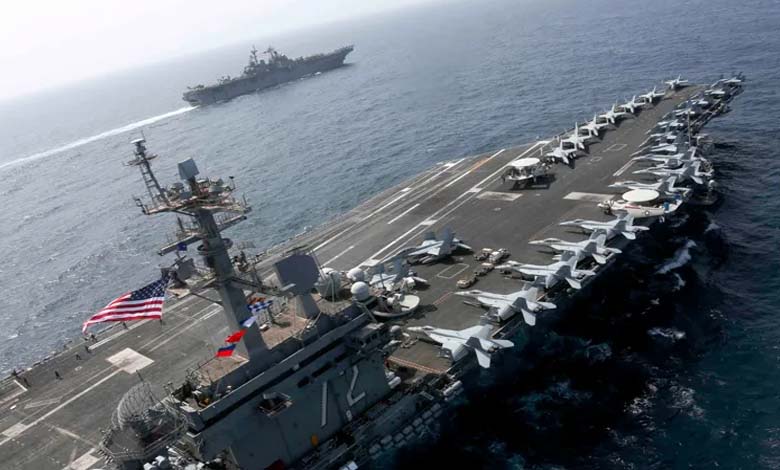
Last Monday, the U.S. aircraft carrier USS Abraham Lincoln, accompanied by three escort destroyers, entered the Middle East. Two days later, President Trump announced that a naval fleet was heading toward Iran “with strength, determination, and a clear objective,” threatening to bomb the regime if it did not halt its nuclear program.
Trump warned that “the next attack would be far worse” than previous strikes on Iranian nuclear facilities in June, when Washington bombed Iran following a week of escalating air raids between Israel and Iran.
-
Are the UAE Playing a Mediation Role Between Iran and the United States?
-
New sanctions imposed by the United States, Britain, and Canada on Iranian officials… Details
He stated, “Do not let this happen again.”
Elements of the Lincoln carrier strike group were deployed from the South China Sea, a region of strategic importance to U.S. national security in the Indo-Pacific.
The redeployment of this fleet from a vital security zone suggests that Trump is seeking to demonstrate overwhelming military power ahead of any negotiations with the Iranian regime.
The U.S. president maintains that Iran must not be allowed to acquire nuclear weapons or further develop its nuclear capabilities.
After weeks of violent protests, the Iranian government appears weakened, and Trump seems to be increasing pressure on Tehran’s leadership to force nuclear disarmament by threatening military action in response to the killing of protesters.
-
The United States will sanction more than two dozen people and entities about Iran’s nuclear
-
Iran in the crosshairs of Lincoln and its sisters… Messages of fire before the decision
According to The Telegraph, President Trump would not have sent this fleet without a thorough assessment of how it could be used. The equipment was reportedly selected specifically to overwhelm Iran’s defense systems should Tehran refuse to cooperate.
The aircraft carrier is accompanied by three Arleigh Burke–class guided missile destroyers, while under normal circumstances a nuclear-powered attack submarine operates in nearby waters.
The carrier strike group possesses immense firepower. The aircraft carrier hosts eight squadrons flying F-35 stealth fighters, F/A-18 Super Hornet jets, and EA-18 Growler electronic warfare aircraft.
All of these capabilities were employed simultaneously during the recent “Absolute Resolve” operation that led to the downfall of Nicolás Maduro’s regime in Venezuela and the transfer of the long-ruling president to the United States to face drug-related charges.
-
European recommendation to avoid Iranian airspace: is a U.S. strike drawing closer?
-
In Anticipation of a Potential Attack on Iran: U.S. Military Reinforcements to the Middle East
Growler aircraft jammed radar and communications systems, while F-35s and F/A-18s conducted kinetic strikes to suppress air defenses, enabling special forces helicopters to operate with minimal interference.
Like Venezuela, Iran’s air defense architecture relies heavily on Russian-made technology. A similar operation would likely facilitate the destruction of Iranian radar and surface-to-air missile systems.
What remains uncertain is whether Tehran is capable of rebuilding its air defenses after they were degraded by Israeli strikes, which allowed Israeli F-35s and other aircraft to gain air superiority during the twelve-day war in June. The United States then took advantage of this situation to strike Iranian nuclear sites.
While it is unlikely that the United States would attempt a ground invasion of Iran, it is expected to conduct a comparable aerial operation to test Iranian air defenses before launching broader bombardments, should President Trump carry out his threats.
-
Erosion of Deterrence Places the Iranian Regime in a Deep Strategic Crisis
-
Fleeing Iran: Western countries urge their citizens to leave immediately
The three destroyers — USS Frank E. Petersen Jr., USS Michael Murphy, and USS Spruance — are positioned offshore, carrying missiles that could be used for long-range strikes, including Tomahawk land-attack cruise missiles, as was the case in June.
These vessels could also play a key role in countering any Iranian retaliatory attack.
The Wall Street Journal reported that the United States has also deployed F-15E fighter jets to the region and is transferring Patriot and THAAD air defense systems to protect U.S. facilities and partners from potential Iranian retaliation.
According to the Associated Press, the Lincoln strike group has joined three littoral combat ships, as well as two additional U.S. Navy destroyers already operating in the area.
-
After a five-hour closure, Iran reopens its airspace
-
What weapons could Washington use in a potential attack on Iran?
U.S. Central Command also announced on social media that F-15E Strike Eagle aircraft from the U.S. Air Force are now present in the Middle East, stating that they “enhance combat readiness and strengthen regional security and stability.”
The Associated Press further reported that flight-tracking analysts observed dozens of U.S. military aircraft heading toward the region.
The arrival of the aircraft carrier is believed to have added nearly 5,700 personnel to the already substantial U.S. military presence in the region, which totals around 50,000 troops.
As U.S. warships moved toward the area, Iranian authorities unveiled a new mural on a giant billboard in central Tehran, carrying a direct warning to the United States against any attempt to launch a military strike on Iran.
-
Trump threatens intervention in Iran if protesters are executed
-
After Trump’s threats, Iran affirms readiness for war and dialogue