Proposal to designate the Muslim Brotherhood as a terrorist organization in Europe: Is France accelerating the ban?

The Muslim Brotherhood file has returned to the legislative spotlight in France following a proposal to designate the group as a terrorist organization at the European level, a move that could accelerate the pace of a ban across the Old Continent.
In a notable step within the French Parliament, the European Affairs Committee of the National Assembly adopted a draft resolution calling for the inclusion of the Muslim Brotherhood on the European Union’s list of terrorist organizations, after amendments were introduced to the original text submitted several months ago.
-
The Muslim Brotherhood in France Practices Judicial Terrorism
-
The Muslim Brotherhood and La France Insoumise: a discreet path of infiltration into Parliament
This development comes amid an intense political and security debate in France and across Europe regarding what is described as “ideological infiltration” or “penetration” into institutions and societies.
The proposal, submitted in May 2025 by MP Éric Pouget, received the approval of a majority of members of the European Affairs Committee, paving the way for a more sensitive stage in the legislative process.
According to the rapporteur appointed to the text, the proposal will be examined “in substance” by the Foreign Affairs Committee, before later being presented for general debate in the National Assembly’s plenary session, scheduled for January 22.
-
A parliamentary report reveals a troubling rapprochement between ‘La France Insoumise’ and the Muslim Brotherhood
-
The Muslim Brotherhood specter cancels a pro-Palestinian conference in France
Provisions
This proposal falls within the framework of the mechanisms adopted by the European Union to combat terrorism, foremost among them the EU list of terrorist organizations, established in the aftermath of the September 11, 2001 attacks.
Inclusion on this list entails direct legal consequences, including:
– the freezing of financial assets;
– a ban on all forms of funding;
– enhanced security and judicial cooperation among EU member states, according to the official website of the French Parliament.
The text of the resolution asserts that the Muslim Brotherhood is fundamentally a political movement rather than a religious one, highlighting its transnational presence within Europe and beyond.
-
Muslim Brotherhood Infiltration Shakes France’s Left: Bleeding Inside Mélenchon’s Party
-
The Muslim Brotherhood in France: The Book “Conspirators of Evil” Shakes the Political Scene
It also warns of the risks the group may pose to democratic values, social cohesion, and the internal security of the European Union.
The proposal calls for a coordinated European response to what it describes as a “threat that goes beyond a narrow national framework,” arguing that addressing this phenomenon cannot remain the responsibility of a single member state, but instead requires a collective approach at the EU level.
The European Affairs Committee formally adopted the proposal last Wednesday in its capacity as the competent body, thereby opening the way for the continuation of its parliamentary process and its referral to subsequent stages of political and legislative debate at both the French and European levels.
-
The Muslim Brotherhood and Education in France: the Ibn Khaldoun Crisis Unveils Hidden Funding Networks
-
France’s Muslim Brotherhood… warnings over infiltration and calls to address its root causes
Background and implications
The text seeks to encourage France to exert pressure within EU institutions to designate the Muslim Brotherhood as a “transnational ideological and organizational movement” on the European list of terrorist organizations.
Supporters of the proposal argue that such a designation would provide a stricter legal framework to counter what they view as networks of intellectual and organizational influence working to undermine republican values from within, through associations, religious discourse, or indirect political influence.
Backers of the resolution maintain that the group constitutes an “ideological incubator” that may lead to radicalization, thereby justifying its inclusion within preventive European security strategies.
-
The Brotherhood’s Claw Resurfaces in France… What Is Baraka City About?
-
Muslim Brotherhood Infiltration in France: A Threat to Society and How to Respond
European stakes
The debate is not confined to the French arena alone, as any move of this nature requires broad European consensus within EU institutions, particularly the Council of the European Union.
Observers note that even if the resolution is supported by the French Parliament, it would not be legally binding in itself. However, it could serve as a strong political signal, exerting pressure to reopen the European debate on the nature of non-traditional threats, including transnational organizations with ideological dimensions.
As the text moves to the Foreign Affairs Committee and then to the parliamentary chamber, the intensity of the debate is expected to increase in the coming weeks, with the proposal presented as a necessary tool to enhance security and counter ideological extremism.
-
France Unmasks the Muslim Brotherhood: A Late but Decisive Battle
-
A Step in the Fight: France Cuts Off Funding to Brotherhood-Linked Institute
Trump, the United Kingdom, and the Muslim Brotherhood
Observers say that by signing an executive order opening the door to reviewing the designation of certain branches of the Muslim Brotherhood as terrorist organizations, US President Donald Trump has placed the group under institutional scrutiny. This step suggests that the anticipated decision may go beyond political symbolism toward the use of tangible pressure mechanisms.
This appears to be a phase the US administration is on the verge of entering, according to Massad Boulos, senior adviser to Donald Trump on Arab and African affairs.
Last November, the US president signed an executive order requiring his administration to determine whether certain branches of the Muslim Brotherhood, including those operating in Lebanon, Egypt, and Jordan, should be designated as foreign terrorist organizations or specially designated global terrorist organizations.
-
Is France Moving Towards a Decisive Confrontation with the Muslim Brotherhood After the Intelligence Report?
-
France Leads European Initiative to Ban the Muslim Brotherhood… What’s New?
Last month, US Secretary of State Marco Rubio stated that Washington would most likely issue announcements regarding the Muslim Brotherhood in the following week.
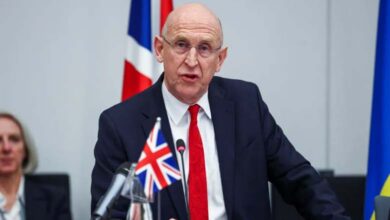
In the United Kingdom as well, the Muslim Brotherhood file has returned to the forefront of political debate, amid questions over whether London will follow Washington’s lead in designating some branches of the group as terrorist organizations.
Recently, the House of Lords in the British Parliament held an extensive debate on the government’s position regarding the document issued by the White House on November 24, concerning the executive order signed by Donald Trump, according to information on the Parliament’s official website.
-
Muslims of France: A Brotherhood Front Undermining the Fifth Republic
-
The Muslim Brotherhood Threat in France: A Digital and Geographical Mapping
-
The Muslim Brotherhood’s Threat to Education in France: The Frontlines Begin at Averroès