Retreat Summits: European Leaders Take Shelter in Castles During Times of Crisis
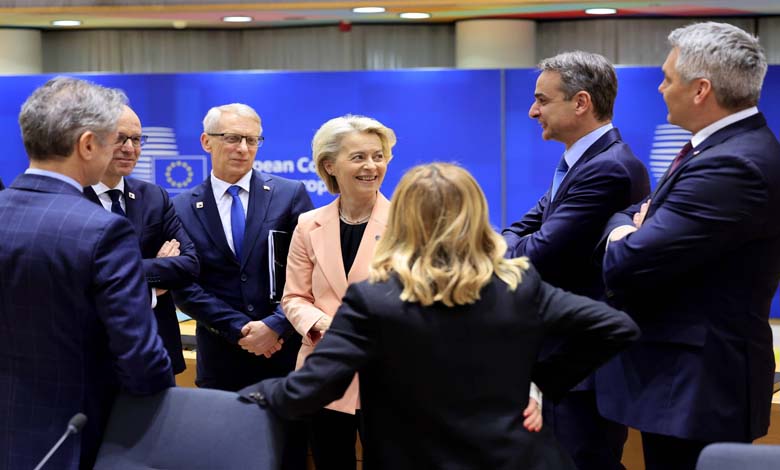
European Union leaders have often used difficult periods — from Russia’s attack on Ukraine to Brexit — as a pretext to retreat to the countryside.
According to the American magazine Politico, the bloc’s leaders have developed a habit of locking themselves behind fortified rural walls whenever circumstances become challenging.
This week is no exception. On Thursday, leaders are gathering at Alden Biesen Castle in Flanders for a series of highly serious discussions, as debate intensifies over the future of the European Union in an unstable world.
-
Ukraine’s Funding at Risk: Russian Assets Threaten to Divide the European Union
-
European Union Calls for Withdrawal of Military Forces from Tripoli: The Crime-Fighting Apparatus Denies Agreement with Dbeibah’s Seven Conditions
Located near Bilzen in the Belgian province of Limburg, Alden Biesen is one of the largest castle complexes between the Loire and the Rhine. It even features a moat designed to prevent unwanted intrusions.
According to Enrico Letta, a former Italian prime minister invited to the meeting, the task assigned to participants is highly ambitious: to save Europe.
The meeting is expected to show whether “Europe is capable of changing course and becoming truly united, mature, and fully independent,” just as the signing of the Maastricht Treaty in 1992 shaped “the Europe we know today,” the former Italian leader said.
-
French campaigns to ban the Muslim Brotherhood in the European Union… Details
-
Top diplomat: The European Union is preparing sanctions against Turkey
“Now we must do the same again,” Letta added.
Leaders seeking to revive the EU’s competitiveness may draw on reports prepared by Letta and another invited former Italian prime minister, Mario Draghi, or find inspiration in the venue’s high vaulted ceilings, ancient tapestries, and grand halls.
Luuk van Middelaar, historian and director of the Brussels Institute for Geopolitics, noted that “the enclosed halls of European palaces have long been favored gathering places for the EU’s political elite,” as they “provide the isolation needed to work away from public scrutiny and the bustle of major cities.”
He added, “Castles offer what EU decision-making often lacks: drama and grandeur.”
Since October 2003, all official European Council meetings have been held in Brussels.
-
European Broadcasting Union condemns Qatar’s stance and demands respect for journalists
-
Drone Fear: Four Armies Deployed to Guard European Leaders’ Summit in Copenhagen
Before that, meetings were often hosted by the country holding the rotating presidency of the Council of the European Union.
When António Costa assumed the presidency of the European Council, he spoke of informal “retreats” — meetings designed to allow leaders to exchange ideas without the pressure of reaching immediate conclusions.
The idea was simple: leave Brussels and think, Costa’s team told Politico.
The first such retreat, focused on defense, was organized hastily. With limited time to search for a majestic castle, the Council opted for Egmont Palace in Brussels, headquarters of the Belgian Foreign Ministry — a suitable venue, though not a castle.
Council officials later reviewed locations across Belgium before settling on Alden Biesen, which met all requirements: security for 27 leaders, space for the press, and the right balance between practicality and stone-walled symbolism.
This week is not the first time the EU has adopted such an approach.
-
France Leads European Initiative to Ban the Muslim Brotherhood… What’s New?
-
New European Sanctions Await Russia… France Seeks U.S. Coordination
Historical Glimpses
In March 2022, just days after Russia launched its attack on Ukraine, EU leaders met at the Palace of Versailles outside Paris, at the invitation of French President Emmanuel Macron.
In September 2016, they convened at Bratislava Castle overlooking the Danube in Slovakia for their first meeting after the United Kingdom voted to leave the European Union.
Following the September 11 attacks, the European Council met in December 2001 at the Château de Laeken, the official residence of the Belgian royal family. The secluded location provided the necessary security for sensitive discussions on terrorism.
-
Nordic Unity: A Model for European Defense Beyond NATO
-
Why Is It Time to Reconsider the Creation of a European Army?
Going further back, in December 1991, the European Council summit that paved the way for the Maastricht Treaty was held at the Limburg Provincial Government building, not in a castle.
However, a side event took leaders to the nearby Château Neercanne, where they symbolically signed their names on a cave wall during a luncheon hosted by the then Queen of the Netherlands, Beatrix.
Medieval historian Matt Lewis explained: “Castles largely emerged in Europe following the collapse of Charlemagne’s empire. They were a response to the uncertainty created by a power vacuum and the fear of what that might mean for those holding authority.”
He added: “Hosting major international events in castles and palaces remains attractive even today. Contemporary politicians, at least in part, employ the same methods as their medieval predecessors. At the same time, such refuge reflects a degree of fragility, reinforced by the centuries-old defenses of the castle.”
-
European countries pledge to enforce ICC warrants against Netanyahu
-
After America: Is it Time to Transform NATO into a European Organization?
-
Slovenia Becomes Fourth European Country to Recognize Palestine Amid Gaza War