Kaliningrad and the Suwałki Gap: Nuclear Confrontation Scenarios at the Heart of Eastern Europe
By escalating its warnings that it could use nuclear weapons if Kaliningrad’s borders are threatened, Russia is seeking to control the rules of military confrontation with NATO rather than offer a precise forecast of how a future conflict would end.
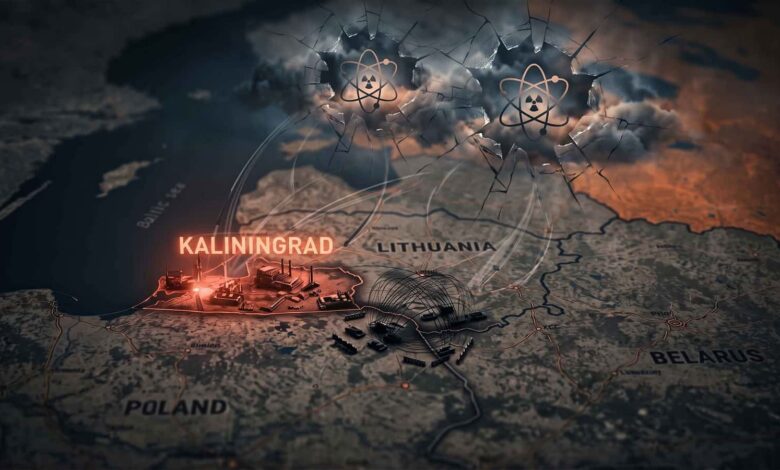
Strategic experts say Moscow’s military leadership understands that the Kaliningrad exclave, located between Poland and Lithuania, would be among the first targets in any confrontation with the West. The Russian territory hosts naval facilities, air-defence systems, electronic warfare equipment and nuclear-capable Iskander missiles.
NATO, for its part, knows that it would be impossible to defend the Baltic states effectively without neutralising the military capabilities deployed in the exclave.
Moscow is therefore attempting to frame any military action against Kaliningrad as carrying an immediate risk of nuclear escalation. This calculation is the true driving force behind its latest warnings.
In a diplomatic memorandum sent to NATO members, Russia claimed to have detected preparations for an air and naval blockade of Kaliningrad. It indirectly threatened to use “its full arsenal”, including nuclear weapons, if the region were isolated.
NATO officially denied the claim and questioned the allegations because of the lack of evidence. The meaning of Moscow’s message nevertheless remains clear: Russia is drawing a red line and warning the West that even a limited conventional operation against the territory could lead to the nuclear threshold being crossed.
Strategic Advantage and an Unequal Balance
Kaliningrad creates a unique operational challenge. Russia uses the territory as a forward platform for deploying missiles, radars and naval vessels deep inside northern Europe, threatening Polish ports and vital NATO supply routes.
The Kremlin, however, is seeking an asymmetric arrangement: it wants to retain Kaliningrad as an offensive base while granting it the protection of a nuclear sanctuary.
Reports from research centres suggest that this tactic provides Moscow with substantial strategic benefits. If NATO accepts that striking or blockading the region would be too dangerous, Russia will retain a heavily armed base behind the Alliance’s lines.
If NATO refuses to accept that restriction, Moscow can quickly accuse it of threatening Russian territory and assign responsibility for any subsequent escalation to the West in advance.
Although media analyses have said that Russia does not intend to attack NATO, Moscow insists that it would respond with maximum force to any attempt to isolate the region.
This is a familiar manoeuvre: Russia denies offensive intentions while classifying Western defensive measures as acts of aggression.
Blurring the Line Between Wartime Planning and an Impending Blockade
According to a report by Frontline Radar, a website specialising in international conflicts and strategic studies, imposing a blockade on Kaliningrad would constitute an explicit act of war under military norms. It would require the interception of Russian shipping and the closure of access routes.
There is no evidence that NATO is planning such action in peacetime.
Western militaries must nevertheless prepare for scenarios involving full-scale war, in which Russian military capabilities inside the exclave would need to be neutralised as soon as hostilities began.
Russian rhetoric deliberately erases the crucial distinction between defensive contingency planning and preparations for an imminent blockade.
This conflation allows Moscow to justify reinforcing its forces, exert political pressure on European governments and portray the Alliance’s routine preparations as a prelude to nuclear war.
The deterrent message is not directed solely at military planners in Brussels. It also targets European public opinion by fuelling doubts over whether protecting the Baltic states is worth the risk of a nuclear confrontation.
The Kremlin does not necessarily need to win European support. It only needs to create fear that the cost of resistance would be unbearable.
One Battlefield: Kaliningrad and the Suwałki Gap
Kaliningrad’s military significance is closely connected to the Suwałki Gap, the narrow border corridor between Poland and Lithuania that separates the Russian exclave from Belarus.
For NATO, the corridor is the only land connection to the Baltic states. For Russia, it is the geographical barrier separating Kaliningrad from its Belarusian ally.
If conflict erupted, Moscow would probably seek to close the corridor and isolate the Baltic region. NATO would then be forced to secure it, including by striking missile systems inside Kaliningrad.
This interdependence makes the two areas a single battlefield that cannot easily be separated in operational terms.
Moscow is nevertheless trying to break that link politically. It wants NATO to regard the defence of the corridor as a conventional confrontation while treating any action against Russian forces inside the exclave as a leap towards nuclear war.
Nuclear Threats Compress the Decision-Making Timeline
The greatest danger posed by nuclear threats lies in the pressure they place on commanders’ decision-making timelines.
NATO’s fear of an attack launched from Kaliningrad could encourage pre-emptive action. At the same time, Moscow’s fear that its forces might be rapidly neutralised could push it towards preventive strikes.
This dynamic increases the likelihood of impulsive behaviour, miscalculation and uncontrolled escalation.
Russian nuclear doctrine permits the use of nuclear weapons when a conventional attack threatens the integrity of Russian or Belarusian territory.
Analyses suggest that the flexibility of this wording allows the Kremlin to classify a “blockade” as an existential threat that crosses the nuclear threshold, even if no NATO soldier enters the region.
This deliberate ambiguity is intended to paralyse NATO decision-making by overwhelming its leaders with complex risk calculations.
Yet that ambiguity could also work against Moscow. NATO’s uncertainty about the credibility of the threat might encourage the Alliance to take pre-emptive offensive steps.
NATO’s Operational Dilemma
NATO Secretary General Mark Rutte has responded firmly, calling on Moscow to end its nuclear rhetoric and asserting that Russia would inevitably lose any direct confrontation. Such political statements, however, do not resolve the operational problem on the ground.
The Alliance faces a dilemma: how can it deter Russia without appearing to prepare an attack on Kaliningrad? How can it defend the Baltic states without creating the impression that it is preparing a blockade?
At the same time, NATO cannot grant immunity to bases from which attacks could be launched against its members.
Excessive reassurance would weaken deterrence, while insufficient reassurance would reinforce the Russian narrative.
The situation therefore requires direct and confidential communication channels to clarify routine military activities, combined with an unequivocal warning about the catastrophic consequences of any use of nuclear weapons.
Raising the Cost of Deterrence
Russia’s strategy is not merely intended to portray Kaliningrad as a protected zone. It seeks to persuade NATO that responding to the threat would be more terrifying than learning to coexist with it.
Nuclear warnings consequently become an instrument in a broader struggle for influence. Moscow preserves its freedom to build up forces inside the exclave while restricting the Alliance’s military planning.
NATO, meanwhile, seeks to protect its eastern borders without giving Russia a pretext for further aggression.
Kaliningrad’s strategic peculiarity lies in the fact that it is both a vulnerability and an offensive weapon. The Kremlin’s message transforms that contradiction into a direct threat.
According to observers, if the Alliance attempts to neutralise this capability, Russia may treat the move as an existential danger. Moscow is therefore seeking to place a nuclear shield over its most vulnerable and exposed military position in the heart of Europe.