China gains ground on the United States in Latin America under Trump
For the first time since Latinobarómetro began polling in 1995, China’s influence in Latin America is viewed more favorably than that of the United States. The 2026 survey, conducted in 17 countries across the region, found that 65% of respondents considered China’s influence positive, compared with 57% for the United States.
The shift comes during Donald Trump’s second term, as his administration seeks to strengthen Washington’s influence in the region, in part by making greater use of military force.
Public opinion is more complex
The United States remains more popular as a country, with a 63% favorable rating compared with 58% for China. Still, the U.S. rating has fallen by 10 percentage points from 73% in 2024.
The survey also found that a majority of respondents in every country surveyed except Argentina supported the arrest of Venezuelan President Nicolás Maduro by U.S. special forces. More favorable views of Beijing therefore do not necessarily signal a wholesale rejection of Washington’s role in the region.
Trade grows amid new tariff pressures
Trade between China and Latin America reached $565 billion in 2025, up 6.5% from the previous year. It exceeded $500 billion for the second consecutive year.
U.S. imports from the region rose 4.7% to $705 billion, while U.S. exports to the region increased 2.5% to $549 billion. The U.S. goods trade deficit with the region widened to $156 billion, driven largely by trade with Mexico.
According to the Economic Commission for Latin America and the Caribbean (ECLAC), the region accounted for 22.2% of U.S. goods trade in 2025. The commission attributes the decline in that share from the previous year primarily to strong global trade.
Those trade flows face new tariff pressures. On July 24, 2026, Washington imposed a tariff linked to “forced labor” on 18 countries in the region. ECLAC says Haiti and Brazil face the highest average U.S. tariff rates in Latin America and the Caribbean.
The Belt and Road Initiative and Peru’s Chancay port
Twenty-two countries in Latin America and the Caribbean have joined China’s Belt and Road Initiative. In May 2025, President Xi Jinping announced a $9 billion credit line to finance investment in the region.
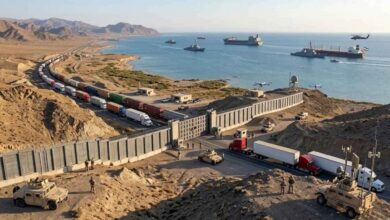
The port of Chancay in Peru has become a symbol of China’s presence. Total investment in the two-phase project exceeds $3.4 billion. The second phase, scheduled to begin in 2027, is expected to cost more than $1.3 billion and expand the port from four to 15 berths.
The port has also become a point of contention. In February 2026, a court ordered the regulator to refrain from overseeing port operations.
Washington redirects military aid
U.S. military aid to eight of the region’s major economies fell to $56 million, its lowest level since at least 2001, according to Bloomberg Economics.
Washington has begun redirecting resources. Last September, the U.S. State Department notified Congress that it was reallocating $52 million in foreign military financing to Panama, Peru, Ecuador and Colombia.
The department said the funds were intended to combat narcoterrorism and secure the Panama Canal. It said the funding would also prevent U.S. adversaries from consolidating strategic footholds in the Western Hemisphere.
Latin American countries seek a wider range of partners
In December 2025, the United States and China each released a report setting out their objectives and strategy for engaging with countries in the region.
The competition, however, appears far from a zero-sum game. The United States remained the region’s largest foreign investor in 2024, accounting for 38% of total foreign investment.
Some analysts say Beijing’s shrinking financial capacity could limit its influence. Framing the contest solely as a rivalry between Washington and Beijing also overlooks Latin American countries’ own efforts to diversify their partnerships.