Daily suffering for residents of Lebanese border villages amid Israeli bombardment
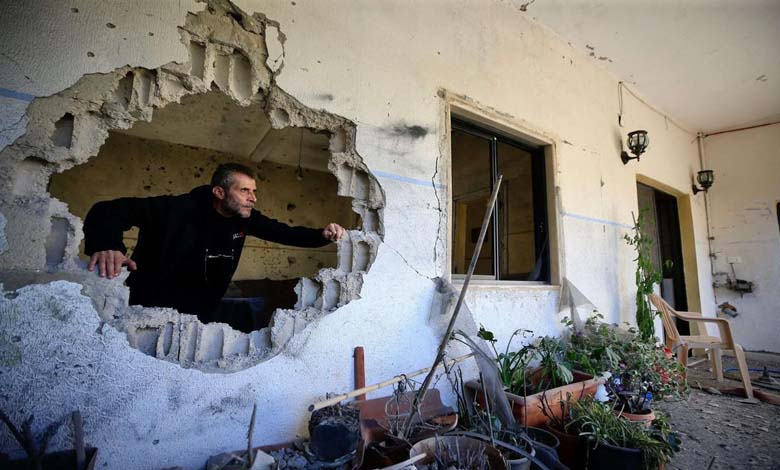
Residents of border villages and towns find themselves facing a tragic reality that combines daily attempts to endure with the risks of ongoing escalation.
People living in the border areas of southern Lebanon, particularly in the towns of Al-Habbariyeh and Ibl al-Saqi, in the Marjeyoun district of the Nabatieh Governorate, are experiencing deteriorating humanitarian and living conditions amid the continuation of Israeli airstrikes as part of the latest escalation ongoing since March 2.
Amid repeated shelling and the decline of basic living conditions, residents face a tragic situation that merges daily efforts to persevere with the dangers of continuous escalation in areas considered among the most sensitive points along the line of contact with Israel.
The security escalation has directly affected residents’ lives, as sources of income have declined, daily activities have been disrupted, and the limited savings of families have been depleted as the crisis drags on.
The head of Al-Habbariyeh municipality, Mohammed Abu Ali Assili, stated that “the situation is worsening day by day,” explaining that residents live in a state of “total instability, with neither calm nor job opportunities, due to the reliance of a large segment of the population on daily labor to secure their livelihood.”
He added that “the continuation of the crisis for more than a month constitutes a heavy burden on residents, especially those who depend on daily income,” noting that “this prolonged period without work or stability severely exhausts people.”
He pointed out that Al-Habbariyeh, located about 6 kilometers from the border with Israel, lives under constant bombardment, with residents hearing the sounds of aircraft and explosions almost daily, day and night.
In recent months, southern and eastern Lebanon have turned into a near-permanent scene of Israeli airstrikes, extending from the hills of Al-Khordali, through the heights of Iqlim al-Tuffah, to the edges of the western Bekaa, reflecting a sustained pace of escalation with repeated strikes across wide geographic areas.
Regarding the calls received by residents of several towns in southern Lebanon from entities claiming to be affiliated with the Israeli army, warning against the presence of Hezbollah members in the area, the municipal head said this “has intensified the state of anxiety” in the region.
He explained that these Israeli warnings were perceived as “preliminary alerts,” raising fears among residents of possible future evacuation orders.
Despite this, Assili affirmed residents’ determination to remain in their villages while calling for a stronger state presence, saying, “We are committed to legitimacy and to the presence of the Lebanese army, as this gives us some morale and reassurance.”
He stressed that basic needs “have become urgent,” explaining that those who had stored essential supplies “have begun to exhaust them over time.”
On March 2, Israel expanded its offensive against Lebanon after launching, in coordination with the United States on February 28, a continuous offensive against Iran that resulted in thousands of deaths and injuries.
Hezbollah, an ally of Iran, attacked an Israeli military site on March 2 in response to Tel Aviv’s continued attacks on Lebanon despite the ceasefire agreement in place since November 2024. On the same day, Israel launched a new offensive against Lebanon through airstrikes on Beirut’s southern suburb and areas in the south and east of the country, in addition to ground incursions.
For his part, the mukhtar of Ibl al-Saqi, Monsef Abu Ajaj, said that the situation on the ground is becoming increasingly complex, despite the partial continuation of movement between some areas.
He explained that “the situation is tightening more and more,” noting that some residents have moved to nearby areas and that certain neighborhoods have become “almost empty” due to security warnings, especially in areas close to the lines of contact.
He added that residents have dispersed across several regions, including Hasbaya and the Chouf, while other families have remained in the town despite the risks in an attempt to preserve their homes and lands.
The mukhtar spoke about the deterioration of infrastructure in the area, noting power outages in some zones following strikes on nearby sites, as well as damage to roads and bridges, which has complicated movement and the provision of basic needs.
He added that neighboring towns such as Marjeyoun and Qlayaa are experiencing similar conditions, with difficulty securing essential supplies due to security tensions.
Abu Ajaj indicated that the presence of the Lebanese army and the United Nations Interim Force in Lebanon (UNIFIL) contributes to providing a degree of reassurance to residents through patrols in the area, noting that this “does not eliminate the anxiety caused by the ongoing Israeli bombardment.”
He stressed that the continued targeting of the area, including civilian facilities, increases pressure on residents to leave, while affirming “ongoing efforts to provide services even under bombardment in order to preserve a minimum capacity to endure.”
The head of Al-Habbariyeh municipality likewise emphasized that residents “remain determined to stay in their homes despite all circumstances,” noting that “their attachment to the land and the state gives them moral motivation to remain despite the bombardment.”
A resident of Al-Habbariyeh, who asked to be identified only as Abu Shadi without revealing his full name, said that residents face a difficult choice between displacement and staying.
He added, “Leaving the area means losing one’s home and source of livelihood, while staying carries continuous risks,” reflecting the deep attachment of residents to their land despite the extremely harsh conditions.