The Syrian Democratic Forces cling to the administration of Hasakah, al-Charaa threatens escalation
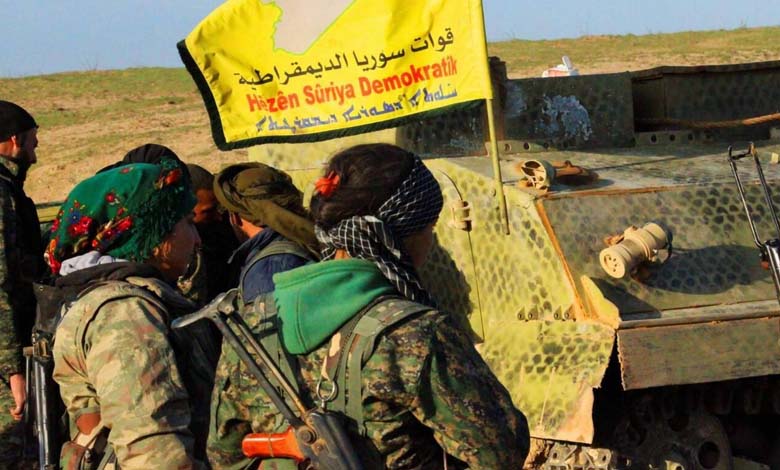
Sources confirm that the Syrian president offered Mazloum Abdi the post of deputy minister of defense and the nomination of a governor for Hasakah, in exchange for distancing the SDF from the Kurdistan Workers’ Party.
Negotiations between Syrian President Ahmad al-Charaa and Mazloum Abdi, commander of the Syrian Democratic Forces, over the future of the administration of Hasakah continued for five hours, during which the latter insisted that control of the province remain in the hands of his organization, while al-Charaa threatened a military option, according to multiple consistent media reports.
-
Children in the Grip of Extremism: SDF Uncovers ISIS Secret Cells in Roj Camp
-
SDF Fights Syrian Army, Calls on Coalition to Combat ISIS
The platform “Al Jazeera Syria Now” reported, citing unnamed private sources on Monday evening, that the talks on Hasakah lasted five hours between President al-Charaa and Mazloum Abdi. The former reportedly offered the latter the position of deputy minister of defense and the nomination of a governor for Hasakah, in return for neutralizing the SDF with regard to the Kurdistan Workers’ Party.
It added that this took place during a meeting marked by intensive negotiations over the future of Hasakah’s administration, without specifying the location. The sources said that al-Charaa conditioned the entry of internal security forces into the city, while Abdi insisted on maintaining full administrative control by the SDF.
-
American Failure in Managing the SDF and Tribal Crisis Warns of Escalation in Battles
-
SDF Accuses Iran of Fueling ‘Tribal Uprising’ in Deir ez-Zor
They stressed that the Syrian president refused to grant Abdi a five-day consultation period, demanded a final answer by the end of the day, and threatened to resort to a military solution and to inform the international community of his withdrawal from the negotiations.
Many indications suggest that SDF leaders were taken by surprise by the American position, which was viewed as a green light for the Syrian army to push further east of the Euphrates, a stance that al-Charaa sought to exploit on the ground.
-
SDF accuses Turkey of preparing for the return of ISIS… How?
-
Washington resumes operations with SDF amid Turkish threats
On Monday, Abdi reaffirmed his commitment to what he described as the “people’s gains,” explaining that the decision to withdraw from Raqqa and Deir ez-Zor was part of an effort to halt bloodshed and protect civilians, while redeploying forces in Hasakah province.
In statements to the Ronahi channel, he stressed that these gains would remain defended and protected, noting that the choice of withdrawal did not represent a retreat but a calculated step aimed at sparing the region further human losses.
-
The Syrian army expands its deployment in the Jazira and secures the Tishreen Dam
-
Syrian army takes control of the country’s largest oil field
He explained that the clashes had been imposed on his forces despite their repeated attempts to stop the attacks, which began on January 6, confirming that the war had resulted in casualties among military and security forces, as well as the displacement of a number of residents.
He said that before heading to Damascus, expected later in the day, he was keen to clarify a number of positions, reaffirming the continuation of resistance and struggle, and emphasizing that his forces possessed the capacity and determination to continue the confrontation, with a firm belief in achieving victory and making every necessary sacrifice.
-
Damascus links coastal unrest to plans aimed at dismantling the state
-
Israel secretly armed al-Hajri’s forces to sow chaos in Syria
He added that his forces had done everything possible to avoid the outbreak of war, but that other parties had taken the decision to confront in advance.
He concluded by affirming that the details of the agreement signed with interim Syrian President Ahmad al-Charaa would later be clarified in a more comprehensive and transparent manner after his return from Damascus.
These developments come as the Syrian army announced its control over the city of Shaddadi and its prison in the countryside of Hasakah in northeastern Syria, and the launch of operations to pursue Islamic State fighters who had been released by the SDF.
-
The United States avenges the killing of its soldiers in Syria with Hawk Eye: airstrikes against ISIS
-
Understandings between Netanyahu and Barak on regulating Israeli movements in Syria
On Sunday evening, President al-Charaa signed a ceasefire agreement with the SDF and an arrangement to integrate its fighters into the government.
Among the fourteen main provisions of the agreement is also the integration of the administration responsible for detainees and camps of the Islamic State, as well as the forces tasked with protecting these facilities, into the Syrian state, which will henceforth assume full legal and security responsibility for them.
The agreement followed a military operation launched by the Syrian army a few days ago, through which it regained large areas in the east and northeast of the country, after repeated violations by the SDF of agreements signed with the government ten months earlier and their refusal to implement their provisions.
-
The ISIS flag, from Syria to Australia: cross-border terrorism
-
Al-Shar’a rejects the division of Syria
The SDF had rejected the March 2025 agreement with the Syrian government, which stipulated respect for the Kurdish component within equal rights for all components of the people, and the integration of civil and military institutions in the northeast into the state administration.
The administration of President Ahmad al-Charaa has been making intensive efforts to restore security and extend its control over the entire Syrian territory since the overthrow of the Bashar al-Assad regime on December 8, 2024.
-
A Rocket Attack Shakes Damascus as Israeli Denial Deepens the Mystery
-
The Entry of Syrian Islamic Factions into Politics: Tactical Shift or Genuine Transformation?