US Military Prepares for Prolonged Military Operation Against Iran
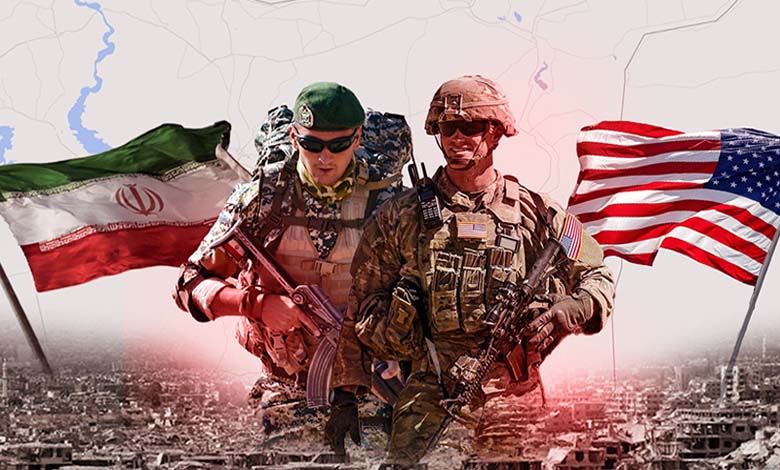
The United States expects Iran to retaliate, potentially triggering an exchange of strikes whose repercussions could affect the entire Middle East.
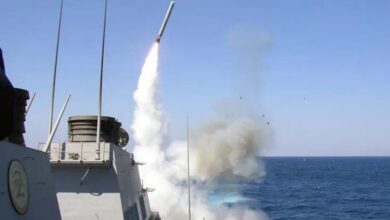
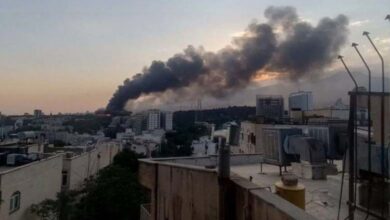
Two US officials told Reuters that the American military is preparing for the possibility of sustained operations lasting several weeks against Iran if President Donald Trump orders an attack, in what could escalate into a far more serious conflict than anything previously witnessed between the two countries.
-
Diplomacy races against rising tensions: anticipation of Muscat talks between Washington and Tehran
-
Washington and Tehran discuss a ‘political ceasefire’
The officials, who spoke on condition of anonymity due to the sensitivity of the planning, said the preparations heighten the risks facing ongoing diplomatic efforts between Washington and Tehran. US envoys Steve Witkoff and Jared Kushner are scheduled to hold talks with Iran next Tuesday in Geneva, with representatives from the Sultanate of Oman acting as mediators.
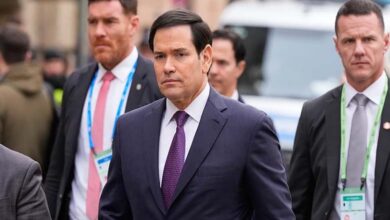
Earlier on Saturday, Secretary of State Marco Rubio warned that although Trump prefers reaching an agreement with Tehran, “it is extremely difficult.”
-
Washington Targets Tehran with Harsh Sanctions as Araghtchi Demands War Reparations
-
Tehran and Washington Resume Nuclear Talks Under the Pressure of Red Lines
US and Iranian diplomats met in Oman last week in an effort to revive diplomacy over Iran’s nuclear program after Trump deployed military forces to the region, raising fears of renewed military action.
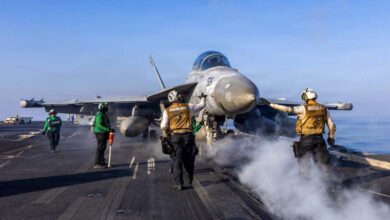
On Friday, US officials announced that the Pentagon would send an additional aircraft carrier to the Middle East, along with thousands of troops, fighter jets, guided missile destroyers, and other offensive and defensive capabilities.
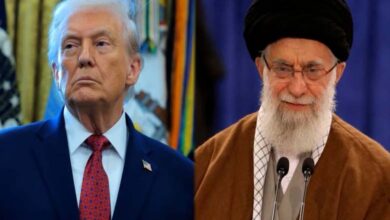
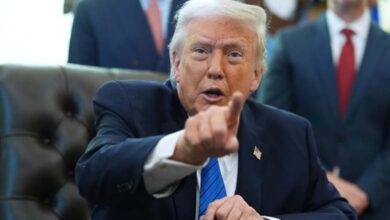
Addressing US troops at a base in North Carolina, Trump said it had been “hard to reach a deal” with Iran, adding, “Sometimes you have to instill fear. That’s the only thing that really solves the problem.”
-
Washington continues military build-up to pressure Iran
-
On the eve of the Muscat talks, five milestones paved the way for Iran and Washington’s return to negotiations
He also publicly suggested the possibility of regime change in Iran, stating that it “seems to be the best thing that could happen,” without specifying who he would support to take power. “For 47 years they have been talking and talking and talking,” he added.
Trump has long expressed skepticism about deploying ground forces to Iran, saying last year that “the last thing you want is to use ground troops.” The types of military assets currently deployed suggest primarily air and naval strike options.
Asked about preparations for a potential prolonged military campaign, White House spokesperson Anna Kelly said that “President Trump is keeping all options on the table regarding Iran,” adding that he listens to diverse viewpoints before making decisions based on national interest and security.
-
Trump and Iran: three military paths on the decision table
-
Washington open to dialogue with Iran, while keeping its finger on the trigger
Last year, the United States deployed two aircraft carriers to the region during strikes on Iranian nuclear sites. However, Operation Midnight Hammer in June was a one-time strike involving stealth bombers launched from the United States. Iran responded with a very limited retaliatory strike against a US base in Qatar. Officials indicated that current planning is more complex.
One official said potential targets could include the Iranian government and security facilities, not just nuclear infrastructure.
Experts warn that risks to US forces would be significantly greater in any such operation, given Iran’s extensive missile arsenal, and that retaliatory strikes could spark a broader regional conflict.
-
Iran in the crosshairs of Lincoln and its sisters… Messages of fire before the decision
-
Iran protests put Trump to the test between escalation and dialogue
Trump has repeatedly threatened to bomb Iran over its nuclear and missile programs and its domestic repression, warning that the alternative to diplomacy would be “very painful.”
Iran’s Revolutionary Guard has warned that if Iranian territory is struck, it could target any US military base. The United States maintains bases across the Middle East, including in Jordan, Kuwait, Saudi Arabia, Qatar, Bahrain, the United Arab Emirates, and Turkey.
During his meeting with Trump in Washington, Israeli Prime Minister Benjamin Netanyahu said that any agreement with Iran “must include elements important to Israel.”
-
Iran protests: a growing movement, escalating military rhetoric, and a watching world
-
Iran draws up a list of Israeli and U.S. targets in response to a potential attack
Axios reported that Trump agreed with Netanyahu on the need to reduce Iranian oil exports to China. A senior US official was quoted as saying that maximum pressure would be applied, particularly regarding Iranian oil sales to Beijing.
China, which purchases more than 80 percent of Iran’s oil exports, responded that normal cooperation between countries under international law should be respected and protected.
Meanwhile, Iran stated it is prepared to discuss restrictions on its nuclear program in exchange for sanctions relief but ruled out linking the issue to its missile program. Deputy Foreign Minister Majid Takht Ravanchi told the BBC that Tehran is ready to consider concessions if the United States shows willingness to lift sanctions.
-
Khamenei calls protesters agents and accuses them of trying to appease Trump
-
Iran faces the most dangerous total war with Israel and the United States
Canada also entered the debate. Foreign Minister Anita Anand said Ottawa seeks a change of government in Iran and announced additional sanctions against seven individuals linked to the Iranian authorities.
Finally, Iranian opposition figure Reza Pahlavi, son of the Shah overthrown in 1979, said US military intervention could save lives and accelerate the regime’s collapse, expressing hope that such action would enable the Iranian people to return to the streets and ultimately bring about the fall of the ruling system.
-
America, Iran, and the nuclear issue: Who can break the stalemate?
-
Washington targets Iran’s weapons supply lines beyond Gulf waters