Iyad Ag Ghali, the desert fox threatening Mali
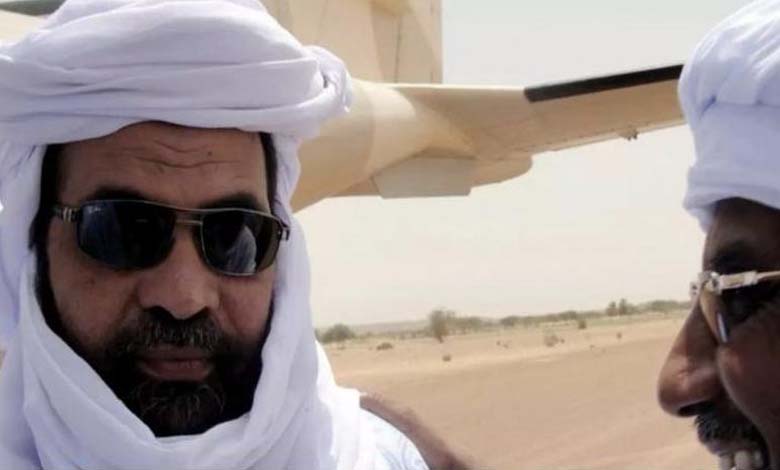
His name has rarely been absent from Mali’s crises since 2012. Whenever gunfire echoes across the troubled country, his shadow seems to emerge from behind the trigger and within hybrid alliances.
Iyad Ag Ghali, the militant leader of Jama’at Nusrat al-Islam wal-Muslimin, widely regarded as the de facto head of Al-Qaeda in Mali, has resurfaced amid an extremely complex security landscape.
Mali has witnessed rapid developments after the militant faction, in coordination with the Azawad Liberation Front, launched attacks on the capital Bamako and other parts of the country.
-
First official appearance of Mali’s military council leader since the Saturday attacks
-
Al-Qaeda before the Malian storm: leadership changes and the choking of arteries
An alliance of necessity
In the latest attacks, it was notable that the simultaneous operation was carried out by Jama’at Nusrat al-Islam wal-Muslimin and the Azawad Liberation Front, an alliance that sparked surprise and controversy between two ideologically opposed factions.
In reality, this is not the first time the two sides have drawn closer despite their deep differences. They had previously allied in 2012, leading observers to believe that their convergence is driven by the necessity of confronting what they see as a common target: the ruling military council and its allies.
In 2012, Ansar Dine, which later became part of Jama’at Nusrat al-Islam wal-Muslimin, allied with the National Movement for the Liberation of Azawad, representing the Tuaregs and forming a core component of the separatist front.
-
Terrorism map in Mali: seven organizations and intertwined networks
-
Terrorism in the Sahel enters a phase of influence management through an increasingly exposed Mali
This alliance enabled the seizure of vast areas in northern Mali and control of major cities such as Gao, Kidal, and Timbuktu.
Each time such a rapprochement occurs, Ag Ghali’s shadow reappears—an individual whose ambitions go beyond controlling gold sites in the African nation.
Tuareg by birth, Ifoghas by tribe, radical by ideology, he embodies contradictions shaped by his beliefs, the blood of his victims, and an agenda willing to ally with opposites to achieve its goals.
-
Gunfire near the palace: what is happening in Mali?
-
Mali and Al-Qaeda… Pragmatism Redefining Priorities (Two Experts)
Links to Gaddafi and training in Syria
Born in 1954 in the Kidal region, Iyad Ag Ghali, also known as Abu al-Fadl, belongs to the Ifoghas tribe, one of the most prominent Tuareg tribes across Mali and Niger.
His beginnings trace back to the Tuareg rebellion. In his youth, he joined Tuareg ranks under the patronage of the late Libyan leader Muammar Gaddafi, receiving military training and support from Libya and participating in several conflicts alongside its forces.
In 1981, he traveled to Syria for training in the use of heavy weapons, later moving to southern Lebanon.
-
Al-Qaeda in Mali: soldiers killed on the road to the city of gold
-
Sovereignty, the plane and the road in Mali… Nioro resists Al-Qaeda
Advisor to President Alpha Oumar Konaré
In 1990, he founded the Popular Movement for the Liberation of Azawad. Despite his rebellious background, Ag Ghali maintained ties with authorities in Bamako and even served for a period as an advisor to President Alpha Oumar Konaré after the fall of Moussa Traoré.
In 2007, he was appointed Mali’s consul in Jeddah by President Amadou Toumani Touré, but was expelled from Saudi Arabia three years later due to his ties with Al-Qaeda.
-
The United States and Terrorism in Mali : A Crucial Test
-
Al-Qaeda’s threats to Mali: A geopolitical shockwave endangering the African Sahel
From music to “jihad”
During his time in Libya, Iyad Ag Ghali learned singing and guitar. He co-founded the band Tinariwen, meaning “sons of the desert,” and wrote several songs.
The turning point came with the arrival of preachers from the Pakistani Tablighi Jamaat in Kidal, which deeply influenced him, leading him to replace his blue turban with the banner of jihad.
In 2012, he founded Ansar Dine, which controlled major cities such as Timbuktu and Kidal, enforcing a strict interpretation of Sharia, including bans on music and smoking.
In 2017, several militant factions merged to form Jama’at Nusrat al-Islam wal-Muslimin.
-
Terrorism in Mali: Al-Qaeda Targets “Dozo” Hunters with Drones
-
Mali Between Fuel Crisis and Expanding Terrorism: Is Al-Qaeda Approaching the Gates of Bamako?
Accused in the killing of journalists
According to the French newspaper L’Humanité, Iyad Ag Ghali is accused of orchestrating the killing of Radio France Internationale journalists Ghislaine Dupont and Claude Verlon in 2013. He also claimed responsibility for the 2018 Ouagadougou attack targeting the French embassy and the French Institute.
Ag Ghali remains elusive, having survived the French military operations Operation Serval and Operation Barkhane, which eliminated several major militant leaders in the region.
The United States has offered a $5 million reward for information leading to his capture.
-
Caught in the web of nostalgia and fear: Al-Qaeda traps foreigners in Mali
-
Washington urges citizens to leave Mali amid escalating jihadist attacks