Crisis cell and 16 presidential directives: full mobilization in Mali to prevent collapse
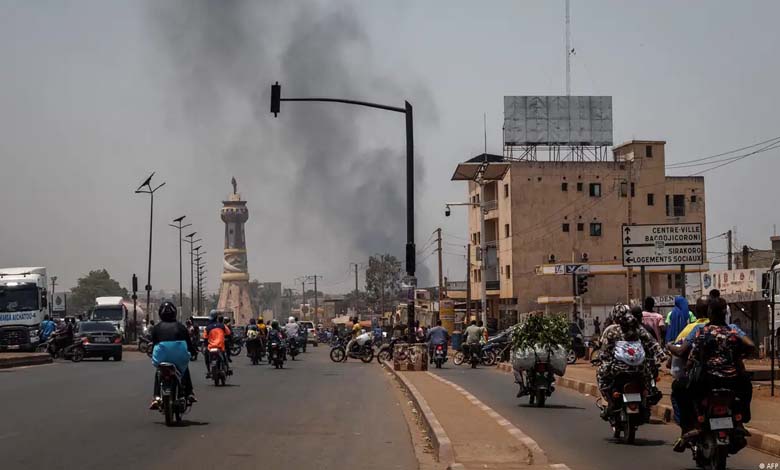
While clashes were raging between the army and terrorists across various parts of Mali, a crisis cell was holding a decisive meeting at the Koulouba Palace in Bamako.
The limited time available at the time did not allow for extensive discussions or consultations, so the directives were security-driven and presidential, aimed at confronting one of the fiercest simultaneous attacks the African country has experienced since the outbreak of its crisis in 2012.
-
First official appearance of Mali’s military council leader since the Saturday attacks
-
Terrorism in the Sahel enters a phase of influence management through an increasingly exposed Mali
Last Saturday, Mali woke up to coordinated attacks carried out by the “Group for the Support of Islam and Muslims,” affiliated with Al-Qaeda, and the separatist “Azawad Liberation Front” (Tuareg).
The simultaneous attacks targeted northern cities such as Kidal and Gao, extending to the southwest, specifically the capital Bamako and the city of Kati located 15 kilometers away.
The attacks included a suicide car bombing targeting the home of Defense Minister Sadio Camara in Kati, resulting in his death, while armed militants raised their flag over Kidal, a city long marked by decades of turbulent crises.
-
Gunfire near the palace: what is happening in Mali?
-
Mali and Al-Qaeda… Pragmatism Redefining Priorities (Two Experts)
Reassurance before response
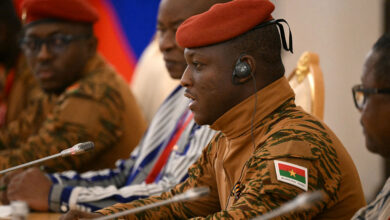
Amid the rapidly unfolding events and complex scene, Mali’s transitional president, Assimi Goïta, remained out of public view for three days after the attacks in what appeared to be a calculated tactic, seemingly prioritizing the field response and stabilizing the situation before moving to reassure the public.
His reappearance itself appeared gradual and carefully staged. Initially, photos released last Tuesday by the Malian presidency showed Goïta attending a meeting at the Koulouba presidential palace with a Russian delegation led by Russia’s ambassador to Bamako, Igor Gromyko, according to the magazine “Jeune Afrique.”
Subsequent images showed the transitional president visiting the family of the late Defense Minister Sadio Camara to offer condolences, as well as visiting the “Boukar Sidi Sall” hospital in Kati to see the wounded from Saturday’s attack.
-
The June 5 Coalition in Mali… A Broken Dream
-
Party Life in Mali… Course Correction or End of an Era?
Later that same day, at 8 p.m., Goïta addressed the Malian people on state television, affirming that “the situation is under control” and that “sweeping operations, searches, intelligence gathering, and security operations are ongoing.”
At the end of his address, Goïta was seen bowing before Sadio Camara’s coffin during his funeral held in Bamako on Thursday.
The palace meeting
Since then, Assimi Goïta has been working to regain the initiative. Two days ago, the meeting of the Higher Council for National Defense, held at Koulouba Palace, marked the first step in structuring the counteroffensive.
-
Mali: Colonel Abdoulaye Maiga appointed interim Prime Minister
-
Al-Qaeda before the Malian storm: leadership changes and the choking of arteries
According to “Jeune Afrique,” the meeting notably included Generals Abdoulaye Maïga (Prime Minister), Daoud Aly Mohammedine (Minister of Security), Oumar Diarra (Chief of Staff of the Armed Forces), and Yamoussa Camara (Secretary General of the Ministry of National Security).
A representative of state security also attended, in the absence of the head of Malian intelligence, Modibo Koné, who was seriously wounded in the attacks and remains hospitalized, along with several government members.
In statements to Malian state television, Daoud Aly Mohammedine said: “The head of state gave us 16 strategic directives aimed at strengthening the national defense and security apparatus.”
-
Terrorism map in Mali: seven organizations and intertwined networks
-
Terrorism in the Sahel enters a phase of influence management through an increasingly exposed Mali
He added: “We leave this meeting with great reassurance,” pledging that the state “will fight to honor the memory of Sadio Camara.”
In practice, the adjustments were primarily defensive. In northern Mali, for example, several forward positions were abandoned in favor of regrouping forces in Gao.
Units of the Malian armed forces stationed in Tessit, Tessalit, Labbezanga, and Intahaka joined the “city of Askia,” signaling a refocusing intended to avoid the isolation of exposed garrisons.
-
Al-Qaeda in Mali: soldiers killed on the road to the city of gold
-
Sovereignty, the plane and the road in Mali… Nioro resists Al-Qaeda
Air rather than ground
The Malian government prioritized airstrikes in its response to the terrorists, favoring this military approach over large-scale ground assaults.
On the day of the attack, last Saturday, army aircraft targeted a terrorist hideout in Sévaré in the Mopti region. In a later statement, the army reported that “ten terrorists were neutralized, in addition to several wounded during a second strike. The targeted site was completely destroyed.”
Further air operations followed, particularly in Kidal last Wednesday, reportedly resulting in the deaths of several fighters and the destruction of their logistical assets.
-
Somaliland affirms full sovereignty over Berbera and rejects Mogadishu’s claims
-
U.S. aid suspension deepens dispute with Somali government
Alongside the strikes, the government strengthened security measures in urban centers. In Bamako, as in other major cities, a curfew was imposed and security patrols were intensified.
Officially, this aims to prevent any infiltration or provocative actions by armed groups, while the government also seeks to contain public anxiety.
Since Saturday’s attacks, fears have risen sharply, “fueled by misleading information circulating on social media,” according to the Malian government.
-
A major blow to Al-Shabab: 15 members killed in Somali army operation
-
Mali in 2025: Al-Qaeda tightens its grip on the land of gold
Rebuilding strength
Among Assimi Goïta’s other priorities was maintaining force cohesion. The Malian armed forces were subjected to a severe test following the attacks, both operationally and morally.
To address this, the military command intensified field visits, and senior officers, including Brigadier General Toumani Koné, were dispatched to units to assess the situation and remobilize the troops.
-
Arrest campaign targets Somali migrants in the United States
-
The United States and Terrorism in Mali : A Crucial Test
The army chief of staff also visited soldiers deployed in Kati and surrounding areas, accompanied by the commander of Defense Region No. 3, Colonel Pascal Berthe.
These multidimensional tactical adjustments outline the roadmap for responding to a hybrid alliance between terrorists and separatists, during one of the most difficult periods in the history of a country that has never truly known respite since gaining independence from France in the 1960s.
-
Al-Qaeda’s threats to Mali: A geopolitical shockwave endangering the African Sahel
-
Terrorism in Mali: Al-Qaeda Targets “Dozo” Hunters with Drones
-
Mali Between Fuel Crisis and Expanding Terrorism: Is Al-Qaeda Approaching the Gates of Bamako?