Europe and the Muslim Brotherhood: why has the Western security mood shifted toward political Islam?
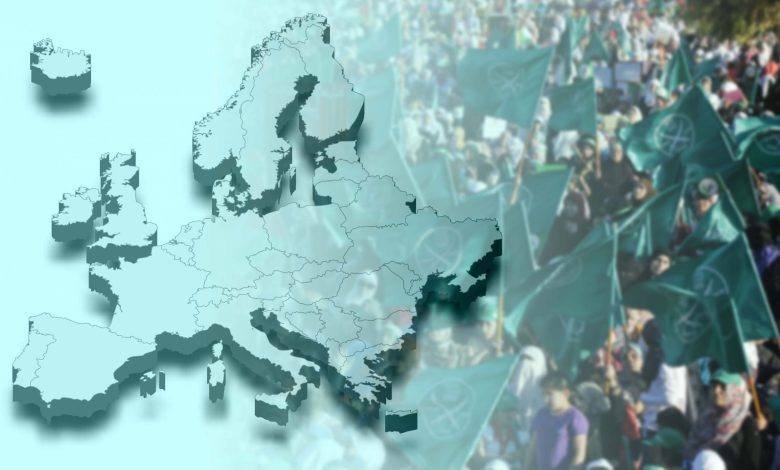
The issue of the Muslim Brotherhood in Europe is no longer viewed merely as a matter of political freedom or religious activity. It has become part of a broader debate related to European national security and the future of social stability across the continent. In recent years, European capitals have undergone a clear shift in the way they deal with movements associated with political Islam, moving from a phase of relative openness and accommodation to a more stringent phase based on monitoring, reassessment, and scrutiny of the ideological and organizational influence of such groups.
This shift did not occur suddenly. It is the result of a long accumulation of security crises, terrorist attacks, and social tensions that prompted European governments to reconsider the relationship between violent extremism and the intellectual environments that may contribute to it or indirectly justify it. With the rise of threats linked to digital extremism and cross-border mobilization, Europe began to treat groups associated with political Islam as a security and strategic issue that goes beyond traditional religious activity.
At the center of this transformation, the Muslim Brotherhood emerged as the most visible and organized movement within the European Islamic landscape. Over the decades, it succeeded in building extensive networks of associations, cultural centers, educational institutions, and media platforms in several European countries, benefiting from the open democratic environment that guarantees freedom of organization and civil action.
However, this broad presence gradually became a source of concern within European institutions, particularly with the growing debate over what is now referred to as “non-violent extremism,” meaning movements that operate within the law but are accused of promoting separatist discourse or creating intellectual environments that may pave the way for more radical forms of extremism.
In France, this shift was especially evident. Following a series of terrorist attacks and crises related to identity and integration, Paris began to view political Islam as a challenge affecting the very nature of the republican state. Official French discourse repeatedly warned of “social separatism” and attempts to build parallel societies within European cities.
French authorities believe that some groups associated with political Islam have used charitable and religious work to expand their influence in neighborhoods, schools, and universities, prompting the government to adopt stricter measures, including monitoring foreign funding, tightening oversight of associations, and closing institutions accused of spreading extremist discourse or hostility to state values.
This French shift was not isolated. In Austria, official warnings about networks linked to political Islam have intensified in recent years. Authorities consider that some organizations use religious discourse to build long-term political influence within society. This has led to security operations and new legislation aimed at monitoring associations and organizations suspected of links to extremism or foreign funding.
In Germany, domestic intelligence services have increasingly focused on activities related to political Islam, arguing that the threat is not limited to armed organizations but also includes movements spreading ideas considered contrary to liberal democracy or harmful to social integration.
European circles believe that the Muslim Brotherhood has, over the decades, developed a complex model of “soft power,” relying more on civil, media, and educational activities than on direct confrontation. This makes dealing with it more complex than the traditional fight against armed terrorist organizations.
The movement does not operate in Europe through a single, clearly identifiable organizational structure, but through a broad network of institutions, associations, and centers active in fields such as education, charity, civil rights advocacy, and media. European governments believe this model gives the movement significant capacity for social penetration and long-term presence that is difficult to dismantle through conventional security means.
Recent international developments, particularly after the war in Gaza and the rise of political and religious polarization in the West, have further heightened European concerns about the growing influence of cross-border ideological narratives among youth and university communities. Security institutions observed that digital platforms have become central tools for mobilization and influence, with groups linked to political Islam using social media to spread political and religious narratives across borders.
This development led Europe to view the confrontation as not only security-related, but also media and cultural. European efforts have therefore expanded into monitoring digital content and strengthening cooperation with technology companies to identify accounts and platforms associated with extremism or incitement.
At the same time, increasing cooperation has emerged between Europe and the United States in addressing networks linked to political Islam and cross-border extremism. Washington and European capitals now share a growing conviction that modern threats no longer take the form of isolated local cells, but rather international networks combining funding, propaganda, recruitment, and ideological activity.
This has resulted in an unprecedented strengthening of intelligence sharing, particularly regarding financial transfers, cross-border organizations, and digital activities linked to extremism.
However, this European shift has also drawn significant criticism from human rights organizations and academics, who warn that expanding the concept of “extremism” too broadly could lead to targeting legitimate religious or political activity and create a climate of suspicion toward Muslim communities in Europe.
Critics argue that some European governments are increasingly conflating political Islam with terrorism, which could produce counterproductive outcomes by reinforcing feelings of marginalization or feeding victimhood narratives used by extremist groups in recruitment strategies.
European governments, for their part, stress that the new measures do not target Islam as a religion or Muslims as communities, but rather organizations and networks believed to exploit religion to build political or ideological influence that threatens the stability of European states and their democratic values.
Despite this careful rhetoric, it is clear that the security mood in Europe has changed significantly. After years of focusing exclusively on “violent terrorism,” Western governments are moving toward a more comprehensive approach based on monitoring the intellectual and organizational environments that may contribute to the production of extremism or provide it with ideological cover.
This shift reflects a growing European awareness that the fight against extremism no longer concerns only the perpetrators of armed attacks, but also the networks that produce discourse, build influence, and invest in media, education, and social engagement. This is why the Muslim Brotherhood has become, for many European capitals, part of a broader debate about the future of security, stability, and identity across the continent.
In a context marked by escalating international crises and political and religious polarization, Europe appears to be entering a new phase of confrontation with transnational ideological movements, a phase that seeks to redefine the boundaries between freedom of organization and civil action on the one hand, and the protection of national security and prevention of extremism on the other.
In a world where ideas and digital networks are becoming instruments of cross-continental influence, Europe’s confrontation with political Islam is likely to remain one of the most complex and sensitive challenges of the twenty-first century, not only because it concerns security, but also because it touches on the future of coexistence and identity within Western societies themselves.