The Muslim Brotherhood and armed militias: how have shadow alliances reshaped the map of conflict in the Middle East?
Conflicts in the Middle East are no longer conducted solely by traditional armies or clearly defined armed organizations. The region has become a complex arena of overlapping networks that combine ideological movements, armed militias, and undeclared alliances. At the center of this intricate landscape, growing questions have emerged in recent years within the United States and Europe about the nature of the relationship between groups associated with political Islam, foremost among them the Muslim Brotherhood, and a number of armed factions and regional powers pursuing cross-border influence projects.
This discussion is no longer confined to research centers or academic analysis. It has become part of the new Western security approach, which views modern threats not as separate organizations but as flexible networks capable of forming pragmatic alliances that transcend doctrinal and political differences when shared interests converge.
Over the past decade, prolonged wars in Syria, Libya, Yemen, and Gaza have pushed Western institutions to reassess the nature of alliances within the region. These conflicts have shown that ideological movements and armed militias no longer always operate along rigid ideological lines, but have become more capable of establishing temporary understandings and indirect forms of cooperation that serve political and military influence objectives.
In this context, the name of the Muslim Brotherhood has reemerged prominently in Western discourse as a political and organizational actor with a broad presence across several regional arenas, prompting some security circles to view the movement as part of a more complex landscape linked to intersections between regional influence and armed movements.
American circles believe that one of the most concerning features of the current phase is the erosion of traditional boundaries between political action, military action, and media activity. Ideological movements now operate within a highly fluid regional environment, where alliances can shift rapidly according to shared interests and field realities, even among actors who differ doctrinally or sectarianly.
This reality has been particularly visible in several conflict zones, especially with the growing role of Iran and the militia networks associated with it across the region. Despite deep doctrinal differences between Iran and some Sunni Islamic movements, Western institutions believe that political and strategic interests have sometimes led to various forms of coordination or indirect understanding across multiple regional issues.
Western security reports indicate that relations between some movements linked to political Islam and forces supported by Iran do not necessarily rest on full doctrinal alignment, but rather on political pragmatism and the presence of common adversaries. This has led Washington to view the region more as a field of shifting alliances than as a map of fixed ideological divisions.
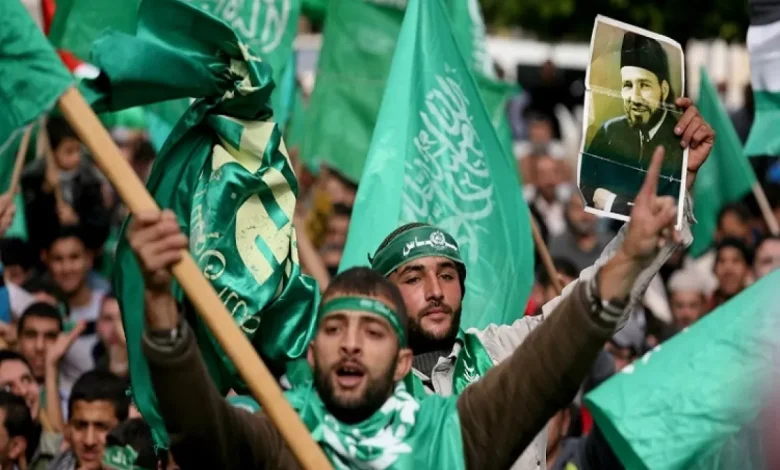
Within this framework, the relationship between Hamas and Iran has become one of the most frequently cited examples in Western circles to explain the nature of new alliances in the Middle East. The movement, historically rooted in the intellectual environment of the Muslim Brotherhood, has at the same time maintained political and military relations with Tehran, particularly in the areas of armament and logistical support.
Washington believes that this model reflects the nature of the current phase, where ideological projects intersect with calculations of power and regional influence. The determining factor is no longer doctrinal affiliation alone, but the ability to build support networks and alliances that serve shared political and military objectives.
The United States is also watching with increasing concern the relationship between certain armed Islamic movements and the Houthis in Yemen, especially amid escalating threats to international maritime security and cross-border attacks. American institutions believe that the expansion of the influence of Iran-linked armed groups has created a regional environment that allows for the exchange of expertise, support, and media coordination among various actors, even if they do not belong to the same doctrinal project.
This entanglement has pushed Washington to adopt a more comprehensive view of the concept of regional threat. U.S. security institutions no longer see armed groups as isolated entities, but as parts of a broader system that includes financing, propaganda, digital mobilization, and indirect political alliances.
For this reason, the new American strategy places greater emphasis on dismantling “networks of influence” rather than focusing solely on targeting armed organizations on the ground. This includes monitoring financial transfers, tracking logistical support networks, and enhancing intelligence cooperation with regional and Western allies.
Meanwhile, movements associated with political Islam argue that this Western approach aims to demonize any Islamic political presence in the region and automatically link it to terrorism or armed violence. Critics of U.S. policies also argue that Washington deals with certain groups inconsistently according to its interests and international alliances.
Within Western institutions, however, there is a growing belief that the danger no longer lies only in direct military operations, but in the ability of ideological movements and armed militias to build overlapping environments of influence that are difficult to contain through traditional means.
Prolonged regional wars have reinforced these concerns. In Syria, Libya, and Yemen, conflicts have shown that armed groups can rapidly adapt to political and military shifts and possess high flexibility in forming field and media alliances. This has led the West to believe that the Middle East is entering a new phase of “networked wars,” where ideology, weapons, funding, and media intertwine within transnational systems.
The rise of digital media has also given these networks unprecedented capacity for influence and mobilization. Movements associated with political Islam and armed militias now use online platforms to construct political and emotional narratives capable of crossing geographic boundaries and reaching wide audiences both inside and outside the region.
The United States believes that this media dimension is no less dangerous than the military one, because modern wars are no longer decided solely by force on the ground, but by the ability to shape narratives and influence global public opinion. For this reason, Washington has strengthened cooperation with technology companies and Western intelligence services to monitor propaganda and influence networks linked to armed groups and ideological movements.
In Europe, concerns have also grown about the extension of the influence of these networks into Western societies, particularly with the rise of political and religious polarization linked to regional crises. In France, Germany, and the United Kingdom, governments have begun to examine more closely the connection between digital extremism and political mobilizations associated with transnational ideological movements.
Despite this tightening approach, the United States and European countries emphasize that the confrontation targets groups and networks linked to violence or incitement, not Islam as a religion or Muslims as communities. The West recognizes that any conflation between religion and extremism could provide radical groups with an opportunity to fuel victimhood narratives and attract more supporters.
What is clear, however, is that the Middle East has entered a new phase of complex conflicts, where the boundaries between the political and the military, and between the local and the transnational, have become blurred. At the heart of these transformations, the Muslim Brotherhood appears, for many Western circles, as part of a broader web of interactions and alliances that have reshaped the map of influence and conflict in the region.
In a world of increasingly unconventional wars, the battle of the future will not be only against isolated armed organizations, but against entire systems that combine ideology, funding, weapons, and media within transcontinental networks of influence capable of constantly reconstituting themselves, regardless of changing names or shifting alliances.