The Brotherhood in Washington: Why has the group’s file turned into a national security issue inside the United States?
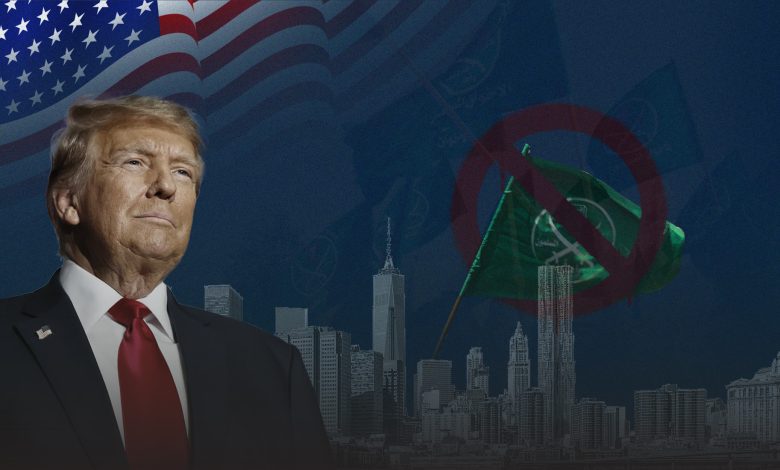
The ongoing debate within the United States regarding the Muslim Brotherhood is no longer a passing political discussion or material used in electoral campaigns between Republicans and Democrats. It has become part of a broader redefinition of the American concept of counterterrorism in a world where ideology intersects with security, finance, media, and transnational influence. More than two decades after the September 11 attacks, Washington has come to recognize that armed organizations do not operate in isolation, but within intellectual and political environments capable of generating renewed waves of extremism. This realization has prompted broad sectors within American institutions to reassess the nature of the relationship between political Islam and contemporary jihadist movements.
This shift did not occur suddenly but developed gradually over years of conflicts stretching from Afghanistan to Iraq, Syria, and Gaza. American security institutions observed that eliminating organizations such as Al-Qaeda or ISIS did not end the environment that produces extremism. Each time one organization collapsed, another emerged with a similar narrative and different tools, reinforcing in Washington a growing conviction that the battle is no longer purely military, but rather a long-term confrontation with ideological and organizational networks possessing a remarkable capacity for self-reproduction.
At the center of this debate, the name of the Muslim Brotherhood has resurfaced as the most influential organization in the history of modern Islamic movements. The group, founded nearly a century ago, is no longer viewed in some American circles merely as a political or religious movement, but as part of a broader framework that contributed, directly or indirectly, to shaping the intellectual environment from which jihadist organizations later benefited. Although the group consistently denies any connection to violence or armed organizations, influential currents in Washington argue that the issue lies not only in field practices but in the intellectual structure that allows for justifying confrontation with the nation-state and creating a mobilizing discourse based on ideological and political division.
In recent years, this perspective has become a central theme within the U.S. Congress, where calls to designate the Muslim Brotherhood as a foreign terrorist organization have intensified. Several Republican lawmakers have led this effort, arguing that the group represents the intellectual incubator from which modern jihadist movements emerged, and that ignoring this ideological dimension has contributed to the failure of many Western policies aimed at containing extremism.
However, the issue is not so straightforward within American state institutions. Another current in Washington believes that a comprehensive designation of the group could be politically and legally complex, especially since the Brotherhood is not a unified organization in the traditional sense, but a broad network of branches and movements that vary from one country to another. Some of these branches have participated in elections and political life, while others have been associated with security conflicts or accused of links to extremist groups. This has led successive U.S. administrations to approach the issue with considerable caution.
This American hesitation is not only related to legal complexities but also to broader geopolitical calculations. The United States is aware that some movements associated with the Brotherhood have been part of the political landscape in countries allied with Washington, and that a comprehensive designation could create diplomatic crises with regional partners or open the door to extensive legal challenges in U.S. courts. For this reason, American institutions have often preferred to deal with specific entities rather than move toward a blanket global classification of the group.
However, recent regional developments, particularly following the war in Gaza, have brought the issue forcefully back to the American agenda. The historical relationship between Hamas and the Muslim Brotherhood has prompted broad segments in Washington to expand the discussion about the nature of transnational networks linked to political Islam. A growing conviction has emerged in some security circles that armed movements cannot be understood independently from the ideological, media, and financial structures that support them or grant them political legitimacy.
This shift has clearly been reflected in the tools the United States has begun to employ. Rather than focusing solely on military operations or security pursuits, Washington has increasingly moved toward targeting the financial, media, and organizational networks associated with extremism. Economic sanctions have become a central tool in the new American strategy, accompanied by expanded monitoring of financial transfers, associations, and institutions suspected of being used as fronts to finance activities linked to extremism or transnational political propaganda.
The United States has also developed an unprecedented level of intelligence cooperation with its European and Arab allies to track financial and organizational networks linked to political Islam. Washington believes these networks have become more complex than ever, especially as much of the funding and mobilization has shifted into the digital space, making the confrontation more intricate than the traditional fight against armed organizations.
At the same time, American institutions have begun to view digital media as one of the most dangerous new battlefields. Groups associated with political Islam have developed significant capabilities in media influence, online mobilization, and political narrative-building. Digital platforms have become open arenas for reproducing mobilizing discourse and influencing public opinion in the Middle East and beyond.
As a result, calls have intensified in Washington to confront what security agencies describe as “transnational propaganda,” particularly amid growing concerns about the ability of ideological groups to recruit young people through social media. The United States believes that the battle of the future will not be decided solely on battlefields, but within the global information space, where technology becomes a tool of mobilization, influence, and political power.
This American shift also intersects with increasing European firmness toward political Islam movements. In France, Austria, and Germany, official warnings have emerged in recent years about the risks of “non-violent extremism,” referring to movements that operate legally but are accused of spreading isolationist or radical narratives that may pave the way for more violent forms.
This climate has prompted Washington to strengthen security coordination with European capitals, particularly in intelligence sharing, financial monitoring, and tracking digital activities linked to transnational networks. There is a growing recognition in the West that countering extremism can no longer be achieved through domestic policies alone, but requires a long-term international alliance.
Despite this growing firmness, the United States seeks to maintain a delicate balance between combating extremism and protecting religious and political freedoms. The American administration understands that conflating Islam as a religion with extremist organizations could produce counterproductive results and give radical groups an opportunity to reinforce the narrative of “targeting Muslims.” Therefore, Washington officially emphasizes that the confrontation targets networks linked to violence, incitement, and extremism, not Muslim communities or the Islamic faith.
Nevertheless, it is clear that the American view of the Muslim Brotherhood is undergoing a profound reassessment. The issue is no longer limited to the group’s behavior in a specific country, but to its potential role within a broader network of transnational intellectual and organizational relationships. This makes the Brotherhood’s file today one of the most sensitive issues within U.S. national security institutions.
In a world where conventional wars intersect with digital propaganda, covert financing, and ideological networks, Washington appears more convinced than ever that the fight against extremism does not begin at the borders of armed organizations, but within the intellectual and political systems that enable them to endure and reconfigure themselves from generation to generation.