Hezbollah drones breach Israeli defenses despite the new interception system
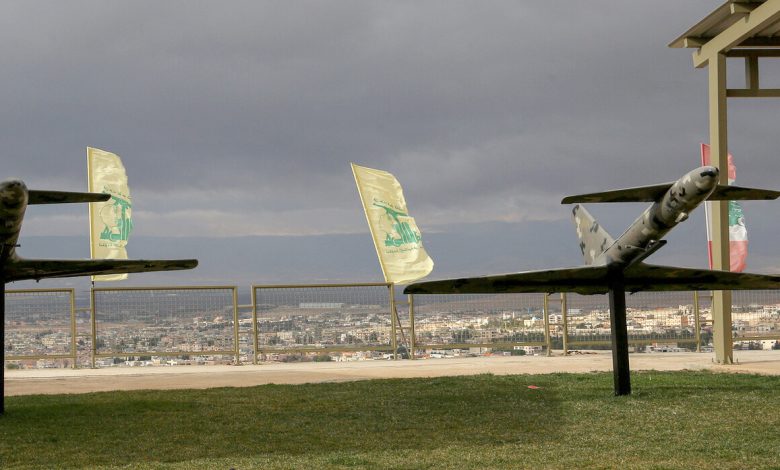
The continued deaths and injuries within the Israeli army during drone attacks reveal the scale of the dilemma facing the Israeli military establishment.
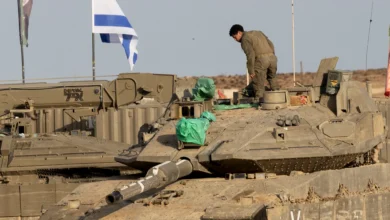
The Israeli army announced on Monday the death of a soldier following an attack carried out by an explosive drone launched by the Lebanese Hezbollah, targeting a military site in northern Israel, exposing the failure of a new drone interception system recently mentioned by Prime Minister Benjamin Netanyahu.
In a statement, the army said that “Sergeant First Class reservist Alexander Glovnyov, 47, was killed in combat near the Lebanese border.”
The Israeli public broadcaster reported that the soldier was killed “as a result of injuries caused by an explosive drone launched by Hezbollah in northern Israel,” noting that he worked as a driver for a military transport center and was transporting heavy equipment at the time of the attack.
It added that Israeli assessments indicate that Hezbollah launched four explosive drones toward the military site where Glovnyov was located, noting that one drone crashed inside the site without exploding before being dismantled by an engineering unit, while two others crashed outside the site.
It confirmed that the attack comes amid an escalation in Hezbollah’s use of explosive drones against Israeli forces operating in southern Lebanon and northern Israel.
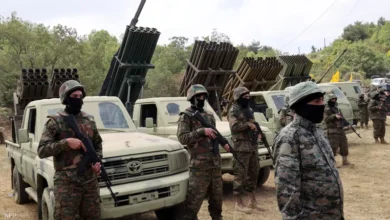
Hezbollah drones operating with fiber-optic technology pose a major challenge to the Israeli army, as they kill and injure soldiers, while Tel Aviv acknowledges the difficulty of detecting and intercepting them.
Last week, the Israeli army began operating a new system based on drones designed to intercept attack drones launched by the Iran-backed Hezbollah, but the system still appears unable to effectively deter them.
This development follows directives issued by Netanyahu, who announced the launch of a “special project” aimed at addressing the growing drone threat, noting that its implementation requires time.
The new system, known as the “Iron Drone Raider” developed by Aerobots, is based on integrating advanced detection technologies, including radar, with autonomous interceptor drones. When an aerial threat is detected, the interceptor drone automatically takes off to identify and pursue the target based on radar data.
Once the target is reached, the system has two options: either to closely track the hostile drone or to deploy a special net designed to neutralize its movement. The net capture process then gradually brings the targeted drone down to the ground via a parachute, in an effort to reduce the risk of explosion or collateral damage.
According to the Israeli state, last April saw the deaths of several soldiers and employees of the Israeli Ministry of Defense in southern Lebanon due to similar attacks, including Sergeants Liam Ben Hamo and Idan Fuchs, as well as contractor Amer Hijirat.
It added that the Israeli army is preparing to supply its forces in southern Lebanon with cluster munitions purchased from the United States, in order to enhance its ability to counter the explosive drones used by Hezbollah.
On Sunday, the Shiite group announced it had carried out 22 operations targeting Israeli army gatherings, vehicles, and headquarters. It released videos on its media platforms that it said documented moments of targeting Israeli forces and vehicles in southern Lebanon using drones.
Since March 2, Israel has been conducting a large-scale offensive against Lebanon, resulting in thousands of deaths and injuries, as well as the displacement of more than 1.6 million people—about one-fifth of the population—according to official Lebanese data.
Despite a ceasefire in effect since April 17, the Israeli army continues incursions into southern Lebanon, along with systematic demolition of homes and buildings and the forced displacement of residents from dozens of villages, under the pretext of targeting what it describes as “military infrastructure and Hezbollah elements.”
Israel occupies areas in southern Lebanon, some for decades and others since the previous war between 2023 and 2024, while during the current offensive it advanced up to around 10 kilometers inside the southern border.