Iran’s division: how regime factions are obstructing the chances of a ceasefire
The American rejection of Iran’s response to the ceasefire proposal has reopened divisions within decision-making circles in Tehran.
As U.S. threats escalate and the possibility of a new strike appears evident in statements by President Donald Trump, Iran seems to be facing a sharp internal split over how to deal with American pressure and the terms of the ceasefire.
Ambassador Ayman Musharraf, former assistant to the Egyptian foreign minister and member of the Egyptian Council for Foreign Affairs, believes that these divergent positions reveal a struggle between factions of the Iranian regime that is leading the people toward the abyss.
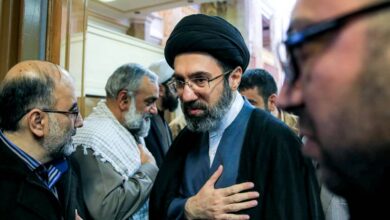
Musharraf said that this division has plunged efforts to end the war into a dark tunnel due to Iranian intransigence, noting that Iran is experiencing deep divisions at the top of the power structure that have eroded the legitimacy of Supreme Leader Mojtaba Khamenei, who has not appeared since his appointment, effectively becoming a shadow of the hardline leaders of the Revolutionary Guard.
He added that the hardline current controlling decision-making in Iran seeks to achieve its goals by linking the fate of the war in Iran to that of Hezbollah in Lebanon, ending the American blockade on Iranian ports, and releasing frozen Iranian assets abroad, while ignoring the major obstacle represented by the nuclear file.
He continued by saying that “Iran tries to distract its people at times by claiming victory in the war, at other times by bombing its neighbors, and at other times by activating its proxies to inflame the region, while the regime ignores that its own problems and factional divisions are the cause of all its people’s suffering.”
The division between factions of the Iranian regime was also reflected in remarks made by President Donald Trump to reporters at the White House last Monday, when he said that Tehran had agreed to transfer enriched uranium to the United States, but later changed its position and did not include this commitment in the written response it sent four days later.
Trump added: “They told us that you must take it (the 60 percent enriched uranium). We were going to go along with them, but they changed their mind because they didn’t put it in writing.”
He continued: “They make a deal with us and then back away from it.”
For his part, Amr Ahmed, an expert on Iranian affairs at the Strategic Forum for Thought and Dialogue, believes that the Iranian regime is currently divided into three currents.
Ahmed said that the first current is the most hardline, the one that came to power after Israeli strikes targeted Iranian leaders who, despite their differences and methodology, had shown strategic patience.
He noted that those currently controlling power in Tehran are the hardline current and members of the Revolutionary Guard, and that this current is led by Mojtaba Khamenei.
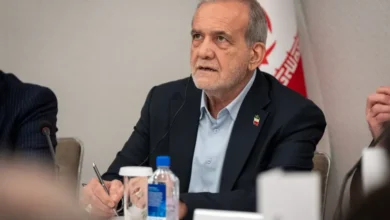
He added that there is also a pragmatic current represented by the head of the judiciary, Mohammad Bagher Ghalibaf, as well as a current described as moderate, represented by the Iranian government and led by President Massoud Pezeshkian and Foreign Minister Abbas Araghchi.
He considered that the pragmatic and moderate currents are open to negotiations, unlike the hardline current, which rejects negotiations because war primarily serves its interests and objectives.
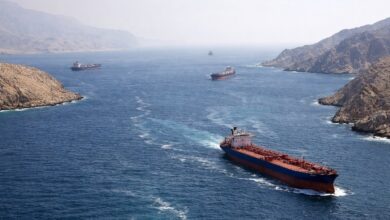
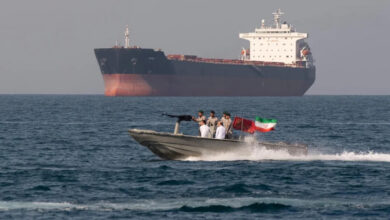
Amr Ahmed believes that Iran is severely affected by this blockade and that statements by regime leaders confirm that Tehran will not be able to endure it, especially in the oil sector, which is suffering heavy losses.
He said that “Iran faces a major problem related to oil production, and exports are also affected due to the targeting of the port of Bandar Abbas, from which more than 55 percent of Iranian container exports depart, in addition to the significant damage to other economic and logistical sectors.”
He added that “Iran cannot withstand the continuation of the blockade, which is an admission of the serious harm it has caused; therefore, the solution lies in negotiations, but the hardline current in the regime believes that war serves its interests more and does not care about the interests of its people.”
According to the same researcher, a comprehensive war and the continued imposition of sanctions on Tehran would lead to the persistence of economic, political, and social problems in Iran. He added that “social problems are the cornerstone in Tehran’s view, which believes that Israel and the United States have succeeded in penetrating Iran’s depth and stirring the street through opposition protests.”