Condemnation Without Support: The International Community Put to the Test in the Battle for Yemen’s Western Coast
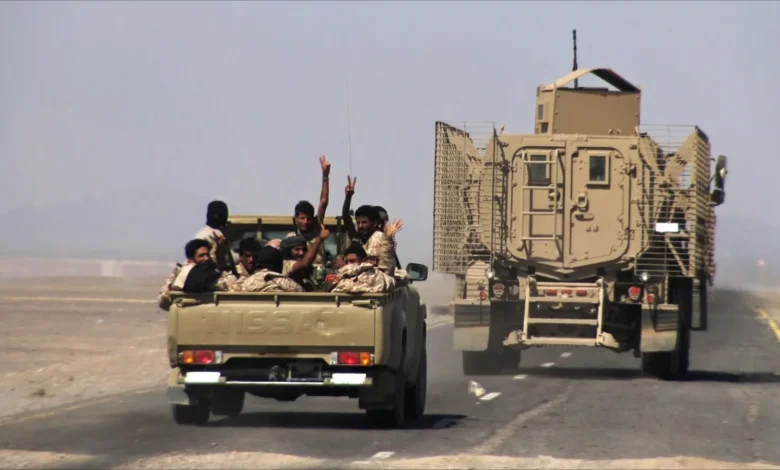
The Houthis’ latest offensive, launched by land and sea towards the Bab el-Mandeb Strait, was not merely an escalation on the Red Sea front. It also represented a test of the international community’s commitment to protecting maritime security.
The attack exposed a significant gap between international positions, which have largely been limited to condemnation, and the reality on the ground, where Yemenis have been left to bear the burden of the battle alone and confront the Houthi militias. According to observers, the group is seeking to exert control over the strategically vital Bab el-Mandeb Strait in the service of Iranian interests.
Tareq Saleh, Vice President of the Presidential Leadership Council and commander of the National Resistance, said that “the international community has limited itself to words,” suggesting that his forces, deployed along Yemen’s western coast overlooking Bab el-Mandeb and the southern Red Sea, are fighting “the battle alone.”
Saleh stated that securing the Red Sea and the Bab el-Mandeb Strait begins with retaking Hodeidah and Sanaa from the Houthi militias. He stressed that the security of the maritime routes off Yemen’s coast depends on completing the liberation of the entire national territory.
The Houthi militias launched more than 100 ballistic missiles and suicide drones against civilian and military targets along the western coast, including the port of Mokha. They also carried out naval and aerial attacks targeting the fronts of Al-Barah, Hays, Al-Tuhayta and Zuqar Island, which is regarded as the first line of defence for Bab el-Mandeb and a forward base for the liberation of Hodeidah.
Linking Maritime Security to the Liberation of Hodeidah
Despite these attacks, the National Resistance took the lead in confronting the Houthis, while, according to observers and analysts, the international community has failed to establish a practical connection between maritime security and the liberation of Hodeidah, despite the latter being seen as necessary to enable state institutions to assume responsibility for securing the coastline effectively.
Political analyst Abdulsalam Al-Qaisi said that the National Resistance had proven its capabilities on the western coast and around Bab el-Mandeb despite having limited resources, while international coalitions established to protect maritime navigation had merely offered “words without action.”
Al-Qaisi said that “international positions continue to treat the Red Sea as a global transit route that must be protected, while overlooking the liberation of Hodeidah and the coastlines overlooking this maritime corridor,” meaning that they remain far from addressing the root causes of an urgent problem.
He added that “the Yemeni National Resistance has served as a barrier preventing Iran from exercising direct control over maritime navigation and the Bab el-Mandeb Strait,” amid what he described as the world’s inability to address developments in the Strait of Hormuz and the ambiguity surrounding the international community’s position.
Al-Qaisi stressed that “maritime security is a strategic Yemeni priority, but the world’s silence and indifference do not mean that Yemenis will abandon the defence of the boundaries of their national battle or cease confronting Iranian-driven instability, even in the face of international abandonment.”
He concluded by saying: “Yemen’s strategic objective is the liberation of Hodeidah and Sanaa. This objective intersects with the international interest in securing global maritime navigation, while the international community exploits the situation to safeguard its own interests at the expense of Yemenis.”
International Awareness Yet to Translate into Support
For his part, Yemeni political analyst Abdul Karim Al-Madi argued that the international community’s hesitant approach towards the Houthi movement is nothing new, saying that the world has displayed the same lack of resolve since 2004.
Al-Madi said: “There is nothing fundamentally new regarding the international position, although there has been a development in the broader discourse, which has become more aware of the Houthi militias’ positions and their alignment with the Iranian project. Perceptions of the situation across the Arab region have also evolved.”
He expressed hope that the international community’s rhetoric and approach towards threats posed by the militias to international navigation in the Red Sea, their attacks on civilian infrastructure and their blockade of the Yemeni people would evolve into concrete support for the National Resistance, the Giants Brigades, the army in Marib, and other units deployed in Al-Jawf, Saada, Al-Dhalea and across all fronts.
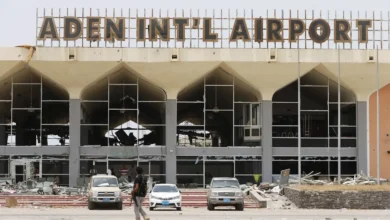
Al-Madi also pointed to what he described as an important development on the Yemeni scene: “the establishment of a unified military operations room, which directs daily drone strikes that inflict significant damage on the Houthis.” According to him, this has pushed the militias to target civilian infrastructure, as demonstrated by the destruction of the port of Mokha and camps for displaced people in Marib.
The political analyst attributed the actions of the Houthi militias to an attempt to escape their internal difficulties following setbacks on the battlefield. He described their conduct as “a major failure,” arguing that “the militias are unable to confront the National Resistance, the army and the other fronts, and instead resort to targeting civilian infrastructure, without this prompting a decisive international response.”