Continuing war crimes: Yemeni civilians remain under Houthi attack
Houthi militias continue to bombard civilian objects and threaten lives in Yemen, showing no regard for the humanitarian consequences.
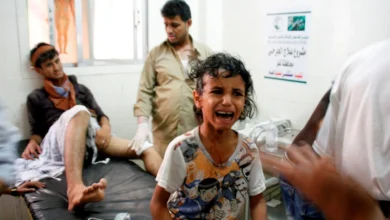
A recent Houthi ballistic missile strike on a public market in Al-Wazi’iyah district, southwest of Taiz, underscored this reality. The attack left dozens of civilians dead or wounded.
Bombarding markets crowded with civilians is not new to the militias. Days earlier, they had also struck Najd market in Al-Misrakh district, south of the besieged city of Taiz, with a ballistic missile. Residential villages in the area continue to face fierce daily artillery bombardment.
Acts described as war crimes
Yemeni political analyst Abdelkarim al-Madi said the attack on Al-Hadara market in Al-Wazi’iyah district reflected the Houthi militias’ willingness to kill and exploit such terrorist acts politically at the domestic, Arab and international levels.
Al-Madi said the Houthis were bombarding Yemeni civilians with ballistic missiles supplied by their Iranian backer. He also alleged that Iran had dispatched around 21 experts to direct the fighting in Taiz.
He described these practices as “war crimes” not subject to a statute of limitations, saying they were being monitored and documented by human rights bodies and organisations. He argued that the Houthi militias, which he described as a terrorist group, had no regard for Yemeni lives, and called for a regional and international stance to expose the group and its crimes.
A deliberate strategy
Yemeni political analyst Jamil al-Mas’adi said Houthi attacks on public markets, residential neighbourhoods, hospitals and schools across Taiz city and the governorate’s districts were not isolated incidents, but part of a deliberate and systematic strategy.
“The militias aim to kill civilians, terrorise them and break the resilience of Taiz’s residents, who have refused to submit to their abhorrent Iranian sectarian project,” he said.
He added that the Houthis deliberately sought to inflict the highest possible number of civilian casualties to advance their political and media objectives. According to him, they then attempted to blame government warplanes falsely in pursuit of what he described as dubious goals.
Military and political objectives
Al-Mas’adi argued that the militias sought to damage the Yemeni government’s image internationally by portraying it as responsible for attacks on civilians.
He said they also aimed to ease military pressure and airstrikes against them by generating media attention and human rights scrutiny that could restrict air operations.
“The militias hope for a breathing space to reposition their military and security forces, stockpile weapons, forcibly displace residents from areas they control and prepare for another phase of expansion and territorial control,” he added.
Houthi responsibility
Al-Mas’adi maintained that Yemenis, particularly the people of Taiz, knew precisely who was bombarding them with ballistic missiles and shells, planting mines on their roads, killing them daily in cold blood and besieging them for more than a decade.
“The missiles hitting public markets, homes and residential neighbourhoods come from Houthi militia positions on the high ground surrounding the city and villages near the front lines,” he said.
He called on “local, international and UN human rights organisations to fulfil their responsibilities, document these terrorist crimes committed by the Houthi militias and avoid being drawn into their misleading narratives”.