Europe bans the Islamic Revolutionary Guard Corps: how will Iran’s arms be affected?
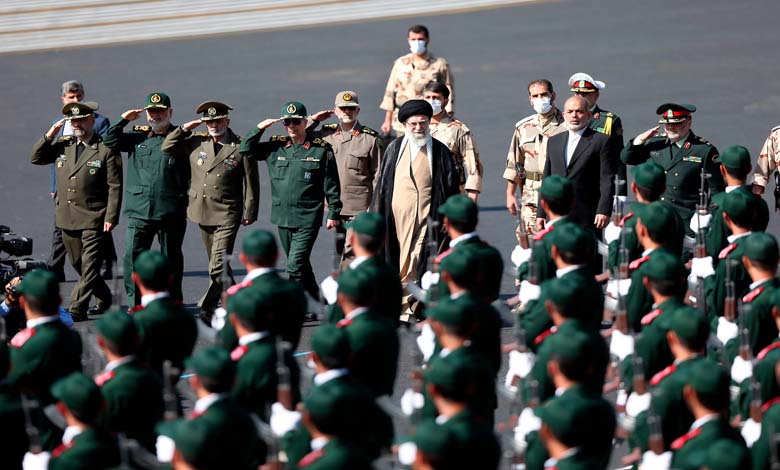
The inclusion of Iran’s Islamic Revolutionary Guard Corps (IRGC) on the European Union’s list of terrorist organizations has raised questions about the potential repercussions of the decision on Tehran’s other regional proxies.
-
Pressure in Britain to designate Iran’s Revolutionary Guard as a terrorist organization
-
Fears of a New Revolutionary Guard: Iraq Divided Over the Popular Mobilization Forces Law
On Thursday, the European Union officially designated the IRGC as a terrorist organization, citing the violent crackdown on recent protests.
The move has sparked wide debate over its implications and its impact on armed factions affiliated with Tehran across the region, amid growing fears of escalating tensions as U.S. threats of military action against Iran intensify and Tehran vows retaliation.
Announcing the decision, EU High Representative for Foreign Affairs Kaja Kallas said that the bloc’s foreign ministers had approved the designation, describing it as a decisive step in confronting the practices of the Iranian regime.
In a post on X, Kallas added that “any regime that kills thousands of its own people is moving toward its own downfall.”
-
Mohammad Pakpour: From the War Fronts to the Helm of Iran’s Revolutionary Guards
-
Hossein Salami’s Death Reveals the Extent of Israeli Infiltration into the Revolutionary Guards
A strategic shift
Commenting on the move, Lebanese political analyst and researcher Tarek Abou Zeinab argues that the EU’s designation of the IRGC cannot be seen as a symbolic or media-driven gesture, but rather as a strategic shift in Europe’s approach to Iran, moving relations from dispute management to direct legal and political confrontation.
Abou Zeinab said that “this decision targets the backbone of Iran’s regional project, namely the institution responsible for financing, training, arming and shaping the combat doctrine of Tehran’s proxies across the region.”
He added: “We are witnessing the beginning of a gradual dismantling of the undeclared international legitimacy that the IRGC had long enjoyed under various diplomatic and security pretexts.”
-
Sweden Calls for Classifying Iran’s Revolutionary Guard as a “Terrorist Organization” in Europe
-
“Controversial” Scenes inside the Revolutionary Guard Operations Room
He further explained that “the designation opens the door to legal prosecutions, asset freezes, financial restrictions and the pursuit of indirect funding networks in Europe and beyond, which will inevitably affect Iran’s ability to finance its proxies with the same momentum as before.”
Hezbollah, Iraqi factions and the Houthis
Addressing the impact of the European decision on Iran’s regional arms, Abou Zeinab noted that “in Lebanon, the move will place Hezbollah in a position of increased international political isolation.”
-
Pager Explosions Lead Iran’s Revolutionary Guards to Ban the Use of Communication Devices
-
New Details on Haniyeh’s Assassination: What is the Involvement of Mossad and Iran’s Revolutionary Guard?
According to him, “the organic link between Hezbollah and the IRGC is no longer merely a political description, but has become an international legal classification, meaning that any financial, economic or logistical pathway associated with the group will face unprecedented scrutiny, even if the effects are not immediately visible on the ground in Lebanon.”
He recalled that the EU has already designated Hezbollah’s military wing as a terrorist organization since 2013.
In Iraq, the analyst explained that “Iran-linked armed factions will face a far stricter international environment, being treated as organizational extensions of an entity designated as terrorist, opening the door to compounded sanctions, diplomatic pressure, and restrictions on the movement of their leaders and financial assets.”
-
Calls to designate Iranian Revolutionary Guard as a Terrorist Organization
-
British lawmakers are calling for the classification of the Revolutionary Guard as a terrorist organization
In Yemen, Abou Zeinab said, “the decision strengthens the international legal framework aimed at containing networks that support the Houthis, and provides broader legal cover for any future measures against Iranian supply lines, whether financial, logistical or political, turning Iranian support from a source of influence into a costly strategic burden.”
He concluded: “We are not talking about the immediate collapse of Iran’s influence, but about the Iranian project entering a phase of long-term attrition, in which proxies shift from tools of expansion to points of international pressure, and the IRGC itself becomes a burden on the Iranian state rather than an instrument of power, within a cumulative process that could reshape regional power balances in the medium and long term.”
-
The Revolutionary Guard reviews the plans for the deployment of Iranian militias in Iraq… What’s the connection with Gaza?
-
American messages to Iran by targeting two sites of the Revolutionary Guard in Syria
From containment to pressure
Jordanian political analyst Maamoun Al-Masad, for his part, believes that designating the IRGC as a terrorist organization “is not merely a symbolic step, but a transformation in the nature of dealings with Iran, signaling a shift from diplomatic containment to structural pressure.”
He explains that Europe has reached the conclusion that separating the nuclear file from Iran’s regional behavior has failed, and that attacks on shipping, military bases and Western interests now directly affect European security.
According to him, Europe no longer views Iran solely as a regional actor, but as a source of international instability through the IRGC, which is seen not as a conventional military institution, but as an influence network encompassing the leadership of external operations, notably the Quds Force, as well as the management and arming of transnational groups through systems of financing, smuggling and investment.
-
The Syrian Observatory reveals the secret relationship between the Revolutionary Guard and ISIS… Agreement terms
-
The British Parliament calls for classifying the Revolutionary Guard as a terrorist organization
Reordering and realignment?
According to Al-Masad, designating the IRGC entails freezing assets linked to it within Europe, criminalizing any financial or logistical dealings with it or its front organizations, and expanding legal action against anyone suspected of ties to it.
This, he argues, poses a serious challenge for Iran, as it is no longer possible to separate political support from terrorism in the European perspective. He concludes that the designation reflects shifting power dynamics, raises the cost of funding and movement, weakens political and diplomatic cover, and forces Tehran to reassess its regional calculations.
Asked about the impact on Iran’s regional proxies, Al-Masad said that for Hezbollah, the decision means greater international isolation and financial pressure, without necessarily leading to direct military confrontation.
-
The Iranian Revolutionary Guard continues to attack commercial ships in the Strait of Hormuz
-
European Parliament pressures to classify Iran’s Revolutionary Guard as a terrorist organization – Details
In the Yemeni case, he added, designating the IRGC as a terrorist organization does not close the door to a political solution, but raises the level of international conditions.
Legal implications
Commenting on the legal ramifications of the European decision, Professor Mohamed Mahmoud Mehran, a specialist in public international law and a member of the American and European societies of international law, said that the designation entails asset freezes, bans on financial transactions and the prosecution of supporters, measures that must be applied in accordance with principles of justice and transparency.
He noted that the IRGC is an official component of Iran’s military establishment, suggesting that the designation could be part of a broader strategy to isolate Iran internationally in preparation for more escalatory steps.
-
New European sanctions against Iran and the Revolutionary Guard – Details
-
Iran’s Revolutionary Guard expresses readiness to train Iraqi forces… why?
The Egyptian legal expert stressed that the European decision should be understood within its complex legal and political context, noting that it comes amid dangerous regional escalation and reciprocal threats that could push the region toward a wide-scale conflict.
Regarding the impact on Iran-linked armed factions, Mehran explained that international law distinguishes between different actors, pointing out that some of these groups have political and social presence in their countries and participate in political processes, such as Hezbollah in Lebanon, which is represented in parliament and government, and the Popular Mobilization Forces in Iraq, which are part of the official security apparatus.
He added that the region is experiencing a dangerous level of polarization that could lead to a comprehensive regional war, stressing that international law provides mechanisms for dialogue and peaceful dispute resolution, and that Article 33 of the UN Charter calls for resolving conflicts through negotiation and mediation.
-
Revolutionary Guard within the reach of European sanctions – German Foreign Ministry reveals the latest step
-
After Mass Demonstrations.. New European Moves to Punish Iran’s Revolutionary Guard
He also emphasized that international law must be applied fairly and without double standards, urging the international community to avoid using legal tools as political weapons, and underlining that regional security and stability require inclusive dialogue that respects state sovereignty and legitimate interests.
Observers also believe that the European designation reflects a growing conviction within the bloc that separating the Iranian regime from the IRGC is no longer feasible.
-
The situation is getting worse in Iran – Defections hit the Revolutionary Guard greatly
-
EU examines classifying Iran Revolutionary Guards as terrorists
-
The Iranian Revolutionary Guard hijack new ship – Details
-
Failure or Betrayal – Iran sacked Hossein Taeb, head of the Revolutionary Guard Corps intelligence service