Somalia presidential election: opposition coalition announces its candidate and pledges consensus and reconciliation
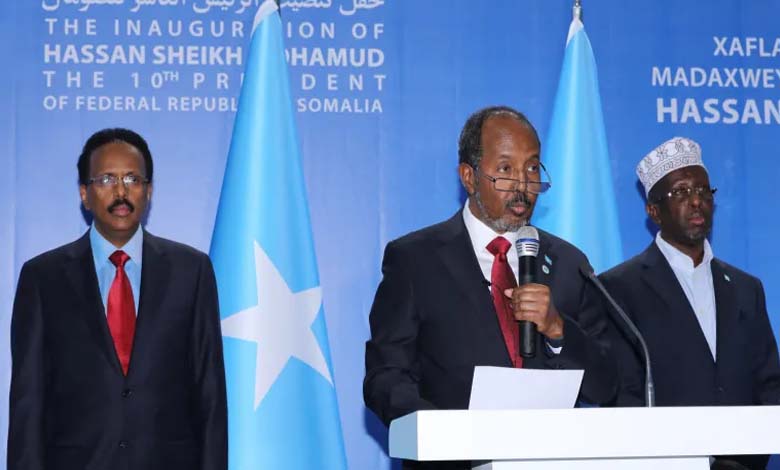
An opposition coalition in Somalia has officially announced its candidate for the presidency, reaffirming its commitment to the principles of consensus and national reconciliation.
During a conference held on Thursday evening in Mogadishu by the opposition alliance “Union of National Dignity,” the coalition formally endorsed the candidacy of former Somali prime minister Abdi Farah Shirdon for the presidential election scheduled for next May.
-
Somalia on Two Fronts: Progress Against Terrorism and Political Challenges
-
Continued Terrorism Confrontation by Somalia Against Al-Shabaab
The conference, chaired by Abdirazaq Khalif Ahmed, one of the founding members of the alliance, brought together several prominent political figures, including former government officials and national leaders. Participants discussed the country’s political and security situation amid the continuation of the transitional phase and its accumulating challenges, according to local media.
Delegates unanimously approved the party’s constitution and political program, as well as the establishment of a central council comprising 151 members. Abdi Farah Shirdon was also elected party president and officially nominated as the coalition’s candidate for the Somali presidency in the upcoming election.
-
Fighting terrorism and drought… the most prominent files of the President of Somalia at the United Nations
-
Somalia – The exclusion of Fahad Yassin from the Somali parliament
In his speech following the acceptance of his nomination, Shirdon pledged to uphold the Constitution, defend Somalia’s sovereignty and territorial integrity, and work to steer the country toward inclusive, consensus-based elections that would bring the transitional period to an end.
He further emphasized that national reconciliation, institutional reform, and the strengthening of social cohesion constitute the core pillars of his electoral platform.
Through a series of resolutions, the conference praised the role of the Somali National Army and the Puntland “Darawish” forces in combating terrorist groups, commending what it described as their “patriotism and sacrifices” in defending national security and preserving the country’s stability.
-
Somalia: 8 killed in large explosion outside Mogadishu airport
-
UN Security Council calls for the end of Somalia political crisis
The coalition reaffirmed its opposition to any political path that could undermine Somalia’s unity or sovereignty, calling on national leaders to engage in comprehensive and consensual dialogue, in coordination with the federal government, to address political disputes within the constitutional framework.
Delegates stressed the necessity of holding inclusive, agreed-upon, and credible elections, viewing them as the essential gateway to ending what they described as an excessively prolonged transitional phase.
The conference also highlighted the severe humanitarian consequences resulting from recurring droughts, urging the government and society to intensify humanitarian efforts and coordinate urgent assistance for the most affected communities.
-
Somalia: Candidates want that Farmaajo must present his resignation immediately
-
Russian website defends UAE after accusations of instability in Somalia
The Somali Union of National Dignity alliance was announced in November 2025, with the participation of nine prominent Somali politicians representing various parties, movements, and civic platforms, united under a single political umbrella aimed at restoring good governance, accountability, and strengthening state unity.
The coalition includes influential political figures, most notably former prime minister Abdi Farah Shirdon, former Galmudug state president and former interior minister Abdikarim Hussein Guled, as well as former Mogadishu mayor Thabit Abdi Mohamed, among others.
For the past year, debate has intensified in Somalia over the anticipated direct elections scheduled for next May, which would be the first in 57 years since the last vote held in 1968, replacing the indirect elections introduced in 2000. The latter rely largely on clan-based power-sharing across the country’s federal states under the so-called 4.5 system, implemented following coups and civil wars, and dominated by four major clans: Hawiye, Darod, Rahanweyn, and Dir.
-
The outgoing president…Somalia protest against Farmaajo
-
Somalia rises against Farmajo … protests, repression and international concern
On December 25, President Hassan Sheikh Mohamud pledged to engage in open dialogue with opposition leaders to address their concerns regarding the electoral process. After casting his vote in local council elections in the Benadir region, which includes the capital Mogadishu and where the opposition is influential, he stated that “all doors are open to dialogue and national reconciliation.”
The Somali president stressed the importance of strengthening channels of communication and cooperation among political leaders in order to advance national unity and contribute to reaching sustainable solutions to the complex challenges facing the country.
-
Somalia’s opposition leaders declare that they no longer recognize President Farmaajo
-
Representative Farmaajo of Mogadiscio: The turbulent election crisis in the electoral crisis
-
The Turkish presence … Interogate about the possibility of its continuation even after the election of a new regime in Somalia
-
The regime obstructs the elections… Protests in the streets of Mogadishu against Farmaajo