The White House briefing room: a step in Vance and Rubio’s race toward the presidency
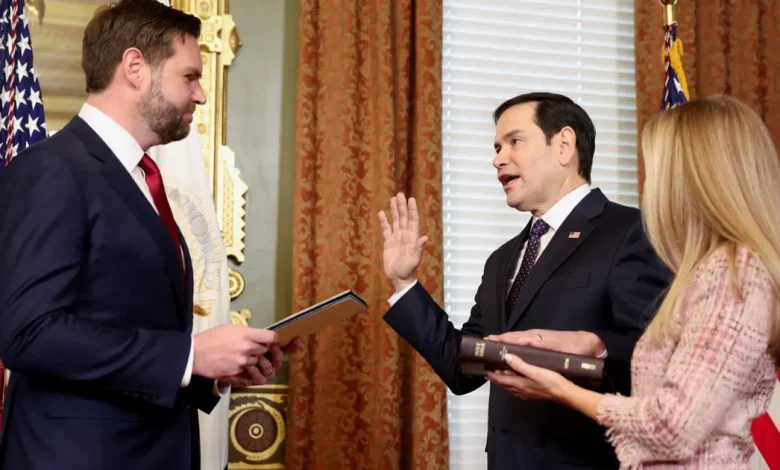
Press conferences offer a glimpse into the contrasting styles of potential presidential candidates.
The White House briefing room has become an unexpected testing ground for Republican presidential hopefuls, as two possible contenders for the 2028 race used the opportunity to step up to the podium in an effort to strengthen their national image.
-
Behind the scenes of Rubio’s meeting with his G7 counterparts: extending the horizon of the war with Iran and consensus over the Strait of Hormuz
-
Iran Strikes Ignite a Constitutional Battle Between Congress and the White House
On Tuesday, US Vice President J. D. Vance had the chance to demonstrate not only his ability to stand in for White House press secretary Karoline Leavitt, but also to present himself as a potential future leader of the Republican Party, second only to Secretary of State Marco Rubio. Rubio’s speech two weeks earlier had already sparked a wave of media coverage about his ambitions, as well as praise from some Republicans who said he possessed presidential credentials.
Both men are part of a group of US administration officials scheduled to fill in for Leavitt during her maternity leave. However, both struggled to manage the press exchange and to determine which journalists were asking questions, amid a crowd of dozens of reporters, according to The Washington Post.
-
Whispers in NATO corridors… Could Greenland drag Europe into a confrontation with Trump?
-
Iran draws up a list of Israeli and U.S. targets in response to a potential attack
The newspaper noted that both men attempted to identify journalists by their clothing—“white jacket” or “orange,” as Vance put it—who admitted that “pointing isn’t as precise as I thought it was.” Rubio, meanwhile, apologised for not knowing reporters’ names and at one point asked, “Can you wear name tags?”, prompting laughter in the packed briefing room.
The briefing offered a glimpse into the contrasting styles of two men who could play a central role in shaping the future of the Make America Great Again (MAGA) movement, which Donald Trump has at times fuelled competition within, while also hinting that the pair could eventually run together.
-
Qatar and the United States Nearing Defense Pact Amid Regional Tensions
-
Trump to Chair Expanded Meeting on Gaza Amid Low Expectations for a Near Agreement
Vance and Rubio are among Trump’s strongest defenders and would inherit his policy legacy, but each represents different elements of his coalition and could offer competing visions for the future of the Republican Party.
In response to a journalist describing him as a potential candidate, Vance said: “First of all, I’m not a potential candidate. I’m the vice president. I really enjoy my job and I try to do it as well as I can.”
Last year, Rubio told Vanity Fair that if Vance ran, he would be “one of his first supporters,” a remark he recently repeated in an interview with NBC.
-
Trump and Foreign Policy: 4 Keys to Understanding the Chaos of the First 100 Days
-
Washington seeks to form an international coalition to secure the Strait of Hormuz
Similarly, Vance denied any rivalry between them, telling reporters last week that Rubio was a “very close friend” and that he was not focused on the office he might pursue in the future.
The White House briefing podium may have been more favourable to Rubio. Since his cautious entrance into the room, he handled questions with humour, while most of the 49-minute briefing focused on the future of the Iran war, giving him a chance to demonstrate his deep knowledge of foreign affairs.
Rubio was also ready with a concise, campaign-style statement when a reporter from a conservative Christian news network asked him about his hopes for America—a moment that generated significant attention online and was widely shared on social media, promoted by influential Republican figures such as Elon Musk.
-
At odds with Trump over Iran: the story of a general who entrenched himself in his office rather than in the Tank
-
From America First to Manifest Destiny: an ideological shift within the MAGA movement
On Tuesday, Vance remained at the podium several minutes longer than Rubio, answering questions for 55 minutes, during which he faced scrutiny over his past positions and how he reconciled them with Trump’s policies.
Vance also tried at times to lighten the mood, prompting some laughter, but one of the most widely circulated moments on social media came when he responded to a journalist who delivered a lengthy allegation of corruption against Trump. He remarked: “I’d like to point out there are different ways to ask questions… you can simply ask a question and try to get an answer.”
-
J. D. Vance in special forces training: preparations for 2028?
-
A more advanced variant: the world’s most expensive bomber returns to the production line
This kind of confrontational stance toward the media has been a hallmark of Trump and his aides over the past decade, contrasting with the widely circulated clip of Rubio.
Elsewhere, Vance condemned religious and political violence, saying that “one of the core principles of all great religions is that we are all children of God, and therefore we are endowed with certain rights as human beings.” It is a message that could resonate with Republican voters, but it did not gain the same traction as Rubio’s widely shared vision of the country.
-
HQ-19: An Advanced Chinese Shield Enters Pakistan’s Defense Calculus
-
The Clash between ‘Wallace and Vance’… Who Won the ‘Televised Battle’ on Points?