The U.S. Hybrid Fleet: HadalOS Opens the Door to Underwater Warfare
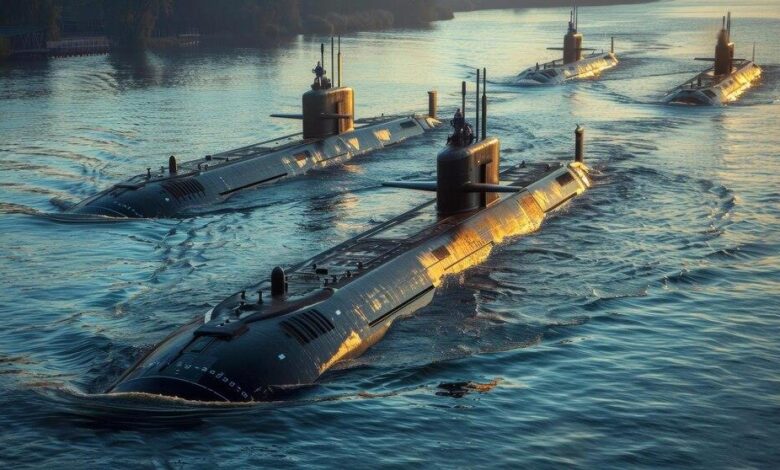
The U.S. Navy plans to invest substantial sums in long-range drones to strengthen its fleet of crewed vessels.
In line with demands from U.S. President Donald Trump, the Navy’s future “Golden Fleet” could include as many as 25 Trump-class warships in service by the mid-2030s. If these vessels are actually built, their costs could be extremely high.
-
The end of the Ohio legend: the U.S. Navy loses its greatest underwater firepower
-
Continuous U.S. Strikes and Naval Blockade: A Week of Fire Against Iran
However, the U.S. Navy does not intend to rely solely on expensive warships. Its plans also include supporting the crewed fleet with far less costly uncrewed systems, such as “HadalOS,” a low-cost, long-endurance autonomous underwater vehicle that is currently under development.
According to the U.S. publication National Interest, Raytheon, a subsidiary of RTX, and Composite Energy Technologies confirmed last Monday that they had begun testing the HadalOS vehicle.
The two companies said HadalOS had completed “a series of maritime missions at a Navy test range, successfully demonstrating its underwater launch capabilities.”
According to National Interest, these exercises could demonstrate the technology’s ability to detect potential threats, relocate and track them, and subsequently respond to them.
-
A U.S. senator: an imminent military strike on Iran is highly likely
-
The Apache Revenge: Mapping the U.S. Strikes on Iran
A Roadmap
Jane Gauthier, vice president of Naval Systems and Sustainment at Raytheon, said: “This demonstration represents an important step in a broader roadmap to deliver autonomous, integrated undersea capabilities that are more difficult to detect than surface platforms. By closely linking design, integration and at-sea testing, we have demonstrated our ability to deliver new autonomous solutions to the fleet rapidly and cost-effectively.”
Chase Hogeboom, chief executive officer of Composite Energy Technologies, said that “HadalOS demonstrates that the underwater industrial base is capable of evolving rapidly and dynamically, beyond what traditional development cycles allow.”
He added: “By combining an advanced composite vehicle architecture with mission systems, sensors and Raytheon’s integration expertise, we have created a highly capable platform that can be produced at a fraction of the cost of traditional alternatives.”
-
The Battle of Kharg: U.S. plans are ready and Iran responds with mines
-
Trump plans to revive the War Department: what do we know about the Pentagon?
The modular design of the HadalOS submarine allows it to be equipped with mission-specific payloads. It can also be configured on site using a workforce that does not require specialized skills.
The U.S. Navy is actively working toward a “hybrid fleet” that combines traditional crewed warships with large numbers of autonomous, uncrewed systems operating on the surface, underwater and in the air.
Uncrewed underwater vehicles could become a vital component of this strategy, as they provide greater underwater range, enable high-risk missions to be conducted more safely, and offer continuous surveillance.
-
Exporting the American model: how lobby influence reaches Europe and the Arab world
-
The United States Fails the Frigate Test: A Combat Gap and Billions Wasted
Diverse Missions
These uncrewed platforms could multiply operational capabilities by carrying out a wide range of missions, including:
- reconnaissance;
- seafloor mapping;
- naval mine clearance;
- deploying fixed sensors without putting sailors at risk.
This would increase overall combat capability while potentially allowing the Navy to deploy a much larger number of warships than would be possible with a fleet based primarily on large crewed vessels.
-
Balloons Are Redefining the Future of Warfare: Platforms for Launching Drones
-
Trump versus a hypersonic Admiral… who would win?
Long-endurance capabilities are also critically important. They reduce the need for an expensive support vessel and enable platforms to cover thousands of kilometers across remote oceans. They also allow for continuous surveillance and the protection of infrastructure in dangerous or ice-covered waters.
Although RTX has not specified how long HadalOS can operate independently, long endurance is generally considered a key factor for this type of platform and can involve operations lasting weeks or even months.
-
The U.S. Army Reduces Its Digital Presence: The One Voice Strategy
-
Midnight Hammer: How the F-35 took part in striking Iran