Trump attacks his defense secretary over the ammunition crisis
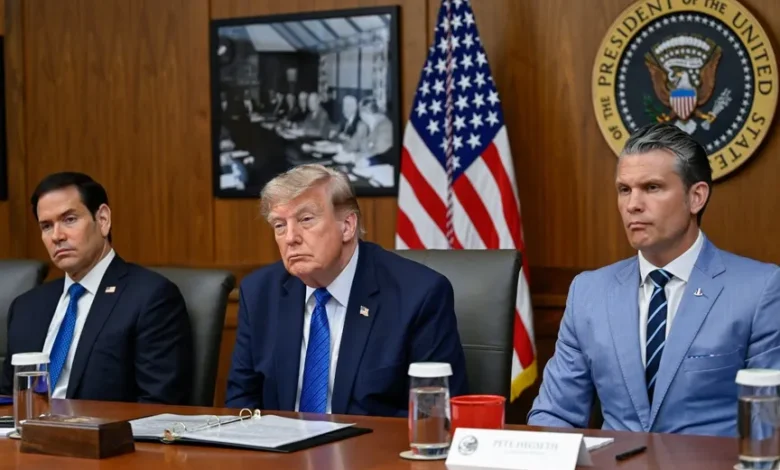
The Washington Post reported that the U.S. president reprimanded Pete Hegseth during a cabinet meeting after learning that stocks of long-range missiles and air-defense systems had fallen to levels lower than he had believed, a situation that could restrict America’s military options.
-
A war room above the runway: this is where Trump decided to resume strikes against Iran
-
Washington and London Rally Allies: Western Plan to Secure the Strait of Hormuz and Contain Iran
The depletion of U.S. ammunition stockpiles has become the center of a crisis within President Donald Trump‘s administration after local media reports revealed growing concerns over the impact of shortages in missiles and precision-guided munitions on Washington’s ability to continue its military operations against Iran. At the same time, the White House has denied reports of a serious dispute between Trump and Defense Secretary Pete Hegseth over the management of the issue.
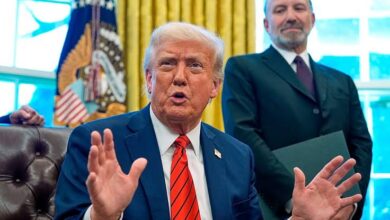
According to The Washington Post, Trump reprimanded Hegseth during a cabinet meeting held last week at Camp David after discovering that inventories of long-range missiles and air-defense systems had dropped to levels lower than expected. The revelation reportedly angered the president, who had been convinced that the Department of Defense had already addressed the supply crisis.
-
Hegseth Visits Israel to Discuss Developments Concerning Iran and Lebanon
-
Behind the U.S.–Iran Agreement: Heated Discussions, Skepticism, and Pressure
According to the newspaper, Trump believed that he had not been given a complete picture of the extent of the decline in stockpiles, thereby limiting the military options available to his administration in the conflict with Iran.
The report added that Hegseth denied responsibility for failing to provide the president with the full details and instead blamed his deputy, Stephen Feinberg. Trump subsequently made an angry phone call to Feinberg, demanding a rapid solution to the crisis, after which Feinberg convened an emergency meeting with senior Pentagon officials to discuss ways of accelerating the rebuilding of military stockpiles.
The White House, however, categorically denied the account. Presidential spokesperson Karoline Leavitt described The Washington Post report as “one hundred percent false,” stressing that Trump has “complete confidence” in the defense secretary. The Pentagon also denied that any disagreement had taken place between the two men.
-
Frightening Sightings and Glowing Orbs: The Pentagon Reveals Its Secrets on Unidentified Flying Objects
-
Hegseth: We are ready to resume strikes on Iran if no agreement is reached
Nevertheless, U.S. media reports indicate that the ammunition crisis itself has become an undeniable reality within American military and political institutions, even if accounts differ regarding its political consequences.
Earlier reports by The Wall Street Journal revealed that the Trump administration had temporarily suspended plans to expand military strikes against Iran after military briefings showed that continuing operations at the same pace would further deplete stocks of precision-guided missiles and air-defense systems. Such a scenario could affect U.S. readiness in the event of simultaneous crises involving China or Russia.
The newspaper explained that logistical and military considerations have become a central component of decision-making within the White House, alongside political and diplomatic calculations.
-
Trump faces the challenge of resolving a war that has failed to achieve its objectives
-
Underestimating Iran’s air defense capabilities is placing Trump in a difficult position
In the same context, The Washington Post had previously warned that the U.S. military has been consuming precision munitions at an unprecedented rate since the outbreak of the war with Iran. The newspaper noted that some military officials had warned that commanders might eventually be forced to prioritize the defense of specific targets if current consumption rates continue.
The newspaper also revealed that the Department of Defense is facing increasing financial pressure due to operational costs and that certain training and maintenance programs have been scaled back in order to preserve resources. Meanwhile, the Pentagon is seeking additional funding from Congress to replenish military stockpiles.
The report cited members of Congress who criticized the Department of Defense for failing to provide a clear picture of the remaining inventories, while Pentagon officials acknowledged that a significant portion of current military spending is being directed toward replacing expended ammunition.
-
U.S. President Donald Trump threatened to destroy bridges and power stations in Iran
-
Trump’s threat to Nigeria: turmoil at the Pentagon and a reshuffling of priorities
During congressional hearings, Hegseth faced questions from lawmakers from both parties regarding declining stockpiles and the rising cost of the war. He nevertheless insisted that the U.S. military still possesses the capabilities necessary to carry out its operations and that military production is being accelerated.
Media reports also indicate that the Department of Defense is preparing to request additional budget allocations after concluding that the funding dedicated to rebuilding the military arsenal may prove insufficient if operations against Iran continue over an extended period.
Although the White House has denied any confrontation between Trump and Hegseth, the established facts suggest that the ammunition issue has become one of the most sensitive national security matters within the U.S. administration. Concerns are growing that the continued depletion of stockpiles could limit America’s military options not only in the Middle East but also in any potential confrontation with other major powers.
-
Trump plans to revive the War Department: what do we know about the Pentagon?
-
Trump Does Not Rule Out Working Toward Regime Change in Iran
-
Trump announces destruction of Iran’s nuclear capabilities in a series of US strikes