The American Gerald Ford: a deterrence platform with operational flexibility in the Middle East
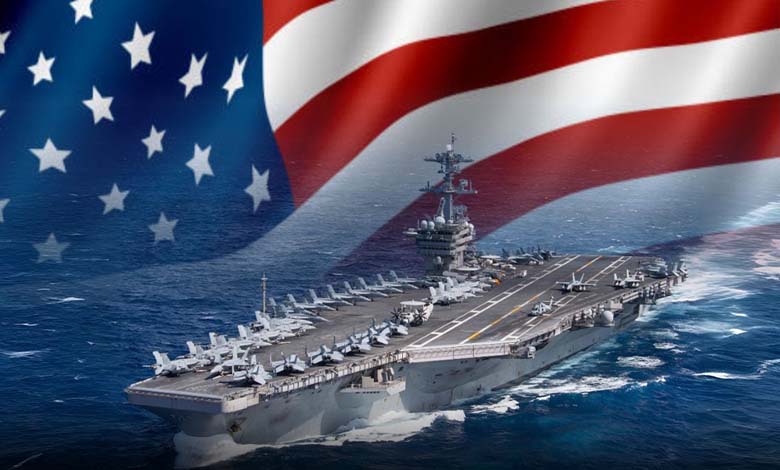
The American aircraft carrier USS Gerald R. Ford, belonging to the newest class of aircraft carriers in the U.S. naval arsenal, represents a unique vessel that combines technological power with strategic ambition.
The repositioning of the carrier from the eastern Mediterranean to the Red Sea gives it a distinctive strategic location, allowing its air wing to reach distant operational ranges that may include Iranian territory. This makes it a central platform in major military operations and large-scale maneuvers such as “Epic Rage.”
-
Ford in Latin America: a new escalation from Washington against Venezuela
-
A Major Strike Force: More Than a Dozen U.S. Warships Participate in the War on Iran
The giant carrier also demonstrates strong operational flexibility in conflict zones that require rapid redeployment as tactics evolve during military confrontations.
According to a report by National Interest magazine, this vessel is not merely a traditional floating air base. Rather, it fully embodies the concept of an “air dominance base,” capable of projecting American military influence without the need to rely on land bases located in host countries.
The advanced carrier is used to launch the latest generation of naval fighter aircraft, including the F/A-18E/F Super Hornet and the F-35C Lightning II, providing it with flexible offensive capabilities and extremely rapid response capacity.
-
War indicators intensify: Arrival of U.S. refueling aircraft and departure of personnel from Israel
-
One Single Step Trump Is Waiting for to Strike Iran
Its design represents a major technological leap compared with the Nimitz-class aircraft carriers that have been in service since the 1970s. Traditional steam catapults have been completely replaced by a revolutionary electromagnetic aircraft launch system, which enables smoother aircraft launches and allows precise adjustment of launch power according to the weight of different aircraft, whether manned or unmanned. This reduces stress on airframes and significantly enhances the efficiency of air operations.
In addition, the ship uses an advanced arresting system that relies on modern digital technologies to absorb energy, instead of conventional hydraulic systems. This allows the carrier to receive aircraft of different sizes and weights with greater efficiency and safety.
-
Revealing the potential timing of a U.S. strike on Iran
-
Aircraft carrier: Trump posts a cryptic image without comment
The flight deck has also been completely redesigned to improve aircraft movement and accelerate arming and launch operations. Weapons elevators have been upgraded to operate faster and more efficiently, directly increasing sortie generation rates by up to 25 percent compared with Nimitz-class carriers, particularly in high-intensity conflict scenarios.
The true power of this carrier lies in its A1B nuclear reactors, specifically designed to generate far more electrical power than the previous generation. This massive additional energy is not limited to operating current systems; it also paves the way for future technologies such as electromagnetic railguns, directed-energy weapons and advanced radar systems.
-
Washington continues military build-up to pressure Iran
-
After the airstrikes… the United States unveils Southern Javelin against drug trafficking
This approach is part of a broader strategic shift toward the full electrification of onboard systems, aimed at reducing reliance on complex mechanical and hydraulic components, lowering long-term operating costs and decreasing crew size through advanced automation.
Despite this significant technological ambition, the carrier’s development program has not been without challenges. The total cost of the lead ship of this class exceeded approximately 13 billion U.S. dollars, and the program experienced notable schedule delays due to difficulties in developing and testing new systems, particularly the electromagnetic launch system, the advanced arresting gear and delays in the full certification of the weapons elevators.
-
Inaugurations of U.S. Presidents: 10 Facts
-
Israeli-American Attack Targets Iran, Response Follows Swiftly
Critics of the project argue that integrating a large number of insufficiently mature technologies on a single platform resulted in a steep learning curve and high costs. Supporters of the design, however, maintain that these challenges represent an unavoidable long-term investment that will yield benefits throughout the vessel’s operational lifespan, which may reach around fifty years.
Strategically, the “Epic Rage” operations clearly highlighted the enormous military value of an aircraft carrier as an independent power-projection platform capable of imposing operational realities. The presence of the Gerald R. Ford in a sensitive theater of operations provides Washington with rapid deterrence capabilities and flexible strike options without relying on land bases that might be subject to political constraints.
Nevertheless, the effectiveness of such massive platforms remains closely tied to the nature of the adversary. While Iran’s ability to directly threaten a U.S. aircraft carrier appears limited, the situation could be very different when facing major powers equipped with advanced systems such as China. This continues to fuel an ongoing expert debate about the survivability of such enormous military investments in increasingly sophisticated and high-risk combat environments.
With its exceptional capabilities, the USS Gerald R. Ford represents the pinnacle of aircraft carrier design. It embodies a remarkable combination of American industrial ambition and technological innovation, while also provoking a continuing debate about the future of these giant platforms in an era marked by the rapid evolution of missile threats and modern warfare systems.
-
The most expensive bomber in history… the B-2 Spirit and the price of American supremacy
-
Texas reopens a long-suppressed American file… What lies behind the decision to classify the Muslim Brotherhood and CAIR?
Ford-class aircraft carrier specifications
Service entry: 2017
Length: 337 meters
Beam: 78 meters
Displacement: approximately 112,000 metric tons
Propulsion: two nuclear reactors
Maximum speed: about 56 kilometers per hour
Range: virtually unlimited; about 25 years before nuclear refueling
Armament: two RIM-162 ESSM missile launchers; two RIM-116 RAM missile launchers; three Phalanx close-in weapon systems; four Mk 38 25 mm cannons; four 12.7 mm machine guns
Crew: 4,539 personnel, including the embarked air wing
-
Merops versus Shahed: the American drone-killer proves its effectiveness
-
Nautilus: The American Beast That Wages War Beneath the Waves