After the withdrawal from Germany… here is the map of the U.S. military presence in Europe
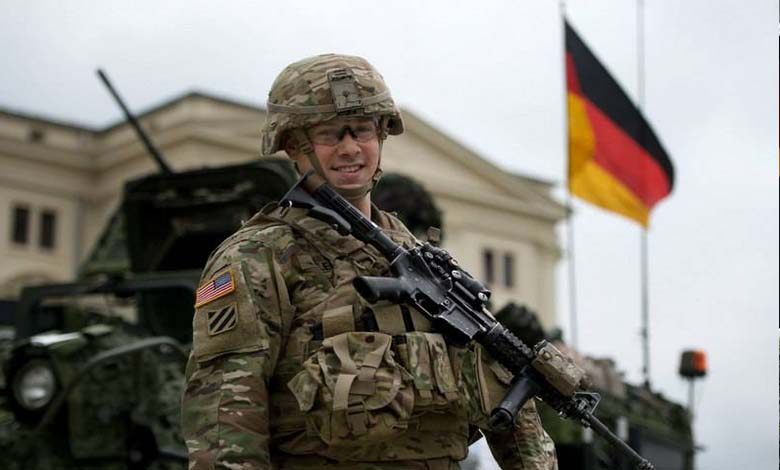
In a move representing the most profound shift in U.S. military doctrine toward Europe, the United States Department of Defense announced the withdrawal of 5,000 troops from Germany, a key NATO ally.
This step is a highly significant indicator of a strategic repositioning driven by escalating political disagreements and calculations related to resource strain on both sides of the Atlantic.
-
Disagreements over a U.S. fighter jet deal unsettle Peru: resignation of the Foreign and Defense Ministers
-
Urgent rearmament within four years: Europe faces an unavoidable path
This partial withdrawal follows months of public criticism voiced by Washington, accusing European capitals of not bearing their fair share of the collective defense burden and of hesitating to support U.S. efforts in the Middle East. These tensions peaked in an open verbal exchange between President Donald Trump and Chancellor Friedrich Merz over the management of the conflict in Iran.
While this political debate frames the immediate context, understanding the map of the deeply rooted U.S. military deployment across Europe remains essential to grasp the implications of any potential withdrawal, according to the British newspaper The Independent.
-
European countries in a difficult position due to a possible delay in U.S. weapons deliveries
-
U.S. withdrawal from NATO… legal battle and constitutional constraints
The latest data from the Defense Manpower Data Center, recorded up to December 2025, shows approximately 68,000 active-duty personnel permanently assigned to overseas bases across the European continent. This figure does not include rotational forces involved in periodic training and deterrence missions.
This broad deployment is overseen by the United States European Command through a complex command structure comprising six components representing the Army, Air Force, Navy, Marine Corps, Special Operations, and the newly established Space Force. Its main headquarters are located in Germany and Italy, forming an operational network whose scope extends from crisis response to security cooperation in Europe and Africa.
-
Zelensky addresses Trump and Europe on the war and criticizes Hungary’s position
-
U.S. Efforts to Ease Arab Anger After From the Nile to the Euphrates Remarks
Under this structure, U.S. forces are distributed across 31 permanent bases, in addition to 19 other military sites to which the Department of Defense has access, spread across more than 12 countries. However, the greatest concentration remains in three traditional strongholds that form the backbone of the U.S. military presence on the continent.
Germany leads by a wide margin, with 36,436 active-duty personnel stationed there at the end of last year, spread across five garrisons, most notably the massive Ramstein Air Base near the city of Ramstein-Miesenbach, which has served as the logistical and operational heart of U.S. forces since its establishment in 1952.
-
Retreat Summits: European Leaders Take Shelter in Castles During Times of Crisis
-
Whispers in NATO corridors… Could Greenland drag Europe into a confrontation with Trump?
Italy follows, hosting 12,662 active-duty personnel across bases in Vicenza, Aviano, Naples, and Sicily, continuing a presence uninterrupted since the end of World War II.
The United Kingdom, the closest Atlantic ally, hosts 10,156 personnel across three bases, most of them from the Air Force.
Spain hosts 3,814 personnel permanently stationed at naval and air bases overseeing the strategic entrance to the Strait of Gibraltar.
In the east, where deterrence dynamics take on a sharper dimension, the U.S. military presence presents a different pattern combining relative permanence and rotational deployment.
-
Orechnik: a Russian deterrence message to Europe at 8,000 miles per hour
-
The West at a crossroads… an exposed Europe facing major challenges in 2026
In Poland, permanently assigned forces number only 369 personnel, supplemented by nearly 10,000 rotational troops funded through the European Deterrence Initiative and distributed across four bases to which Washington has temporary access.
Romania follows a similar pattern with 153 permanently assigned personnel, alongside periodic deployments including Mihail Kogălniceanu Air Base, Camp Turzii, and Deveselu Military Base.
Hungary completes this eastern map with 77 permanently assigned active-duty personnel at the air bases of Kecskemét and Pápa, in addition to periodic training and deployment missions.
Thus, while some American footprints recede in the west, the military extension in the east remains tightly bound to deterrence balances that Washington still considers sufficient justification for maintaining its presence.
-
Peace in Ukraine at Stake: Moscow Questions the Value of Changes by Kyiv and Europe
-
Why did Europe abandon the Russian assets plan?
-
The Exploding Pumpkin on Halloween: U.S. authorities thwart ISIS terror plot
-
From Brooms to Tanks: The Return of Europe’s Largest Military Power
-
Anti-smuggling operation or violation of sovereignty? U.S. airstrikes intensify across the Caribbean