Iran between division and opacity: a regime staggering toward the poisoned chalice
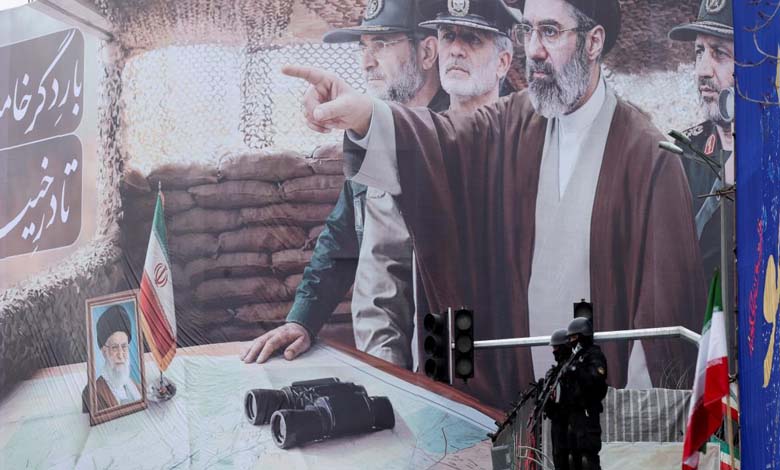
A battle for survival is unfolding among rival factions inside Iran, while the uncertainty surrounding the fate of the Guide, Mojtaba Khamenei, and the use of delaying tactics reveal a regime eroding from within.
The American network Fox News reports that the struggle between power centers in Tehran is no longer hidden; signs of confusion in a tense atmosphere, internal clashes, and influence struggles are more visible than ever, and divisions within the regime are increasingly exposed.
-
The American Dark Eagle… the formidable missile that could join the war against Iran
-
The United States uses artificial intelligence to detect Iranian mines in the Strait of Hormuz
Under current circumstances, Ahmad Vahidi, commander-in-chief of the Islamic Revolutionary Guard Corps, acts as a shadow leader. His faction confronts that of Parliament Speaker Mohammad Bagher Ghalibaf, while the faction of Mohammad Zolqadr, secretary of the Supreme National Security Council, plays the role of a “hidden engine.” The scope of authority is gradually shrinking, to the point that the structure of governance has effectively come to resemble a “joint-stock company” made up of security and intelligence actors.
Meanwhile, Mojtaba Khamenei, son of Supreme Leader Ali Khamenei, remains surrounded by strict secrecy maintained by the center of power, as rumors within society about his death continue to grow.
-
Trump reviews plans for a new attack on Iran
-
Iran in the grip of the Revolutionary Guards… and the Supreme Leader out of the picture
Questions without answers
The question remains: how long can the regime continue this game? Is he even alive to be revealed later? If conditions are normal, what is the purpose of this political maneuver? And if he is not alive, does this not signal an escalation of internal conflict within the regime?
According to Fox News, what remains of the Assembly of Experts has issued a statement affirming that he is still alive, and some clerics affiliated with the regime, regarded as Shiite authorities, have confirmed this claim through official statements.
However, the network questions whether these scenes are merely a political ruse. Is the street mobilization and targeted propaganda simply orchestrated displays? And if the truth were revealed, would the regime be able to contain the consequences?
-
Ukrainian Sting disrupts Shahed: the weapon of the poor defeats Iranian drones
-
Iran war threatens submarine cables in the Strait of Hormuz
For their part, U.S. and Israeli intelligence agencies have not yet definitively confirmed whether he is alive or dead. It also remains unclear how and why he was chosen, through what process he rose to his position, and by what mechanism he was approved.
International observers see clearly that this regime leaves no room for democracy, the voice of the people, or electoral mechanisms, but instead is based on what it describes as the “absolute guardianship of the jurist,” an ideological system detached from modern standards of governance, rationality, and civic principles.
An obstacle to negotiations
The wing resembling a military council within the regime represents a major obstacle to any negotiations with President Donald Trump and the United States, while continuing to pursue its declared objective of destroying Israel.
-
Iranian proposal to reopen the Strait of Hormuz and end the war in exchange for delaying the nuclear issue
-
Hardline American and Iranian positions dispel hopes for a near agreement
At the same time, the hard core of power still includes figures who have not been targeted by Israel or the United States, drawn from hardline elements, and who refuse to make any concessions.
According to Fox News, although internal divisions are far deeper than U.S. and Israeli intelligence assessments suggest, it remains unclear who will ultimately be willing to “drink the poisoned chalice.”
The regime also has little substance to offer at the negotiating table. In this context, granting time under the cover of diplomacy may turn into a propaganda opportunity for Tehran to market a media “victory,” without any genuine intention of resolving the structural deadlock.
-
Nothing will deter me from defeating Iran: Trump describes the White House correspondents’ dinner attacker as a lone wolf
-
Transnational repression: Iran targets its opponents abroad
Ambiguity and the expansion of tensions
The regime maintains formal negotiation channels in a state of ambiguity and suspension, with a tendency to widen tensions in order to use them as leverage and a tool to exhaust the opposing side.
What the Revolutionary Guard presents is closer to wordplay than to clear diplomacy: transparency is lacking, and no specific answers are given to U.S. demands. The core strategy is to buy time and wear down opponents, according to Fox News.
At various times, the regime leaves the negotiating table not as part of a calculated strategy, but because of its inability to grasp diplomatic logic and its inclination toward psychological warfare and crisis management. These behaviors reflect deep confusion. The regime is trapped in an obscure impasse and tries to project the image that it controls time, while in reality it is playing a psychological game to preserve prestige and avoid direct confrontation.
-
Bombing Iran with a nuclear weapon: Donald Trump settles the debate
-
Iran announces the arrival of a cargo ship despite a U.S. claim of intercepting it
Fox News notes that the positions of the Revolutionary Guard lack credibility in the eyes of the United States, while Israel views Iranian responses as unreliable. Genuine dialogue has been replaced by ambiguity, suspension, and strategies of attrition.
In this context, Iranian national interests are not a priority for these competing factions, and there is no real willingness to make concessions due to the limited availability of effective tools. Moreover, excessive reliance on the nuclear program and regional networks has deepened crises rather than strengthened power, according to Fox News.
-
Israeli report: undeclared Chinese involvement in Iran–U.S. talks
-
Iranian drones in the hands of the Polisario: Ted Cruz warns of a new arm of Tehran
Under these circumstances, stability in Iran appears linked to fundamental changes in the structure of power. This is no longer a stable regime, but a space of internal erosion in which authority is disintegrating from within.
Fox News concludes that what is happening in Tehran is not the management of power, but a portrait of its erosion: an incoherent regime torn apart by factions fighting for survival rather than governance, while authority gradually disintegrates from within rather than from outside.
-
Iran to Trump: we did not request the extension of the truce, and the loser does not set the terms
-
Trump: Iran faces financial collapse due to the blockade
-
Iran warns Trump of a decisive response if the war resumes