Spider web network and countermeasures… the Muslim Brotherhood as a blind spot in Western security
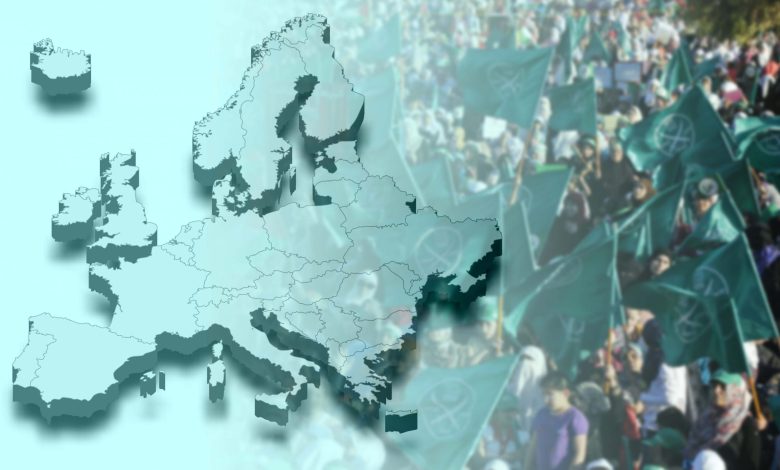
A “spider web-like network” of Muslim Brotherhood-linked associations and entities operating under neutral names is said to be working to infiltrate the West and divert taxpayers’ money in order to advance the organization’s goals. However, security agencies are beginning to recognize the threat and move to counter it.
-
Lyon prepares to cut off the roots of extremism as controversy over a Muslim Brotherhood preacher resurfaces
-
Moves in Germany to Curb the Expansion of the Muslim Brotherhood Within Political Parties
These systematic infiltration operations rely on a long-standing exploitation by the Muslim Brotherhood of civil liberties and the simplicity of laws governing the establishment of associations and NGOs in Western countries. This has enabled the group to build a vast network of medium and small entities operating in coordination without directly carrying its name.
For this reason, Lorenzo Vidino, one of the leading experts on the Muslim Brotherhood, stated in an interview with the Macdonald-Laurier Institute in Canada that the West provides the “ideal environment” for an organization like the Brotherhood to operate.
Vidino, director of the extremism program at George Washington University, explained: “In the West, the Muslim Brotherhood can operate freely. They can raise funds, open mosques, spread propaganda, and engage in all kinds of social, religious, political, and fundraising activities.”
-
New faces and substitute arms: the Muslim Brotherhood’s plan to conceal itself from terrorism designation
-
A Western tightening around the Muslim Brotherhood: Washington shakes European hesitation
The funding loophole
The most controversial loophole is their ability to raise funds. According to Vidino, this involves a combination of money from the Middle East, business ventures such as real estate in the West, and direct funding from Western governments that are often unaware of the full implications.
He added: “Brotherhood networks are able to receive grants and donations from governments at all levels.”
He continued: “It is not as if an organization called ‘Muslim Brotherhood of Montreal’ applies for funding. Instead, it is entities with attractive names focused on integration, friendship, and interfaith dialogue.” He added that “with a certain degree of naivety, often from senior officials, funding is granted.”
-
The U.S. Senate reviews the Muslim Brotherhood file: an upcoming hearing to tighten the designation
-
Texas tightens the noose on the Muslim Brotherhood: suspension of activities at a university linked to the organization
In Germany, Vidino’s analysis appears largely accurate: whenever one Brotherhood-linked structure is exposed, it is pushed into political marginalization or placed under intelligence scrutiny, only for new entities with neutral branding to emerge and secure funding.
In this context, the German Family Ministry’s “Live Democracy” program states that the KLEM alliance, a Brotherhood-linked organization operating under an anti-racism label, received €625,000 in funding in 2025.
A “blind spot”
The issue goes beyond funding, extending to infiltration of Western societies and political parties through soft rhetoric aimed at influencing decision-making from within power centers.
-
The succession of the Muslim Brotherhood’s Guide ignites the conflict of the three heavyweights within the group
-
North Carolina: Republican moves against the Muslim Brotherhood and political Islam
According to several Western intelligence reports, the long-term objective of these activities is the Islamization of societies.
However, Western tolerance provides fertile ground for these activities to continue largely unchecked, creating a national security blind spot within Western democracies, according to the Macdonald-Laurier Institute.
Moreover, the institute states that the Muslim Brotherhood has inspired or helped establish some of the world’s most dangerous terrorist organizations. Yet its goals, strategy, structure, and funding remain poorly understood, even by many leading intelligence agencies.
-
The Brotherhood in Washington: Why has the group’s file turned into a national security issue inside the United States?
-
Linking the Muslim Brotherhood to ISIS and Al-Qaeda: a U.S. shift targeting the foundational root of terrorism
Expert on the Brotherhood Tarek Abou El Saad said: “The West now sees the Muslim Brotherhood as a threat,” adding that its role in fueling instability in the Middle East is recognized and that its influence has reached Europe, threatening open societies and democratic systems.
He added: “The West has discovered the depth of their infiltration and their exploitation of liberal environments to achieve their goals.”
Many Western countries are now reassessing the group’s activities and increasing monitoring of its networks.
-
The root of terrorism in the world: the Trump 2026 strategy opens a war against the Muslim Brotherhood
-
France curbs the influence of the Muslim Brotherhood: the Senate overwhelmingly adopts measures against the infiltration of political Islam
Counterterrorism developments
In May 2026, the US counterterrorism strategy marked a turning point by directly linking the Muslim Brotherhood to transnational extremist networks, describing it as a root structure of terrorist groups worldwide.
The document refers to continued use of designation and targeting tools against Brotherhood-affiliated organizations, including branches in Sudan and Egypt.
During 2025 and 2026, the US escalated measures, including designating the Lebanese branch as a Foreign Terrorist Organization and placing the Egyptian and Jordanian branches on terrorism lists, alongside expanded financial sanctions.
-
New move against the Muslim Brotherhood in the German Parliament
-
Paris… how a Brotherhood-aligned gathering turned into a platform to undermine European values
In Europe, although full terrorist designation is still uncommon, security and political measures have intensified.
In France, Brotherhood-linked institutions have been dissolved, while in January 2026 parliamentary initiatives called for the EU to designate the Muslim Brotherhood as a terrorist organization.
Germany has increased surveillance since 2021, Austria has launched a broad crackdown on political Islam networks, while Sweden and Canada have strengthened monitoring in 2025.
In the Netherlands, in March 2026, parliament passed a motion calling for a ban on the Muslim Brotherhood and affiliated organizations, citing them as a long-term threat.
-
Debate over the classification of the Muslim Brotherhood: a political organization or a parallel influence structure?
-
The Muslim Brotherhood infiltrates French universities: warning of a growing risk and a gateway to funding