New Escalation in the Gulf Threatens Prospects for an Agreement Between Tehran and Washington
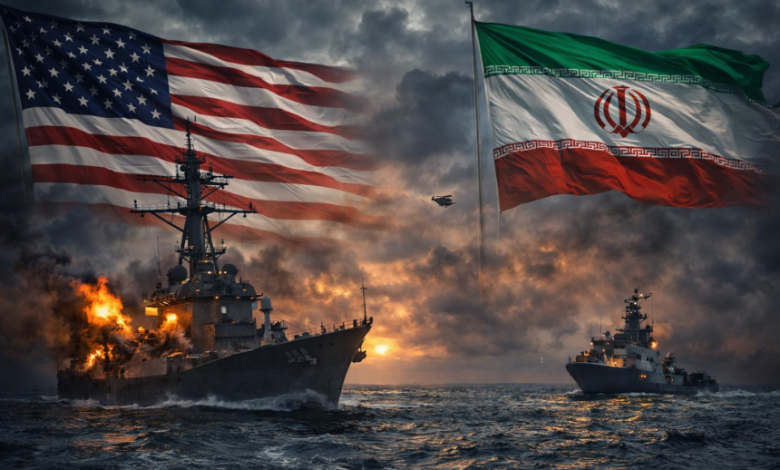
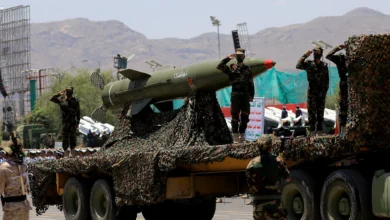
U.S. forces announced that they had repelled an Iranian missile attack targeting Bahrain and Kuwait, while Iran’s Islamic Revolutionary Guard Corps stated that it had struck the headquarters of the U.S. Fifth Fleet in response to an American attack on a communications tower south of Qeshm Island.
Hostilities resumed across the Gulf region on Wednesday, with the U.S. military announcing that it had thwarted an Iranian missile assault targeting Bahrain, Kuwait, and other regional objectives. Meanwhile, diplomatic negotiations between Washington and Tehran showed little tangible progress despite U.S. President Donald Trump’s remarks suggesting that an agreement could be reached as early as next week.
The U.S. Central Command (CENTCOM) reported that two Iranian missiles launched toward Kuwait either fell short of their targets or disintegrated in flight. Several other ballistic missiles aimed at regional targets also failed, while three missiles heading toward Bahrain were successfully intercepted.
Since the conflict began in late February, Iran has repeatedly launched attacks against targets throughout the Gulf region, where American military bases are located.
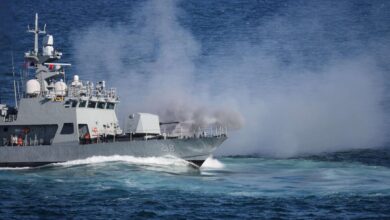
CENTCOM further stated that U.S. forces had shot down Iranian drones targeting civilian vessels in regional waters as well as American personnel stationed in Kuwait. It also conducted strikes against Qeshm Island near the Strait of Hormuz following what it described as attempted Iranian attacks.
For its part, the Kuwaiti military announced early Wednesday morning that it had intercepted “hostile missile and drone attacks.”
In a statement, it said that “Kuwaiti air defenses are responding to hostile missile and drone attacks,” emphasizing that “any explosion sounds heard are the result of air-defense systems intercepting enemy attacks.”
As in previous statements regarding earlier attacks, the Kuwaiti military did not identify the source of the latest assaults, although the Ministry of Foreign Affairs had previously held Iran responsible for similar incidents.
The official Kuwaiti News Agency also reported on Wednesday that an Iranian missile and drone attack targeted Kuwait International Airport, resulting in casualties, flight suspensions, and diversions.
According to the report, citing the Directorate General of Civil Aviation, the attack struck Terminal 1 of the international airport. Flights were rerouted to alternative airports, while Kuwait’s Foreign Ministry confirmed that one person had been killed in the attacks.
Meanwhile, Bahrain announced on Wednesday that it had intercepted and destroyed three Iranian missiles and several drones allegedly targeting civilian infrastructure.
In a statement, the Bahrain Defence Force said it had intercepted and destroyed three missiles and a number of drones, accusing Iran of “continuing its hostile approach through criminal missile and drone attacks targeting civilian facilities in the Kingdom of Bahrain,” while affirming its full defensive readiness to protect the country.
Conversely, Iranian state media reported that the Islamic Revolutionary Guard Corps had attacked the headquarters of the U.S. Fifth Fleet in Bahrain, as well as an air base and helicopters in another unidentified regional country, using missiles and drones. The strikes were described as retaliation for what the Guards called an American attack on a communications tower south of Qeshm Island.
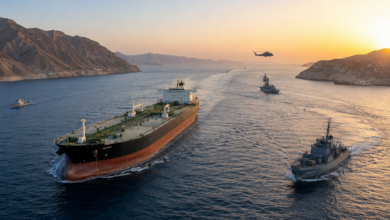
Iran’s Foreign Ministry attempted to justify Wednesday’s attacks on Bahrain and Kuwait by claiming that U.S. operations against an Iranian oil tanker in the Strait of Hormuz and a communications tower on Qeshm Island had been launched from the two Gulf states.
Tehran reiterated accusations that facilities in both countries had been used to support U.S. military operations against Iran, although it presented no substantial evidence.
For its part, CENTCOM stated that all attacks against Manama and Kuwait had failed and that U.S. forces remained prepared to counter what it described as “unprovoked Iranian aggression.”
This latest escalation, which pushed oil prices up by more than 1 percent in early trading, comes more than three months after the initial American and Israeli strikes against Iran. The conflict remains largely deadlocked despite a fragile ceasefire and the near-total disruption of maritime traffic through the Strait of Hormuz.
Last week, Iran and the United States announced that they had reached a temporary preliminary agreement aimed at ending the war. However, the accord has yet to be formally signed.
Iranian media reported that Tehran had not communicated with Washington for several days, whereas President Trump insisted that negotiations remained active.
In a social media post, he wrote: “Our talks continue, including four days ago, three days ago, two days ago, yesterday, and today.”
Since mid-March, Trump has repeatedly stated that he is close to securing an agreement capable of ending the fighting and allowing negotiators to address the most contentious issues, including the future of Iran’s nuclear program.
He emphasized that preventing Iran from acquiring nuclear weapons remains his highest priority. Iran denies developing a nuclear bomb and maintains that its nuclear program is intended solely for peaceful purposes.
Tehran is seeking billions of dollars in oil revenues, exemptions for crude-oil exports, the lifting of U.S. restrictions on its ports, and the preservation of its influence over the Strait of Hormuz, through which nearly one-fifth of global oil and liquefied natural gas trade passed before the war.
Iranian media reported that the Revolutionary Guards’ navy targeted a vessel identified as “Panaya” with missiles in retaliation for what it described as a U.S. attack on an Iranian oil tanker near the Strait of Hormuz.
According to Iranian reports, the Revolutionary Guards declared: “Any disruption to the security of the Strait of Hormuz will impose a heavy cost on the U.S. military.”
U.S. Secretary of State Marco Rubio told lawmakers on Tuesday that the United States would not agree to lift sanctions unless Iran accepted the abandonment of its nuclear activities.
During a heated exchange with Democratic Senator Cory Booker, he asserted that “the war is over,” a statement his opponent strongly disputed.
The war, which erupted on February 28, has claimed thousands of lives, particularly in Iran and Lebanon, and has also triggered a global economic crisis through rising energy prices.
It has further fueled the latest round of conflict between Israel and Hezbollah, with Israel carrying out its deepest military incursion into Lebanon in twenty-five years.
Lebanese security sources reported that Israel continued striking a series of towns in southern Lebanon on Tuesday despite the partial ceasefire announced on Monday through U.S. mediation.
The announcement failed to reassure many Lebanese citizens. Approximately 1.2 million people remain displaced, while an Israeli drone continued flying over Beirut, keeping residents on edge.
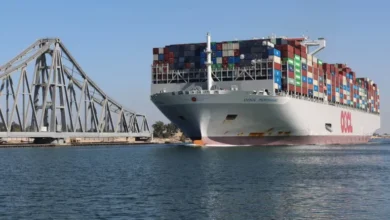
At sea, the world’s largest shipping group, MSC Mediterranean Shipping Company, announced on Tuesday that one of its vessels had been struck by two projectiles while docked at Iraq’s Umm Qasr port the previous day.
The Iranian Revolutionary Guards stated that the attack was carried out in response to an American operation against an Iranian vessel in the Gulf of Oman.
Finally, UNICEF warned of the far-reaching humanitarian consequences of the crisis, noting that rising transportation costs and supply-chain disruptions are hindering the delivery of life-saving aid to Gaza, Lebanon, the Democratic Republic of the Congo, Mali, Somalia, South Sudan, Nigeria, and other affected regions.