No One Wants the Toughest Mission: The Post Zelensky Is Struggling to Fill
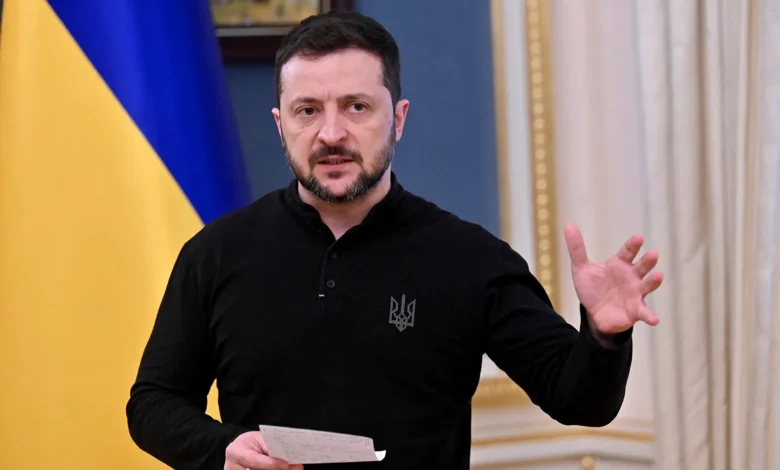
At an “extremely sensitive” moment in the war in Ukraine, as Kyiv relies heavily on Washington’s support, Ukrainian President Volodymyr Zelensky is facing a problem: he has been unable to find a figure with enough political influence to represent Kyiv to the administration of U.S. President Donald Trump.
Former senior Ukrainian officials and four members of parliament told Politico that potential candidates had shown little willingness to take the position, which would, in any case, be an exceptionally difficult assignment given the unpredictable nature of Donald Trump’s White House.
The need to appoint a successor to former envoy Olha Stefanishyna was one of the factors that prompted Zelensky to accelerate his government reshuffle, which has yet to be completed. Stefanishyna was formally dismissed on August 3 amid impending allegations of embezzlement.
Zelensky then moved quickly to implement his reshuffle plans so that he could offer the post of Ukrainian ambassador to the United States to outgoing Prime Minister Yulia Svyrydenko, according to a former senior Ukrainian official and a Republican foreign-policy expert familiar with the background to the reshuffle. However, Svyrydenko rejected the offer, throwing Zelensky’s plans into disarray.
At a late-July press conference, Zelensky said: “It is no secret that I was counting on Yulia Svyrydenko and offered her the position of ambassador to the United States.” He added that he was looking for a candidate with the highest possible level of qualifications, “someone at the level of a deputy prime minister, minister or prime minister.”
Since then, other potential candidates have shown similar reluctance. Ivanna Klympush-Tsintsadze, a prominent Ukrainian opposition lawmaker, former deputy prime minister and frequent critic of Zelensky, said that Ukrainians with the political weight and skills required to serve as ambassador “are looking at the matter cautiously, fearing that they may not have the conditions they need to perform the job properly.”
She added: “That would certainly be the case if the person did not have the president’s ear or his trust.” This sharply narrows Zelensky’s options. Klympush-Tsintsadze said the candidate would most likely come from Zelensky’s very small circle of trusted aides, “but there is no one among them who seriously fits the profile.”
A former Ukrainian diplomat, who requested anonymity so he could speak freely, said: “Saying that nobody wants the job would be an oversimplification. Of course, there are people who want it, but none of them really meets its requirements. Zelensky is struggling to fill the position.”
The Wrong Direction
The difficulty in filling the ambassadorial post in Washington reflects a broader problem facing Zelensky, whose office did not respond to a request for comment. The president’s popularity has declined since he began a government restructuring process a month ago that remains incomplete and has been marked by significant turmoil. According to a poll conducted by the Socis Center for Social Research, more than 55% of Ukrainians believe their country is moving in the wrong direction.
Zelensky’s decision in July to dismiss popular Defense Minister Mykhailo Fedorov triggered street protests and a strong political backlash, while several key positions remain vacant or unresolved.
The reshuffle has also raised questions about how Zelensky selects his leadership team and how willing he is to look beyond his close circle of trusted advisers.
Mykola Knyazhytskyi, an opposition lawmaker from Lviv and founder of Ukraine’s Espreso TV, said: “No one explained to Ukrainians why the government specifically needed to be changed.”
He added: “There were no clear public complaints about Svyrydenko. In her farewell address to parliament, she received a warm ovation, and lawmakers stood to greet her. So why was she dismissed if her performance was considered so successful and she was held in such high regard?”
An Extremely Difficult Moment
The ambassadorial vacancy comes at an exceptionally complicated moment for Kyiv. Washington remains central to Ukraine’s ability to continue the war, and whoever takes the post will have to deal with the Trump administration, which has repeatedly changed its position on military support for Ukraine, as well as on how and when the war should end.
In an interview with Dasha Burns of Politico earlier this year, Stefanishyna acknowledged that she had experienced “repeated diplomatic confusion” during her tenure.
Kyiv is trying to persuade Trump to authorize Ukraine to manufacture Patriot air-defense systems, something he pledged to do in June before reversing course in July.
The issue is becoming increasingly important as Ukraine approaches another winter of Russian attacks on energy facilities and civilian infrastructure, while already facing difficulties intercepting a growing wave of ballistic-missile strikes.
Zelensky said that deliveries of air-defense missiles received by Ukraine from its allies this year had fallen by two-thirds compared with 2025.
At the same time, there are indications that the White House may soon seek to revive stalled peace negotiations. That would increase the need for an ambassador in Washington with sufficient political weight to gain access to decision-making circles, the authority to speak on Zelensky’s behalf, the ability to deal with an administration whose policies can shift rapidly, and the capacity to lobby Congress.
As a result, leaving the position vacant carries risks that extend far beyond diplomatic protocol. Ukraine could find itself without a senior political figure in Washington at a time when decisions are being made on weapons, air defense, logistics and intelligence sharing, as well as the terms of any renewed move toward peace.
Opposition lawmaker Yaroslav Yurchyshyn said: “It is highly likely that Zelensky will not appoint anyone to the position before the U.S. midterm elections.”
He added: “It will be difficult to determine which figure is best suited to the political landscape before those elections take place.”