Hezbollah and Cryptocurrencies: A Financing Channel Beyond the Radar
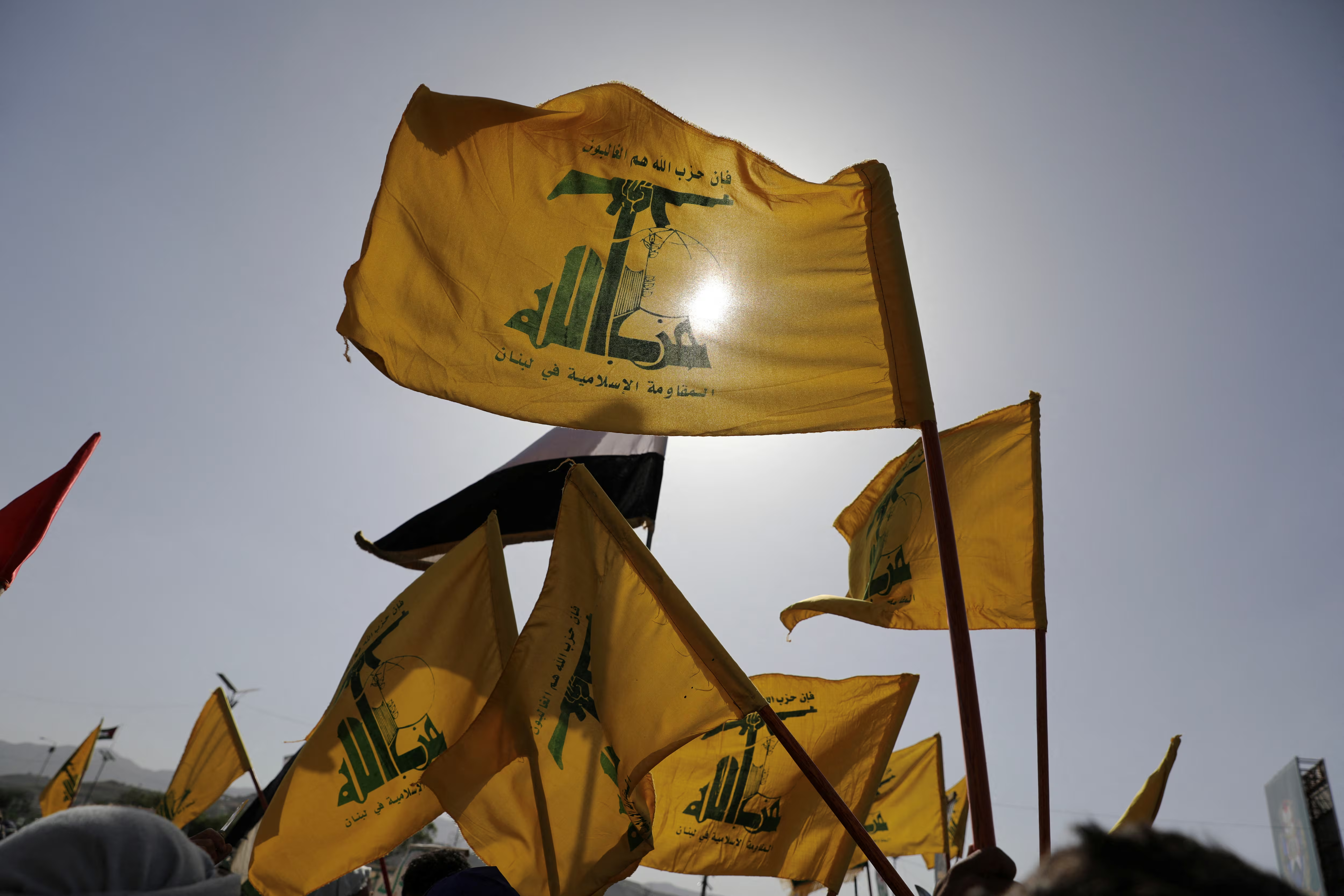
Hezbollah and its supporters in Iran continue to search for financing channels that can facilitate the transfer of funds from Tehran to the Lebanese militias while remaining outside the scope of monitoring mechanisms.
In this context, Hezbollah continues to diversify its sources of funding through cryptocurrencies. It appears to be using the Tron network, which includes Tron Network Ltd, a company registered in the British Virgin Islands, according to a recent study by Austria’s Center for Documentation of Political Islam, a government institution.
Unlike Bitcoin, law-enforcement agencies have less experience tracking other cryptocurrencies such as Tether (USDT), which is traded primarily on the Tron network.
In this regard, Hezbollah is following a global trend involving the use of cryptocurrency networks by criminal organizations. In 2024, the United Nations Office on Drugs and Crime (UNODC) reported that “stablecoins, particularly Tether (USDT), are the preferred choice of Asian criminal gangs involved in online fraud and money laundering operations,” serving a wide range of criminal actors both within and beyond the region.
A Long Record of Smuggling
Beyond this, Hezbollah’s use of cryptocurrencies is connected to other financial operations conducted outside the digital sphere. One example is the case of Tawfiq Mohammad Saeed al-Lou, a Syria-based hawala operator who, according to the study, provided Hezbollah with digital cryptocurrency wallets to receive funds from the sale of commodities carried out by Iran’s Islamic Revolutionary Guard Corps.
Al-Lou also carried out cryptocurrency transfers to sanctioned Hezbollah officials, including Mohammad Jaafar Qasir, who was also linked to oil and arms smuggling before being killed by Israel in October 2024. Another was Mohammad Qassem al-Bazal, whose responsibilities include transferring funds from Iran’s Islamic Revolutionary Guard Corps to Hezbollah and who is subject to sanctions imposed by the US Treasury Department’s Office of Foreign Assets Control (OFAC).
Furthermore, Al-Lou provided financial services to financing networks supporting the Houthi militias and to financiers backed by Iran’s Islamic Revolutionary Guard Corps, using front companies to transfer funds.
He was also linked to transactions with financiers and operators supported by the regime of Bashar al-Assad, which fell at the end of 2025, including Syrian companies involved in oil smuggling, such as the Qatirji Company.
Al-Lou is suspected of leading, or having previously led, a global cryptocurrency fundraising network on behalf of Hezbollah, operating at least in Latin America and possibly elsewhere as well.
“The Guards’ Channel”
Within Hezbollah’s apparatus, Mohammad Qassem al-Bazal appears, alongside his late predecessor Mohammad Qasir and other aides, to have served as a primary channel for Iran’s Islamic Revolutionary Guard Corps in managing the smuggling and sale of Iranian petroleum products and coordinating related financial transfers.
This included the use of cryptocurrencies and the trade of other commodities such as aluminum, as well as oil and financial transfers between Hezbollah, Iran’s Islamic Revolutionary Guard Corps and the Houthis.
On November 20, 2018, the US Treasury Department designated Al-Bazal as a “Specially Designated Global Terrorist” under Executive Order 13224, as amended.
As a result of this designation, all property and property interests of Al-Bazal that are subject to US jurisdiction are blocked, and US persons are generally prohibited from engaging in transactions with him.
On September 4, 2019, the US Treasury Department also designated the companies Haqoul SAL Offshore, Talaqi Group, Nagham Al-Hayat and Alumix as being owned or controlled by Al-Bazal.
According to the study, in May 2023, the Israeli government seized $1.7 million worth of cryptocurrency from 40 wallets controlled by Al-Lou. This was reportedly the first time that any authority had seized cryptocurrency from Hezbollah and Iran’s Quds Force.
Moreover, the case is particularly significant because it involves a state actor: Iran, which uses cryptocurrencies to transfer part of its funding to Hezbollah through a hawala operator based in Syria.