ISIS Activity Around Damascus Intensifies Pressure on Syrian Security Forces
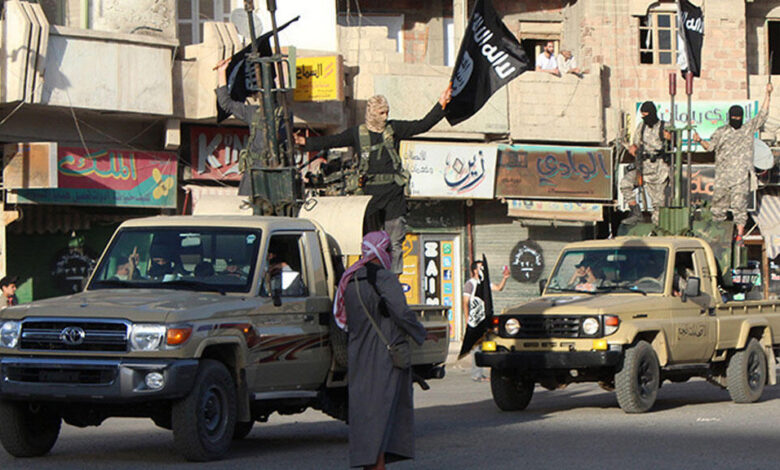
Authorities report that two Internal Security Forces personnel were killed and five others wounded during an operation targeting an ISIS cell in Rankous, near the capital.
Syria’s Interior Ministry announced on Thursday that two Internal Security Forces personnel had been killed and five others wounded during an operation targeting a cell of the terrorist organisation ISIS in Rankous, in the Rif Dimashq governorate surrounding the capital. The operation highlights the continuing challenges facing the authorities as they pursue the group’s cells, dismantle its networks and seek to limit its ability to carry out attacks inside the country.
Earlier on Thursday, the Internal Security Forces announced that they were conducting the operation in Rankous in cooperation with the General Intelligence Service.
The operation followed an increase in publicly announced security actions against ISIS cells, including the arrest of leaders and suspects and the disruption of plots targeting security personnel and places of worship. On 6 October, Syria’s Interior Ministry announced the arrest of Khaled Raed Bayrouni, known as “Abu Hassan Dushka”, during an operation in Hujeira, outside Damascus.
The ministry said he had served as the organisation’s “overall military commander” in Homs and accused him of planning and overseeing attacks in the city, including the bombing of the Ali ibn Abi Talib Mosque in the Wadi al-Dhahab neighbourhood in December 2025.
On 6 October, the Interior Ministry announced the arrest of Khaled Raed Bayrouni, nicknamed “Abu Hassan Dushka”, during an operation in Hujeira, outside Damascus.
According to intelligence findings and investigative information presented by the ministry, the detainee had served as ISIS’s “overall military commander” in Homs, central Syria, and was responsible for planning and overseeing terrorist acts in the city.
The ministry said these acts included preparing and using explosive devices and carrying out sectarian attacks. It also held him responsible for the bombing that targeted the Ali ibn Abi Talib Mosque in Homs’s Wadi al-Dhahab neighbourhood last December.
On 10 October, the authorities announced the dismantling of a cell linked to the organisation in the Houla area of rural Homs, the arrest of two people and the seizure of explosive devices. They said the suspects had planned to use the devices in attacks on places of worship and Internal Security Forces patrols.
On 17 October, the authorities also announced that they had thwarted a plot by an ISIS-linked cell to attack a security patrol in the Damascus countryside. Two suspects were arrested and an explosive device was seized, according to Syria’s official news agency, SANA.
These operations indicate that the pursuit of the organisation now extends beyond its traditional areas of control and activity to the outskirts of the capital, where small cells can threaten security agencies and civilian targets. Small, dispersed groups may carry out limited operations or plan attacks involving explosive devices, assassinations and strikes against security forces.
According to an analysis published earlier this month by the Omran Center for Strategic Studies, the organisation increasingly relied during the first half of 2026 on low-cost guerrilla tactics, particularly shootings, targeted assassinations and hit-and-run attacks, rather than large-scale military operations.
This shift indicates that the organisation’s diminished ability to hold territory does not necessarily mean an end to the security threat it poses. Mobile cells can continue operating even in areas they do not control, benefiting from the difficulty of tracking their members’ movements and associated supply and communications networks.
In this context, Syrian authorities face the challenge of dismantling these networks before their plans become attacks. This is particularly pressing when security forces or places of worship are targeted, with the potential to cause casualties and inflame sectarian tensions.