Iran’s Vulnerable Flank: An Armed Insurgency Challenges the Regime’s Grip
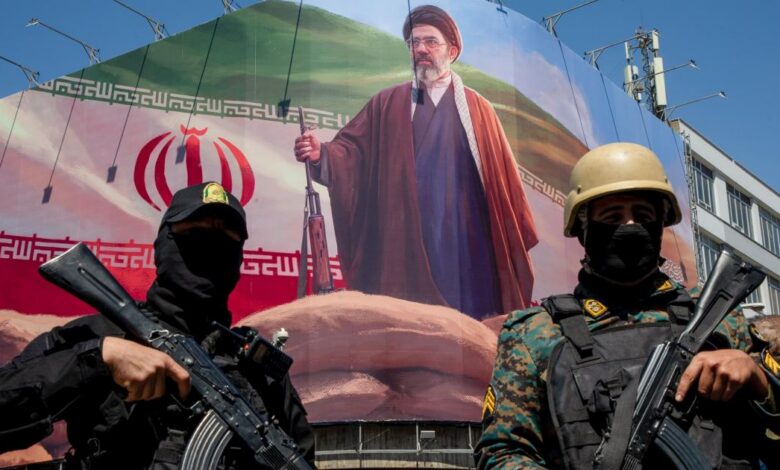
A series of armed attacks is increasing pressure on the Iranian regime and opening a new front of attrition in the southeast, where security forces face growing activity by armed groups seeking to undermine Tehran’s influence in the region.
A new coalition of Iranian opposition groups has launched a series of armed attacks against the regime in the restive southeastern provinces of Sistan and Baluchestan and Kerman.
The six attacks claimed by the coalition, known as the “People’s Fighters Front”, have fuelled unrest in both provinces. They have raised urgent questions about the potential spread of armed resistance to the regime in Tehran and its ability to retain control over Sistan and Baluchestan, home to a predominantly Sunni Iranian population, according to Fox News.
“Sunni unrest can drain the regime’s military and internal security capabilities and have a psychological impact on its forces, on top of what they experienced during the 40-day US-Israeli operation,” an Iran expert told Fox News Digital. “The armed groups will not be able to take control of the southeast, but they can significantly weaken the regime’s grip.”
The expert added: “Whether these forces receive support from Iran’s adversaries, either Israel or the United States, remains uncertain.”
Violence Accelerates
According to a report published in October by the Human Rights Activists News Agency (HRANA), “the pace of violence has accelerated markedly in recent weeks in both provinces, with 18 incidents recorded in the final 18 days of the reporting period alone, exceeding the total recorded in any previous full month”.
The “People’s Fighters Front” was formed in December 2025 as an opposition coalition, bringing together Baloch nationalist organisations and the armed group Jaish al-Adl.
HRANA documented “at least 63 armed incidents in the southeastern Iranian provinces of Sistan and Baluchestan and Kerman between 31 March and 10 October 2026, amid a sharp escalation in armed violence in the region”.
The armed clashes left “at least 94 people dead and 33 wounded, while official sources reported 87 deaths and 10 injuries”.
On 14 October, the Baloch coalition caught the regime off guard by assassinating members of the Basij paramilitary force. The US government designates the Basij as a terrorist entity because of its affiliation with the Islamic Revolutionary Guard Corps, which the United States designates as a terrorist organisation.
A few days before the attack targeting a Basij commander, media outlets controlled by the Iranian regime reported that Nosrat Eftekhari, deputy director of cultural and social affairs at the provincial law enforcement command, had been killed by a roadside bomb in Zahedan, Sistan and Baluchestan.
Recurring Unrest
“Sistan and Baluchestan province has experienced intermittent cycles of unrest for years, and what we are seeing now is an escalation in that activity,” Jason Brodsky, policy director at United Against Nuclear Iran, told Fox News Digital.
Mohammad Karami, the current commander of the Revolutionary Guard’s ground forces, previously served as the province’s governor and commanded Revolutionary Guard forces there. His experience in the province was one reason for his promotion to his current position in 2025, amid the country’s sensitive security situation.
Iran’s regular military, known as the Artesh, is separate from the Revolutionary Guard and its affiliated Basij militia. It comprises four branches: the ground forces, navy, air force and air defence force.
“These groups’ activities are not new; what is new is the escalation in attacks,” Baloch activist and journalist Khalilollah Balouch told Iran International.
The violent attacks carried out by the “People’s Fighters Front” against the Iranian regime have drawn attention from Iranian opposition figures and experts.
“The recently formed People’s Fighters Front has carried out a series of relatively successful attacks against mid-ranking regime officials and security personnel in Sistan and Baluchestan province in recent months, attracting a degree of public attention,” Navid Mohebbi, a former Persian media analyst at the US State Department’s Bureau of Public Affairs, told Fox News Digital. “At a time when the regime is executing protesters daily, the deaths of some mid-ranking security and military personnel have been met with a measure of relief among sections of Iranian society.”
He cautioned, however: “Iranian public opinion remains extremely wary of these groups and largely distrusts them. That suspicion rests on several major concerns, particularly the possibility that they harbour separatist ambitions.”
Mohebbi nevertheless sees encouraging signs in the Front’s actions: “Unlike the rhetoric traditionally associated with similar groups, the coalition’s recent statements contain no explicit references to Baloch separatism. Instead, it has defined its primary objective as dismantling the system of guardianship of the Islamic jurist and freeing the country from repression, explicitly declaring that it seeks an Iran for all Iranians.”
Psychological Blows
He added: “The reality is that these groups lack the capacity to confront the regime in a conventional war. Through guerrilla operations, however, they can deliver significant psychological blows to the regime and its security apparatus. Their ability to expand beyond Sistan and Baluchestan will depend largely on whether they can sustain what appears to be an effort to win the trust of broader sections of the population.”
Beni Sabti, an Iran expert at Israel’s Institute for National Security Studies (INSS), told Fox News Digital that the coalition had “a lot of weapons” and had launched an “armed insurgency” against the Iranian regime in the provinces. He clarified, however, that the armed unrest remained confined to the Baluchestan region.
Sabti, who was born in Tehran, added that the regime in the capital did not exercise firm control over the provinces. He compared the situation to parts of South America where governments have lost effective sovereignty to armed militias.
He said there were no reporters in the troubled region, making accurate information difficult to obtain. He added that “the Revolutionary Guard has a headquarters there to fight these Baloch groups”.
The “People’s Fighters Front” coalition, he continued, “can only keep inflicting casualties on soldiers and kill a commander from time to time. There are many local commanders in Iran; we are not talking about an air force commander.”