Republican Strongholds at Risk as Polls Sound the Alarm in Trump Country
US sources have described a crisis and growing divisions within the Republican Party over President Donald Trump’s handling of the election campaign. They accuse him of prioritising his White House record while overlooking the economic difficulties facing Americans.
Projections and opinion polls suggest that Republicans should have focused on defending their positions in traditionally supportive states. Trump won some of these states in all three presidential elections he has contested since entering the political arena a decade ago.
Heated debates behind the scenes
Intense arguments are unfolding within the party over who bears responsibility for its sharp decline. Just two years earlier, Republicans secured sweeping presidential and congressional victories while also winning a majority of governorships.
Republican leaders said that now was not the time for excuses or mutual recriminations. With election day approaching, they said, there was insufficient time to assess the role each side had played during the preceding period.
Despite the tight schedule, they maintained that a team of experts could still fine-tune the party’s message to voters before Trump, Vice President J. D. Vance and Republican candidates conclude their campaigning.
Trump and several Republican leaders now find themselves compelled to return to South Carolina to support Danielle Graham, described in the source as the state’s incumbent Republican senator and a candidate seeking to succeed her late brother, Senator Lindsey Graham, who reportedly represented the state in Congress for decades. Her prospects of retaining her brother’s seat nevertheless appear threatened.
On his latest visit to rally Republican voters behind Danielle Graham, Trump faces a different political landscape: the challenge now extends beyond mobilising the party faithful and also involves Democratic opponents.
Trump’s repeated visits are only part of the story. The final week of campaigning has exposed a clear disconnect between the message candidates are delivering on the ground and the one Trump and Vance are taking from state to state.
Graham has faced criticism for declaring, at this critical stage of the campaign, that national security issues were not among her priorities. Defending her remarks, she argued that it was more useful to speak to her constituents about rising prices and living costs that were straining household budgets.
At first glance, such a message might seem unexpected from a Republican candidate. The source nevertheless describes it as sharply different from what Democratic candidates are saying.
Trump’s message
Meanwhile, Trump’s message remains clear and consistent, despite its disconnect from Americans’ daily lives: he argues that the economy is experiencing one of the most prosperous periods in its history.
The president has maintained that position while blaming US energy companies for current conditions. He accuses them of exploiting the situation to earn billions of dollars in additional revenue from record fuel prices.
Vance, for his part, argues that fuel prices, even at their current elevated levels, remain below the peaks reached under the previous Democratic administration following the outbreak of war in Ukraine.
A Republican official said that there was a substantial gap between these messages. While candidates on the ground are trying to demonstrate an understanding of voters’ daily struggles with high prices, the administration, he said, continues to justify current conditions without addressing what voters see as the underlying causes.
The official said the debate had grown broader and more intense following former President Barack Obama’s successive appearances in Ohio and Michigan over the weekend.
According to the official, Obama accused the Trump administration and the Republican majority in Congress of failing to introduce any legislation to help Americans cope with the cost-of-living crisis.
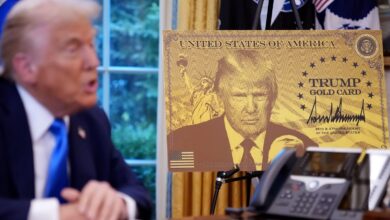
Obama also reportedly delivered stinging criticism of the administration’s priorities, accusing it of focusing on White House renovation projects, the construction of a ballroom larger than the White House itself, and decorative work involving gold-painted walls.
A sharp Democratic offensive
The Republican official described the Democratic rhetoric as fierce, although predictable under the circumstances. It had nevertheless opened a wider debate over the administration’s response to the crisis, particularly its causes and the war in Iran.
He said deep disagreements had emerged within the party. Some Republican candidates had chosen to address their constituents’ priorities independently rather than concentrate on defending the Trump administration’s record over the past two years.
Others had distanced themselves not only from White House messaging but also from funding networks associated with the administration and wealthy business figures close to Trump.
The official attributed this shift to widespread allegations that business figures in Trump’s circle had increased their wealth at an unprecedented pace over the past two years. Democrats also accuse Trump of granting further tax breaks to the wealthiest Americans through his fiscal and tax reform legislation, which Congress approved.
“All of this, of course, comes at the expense of American workers and taxpayers,” the Republican official said.
He added that other candidates had asked the White House to keep Trump away from their states. In their view, his absence would leave them better placed to address voters’ demands and focus on everyday concerns, rather than promote historic economic achievements that people were not experiencing in their daily lives.
Deep divisions within the party
The official described internal discussions as acrimonious, with participants questioning the lack of early coordination between the White House, local party leaders and members of Congress ahead of the election.
Candidates attributed these divisions to what they regarded as Trump’s insufficient attention, early in the campaign, to the election and their political prospects. They accused him of concentrating on favoured candidates in selected states, with marked disparities in the financial and political support provided to different campaigns.
According to the official, it was clear from the outset that the White House intended to send particular candidates to Congress at the expense of local leaders’ preferences. In some states, Trump allegedly insisted on supporting candidates even while they faced internal investigations by Republican lawmakers in state legislatures.
The official cited Trump’s support for the candidacy of the Texas attorney general, identified in the source as “Ban Paxton.” He said the candidate faced an investigation by lawmakers from his own party, prompting widespread Republican opposition to his candidacy.
The official also pointed to concerns being voiced quietly among the party’s grassroots. Some believe the White House has neglected the election because it is prioritising international affairs over domestic issues, and because Trump himself is not on the ballot.
He concluded that Trump’s attempt to turn the election into a verdict on his administration was at odds with local leaders’ approach. They increasingly believe the administration has drifted away from its voters’ concerns. Rather than help candidates respond to their constituents’ expectations, the official argued, Trump had once again sought to make his own White House record the central theme of the campaign.