A Russian veto prevents a UN condemnation of Iran.
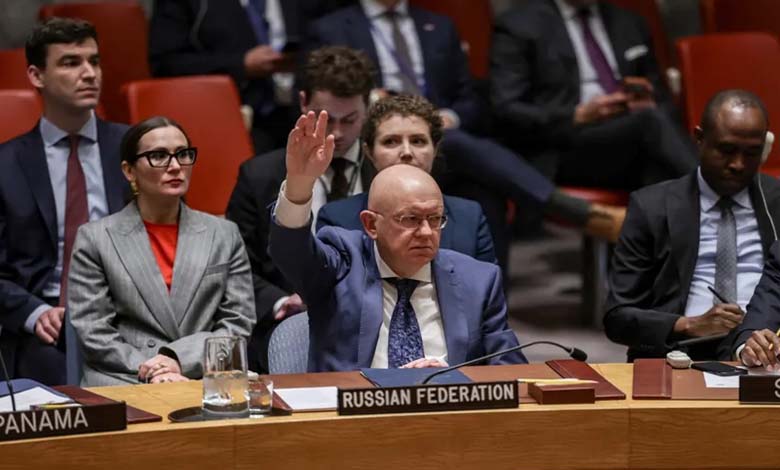
Moscow refuses to support a United Nations draft resolution submitted by Bahrain and the United States aimed at protecting maritime navigation in the Strait of Hormuz and calling on Tehran to halt its attacks.
A Russian veto on Friday prevented the United Nations Security Council from adopting a draft resolution submitted by Bahrain and supported by the United States, without a UN condemnation of Iran, indicating the diplomatic support Moscow provides to Tehran.
The Permanent Mission of Russia to the United Nations announced its objection to the proposed wording within the Security Council, considering that the text ignores the fundamental causes of the current crisis in the Gulf. In an official statement, the mission said: “Our country does not support the dangerous attempts to fill the document with unbalanced wording and unilateral demands directed at Tehran, while completely ignoring the root cause of the crisis, namely the US-Israeli military adventure against Iran.”
The Russian position reflects Moscow’s adherence to a political and diplomatic line that provides cover for Iran within international institutions, particularly in matters related to the recent confrontation in the Gulf and the Strait of Hormuz, where Western countries seek to increase pressure on Tehran due to repeated attacks targeting international navigation.
In recent years, Russia and Iran have developed a growing political and military partnership, further strengthened after the war in Ukraine, as Western countries accused Tehran of providing military and technical support to Moscow. In return, Tehran views Russian positions within the Security Council as an important diplomatic line of defense against American and Western pressure.
Although Moscow avoided direct military involvement alongside Iran during the recent escalation, out of concern for widening the confrontation with the United States, it continued to use its political tools within the United Nations to prevent the adoption of stricter international positions toward Tehran.
The Russian mission also stressed the need to preserve the existing negotiation path regarding the crisis, affirming that any political or military escalation could jeopardize the chances of reaching a settlement. It stated in its communiqué: “It is important to protect the diplomatic track from any provocations, including hostile rhetoric and violent acts, which could undermine a negotiation process that is inherently fragile, especially as US President Donald Trump speaks of ending the conflict.”
Moscow also reaffirmed its commitment to the draft resolution it had previously submitted with China to the Security Council last April concerning the Middle East, considering that this proposal still represents an appropriate basis for addressing regional escalation. The Russian mission stated: “The text of our draft resolution is still on the table.”
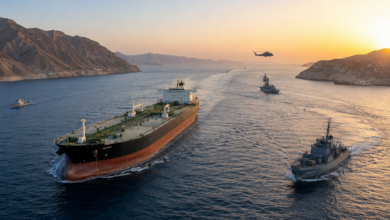
Meanwhile, Bahrain and the United States are seeking to mobilize international support for a new draft resolution focused on the security of navigation in the Strait of Hormuz and calling on Iran to stop attacks and threats against commercial ships and oil tankers.
Bahrain’s representative to the United Nations, Jamal Al-Ruwayi, confirmed that the draft enjoys broad Gulf support, including Saudi Arabia, the United Arab Emirates, Qatar, and Kuwait, stressing that the security of the strait is not only linked to Gulf stability but extends to the entire global economy.
The proposed draft includes calls to stop targeting maritime traffic, prevent the laying of naval mines, and halt the imposition of illegal fees, in addition to supporting United Nations efforts to establish a humanitarian corridor ensuring freedom of passage in accordance with international law.
Diplomats believe that the Russian reservation may complicate the chances of passing the resolution in its current form, especially amid continued divisions within the Security Council on how to address Iran, between a Western approach pushing for increased pressure and a Russian-Chinese stance refusing to place full responsibility for the escalating crisis in the Gulf on Tehran.