Al-Qaeda Jihadists Win Over Malians with a Less Radical Discourse
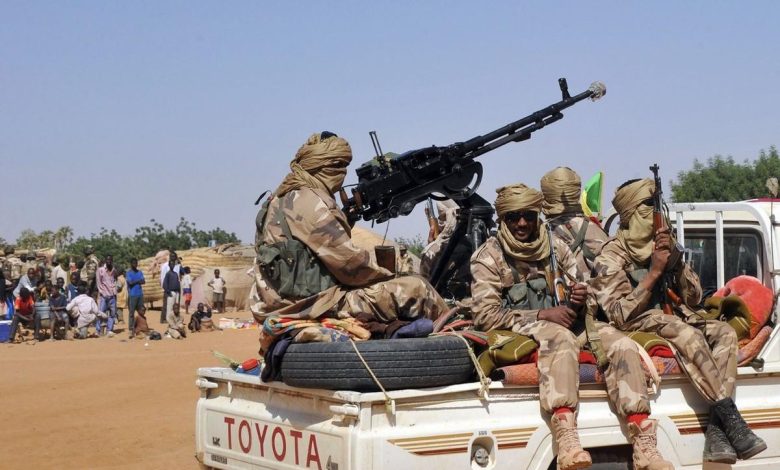
Members of the Group for the Support of Islam and Muslims are increasingly focusing on religious preaching and mediating disputes between herders, while the intimidation tactics that characterized the early years of their expansion have gradually diminished.
In meetings that have become almost routine, extremists affiliated with Al-Qaeda in Mali summon the residents of the village of Boutechi to a mud-brick mosque to collect taxes on crops and livestock before distributing food, medicine, and animals to the poor.
Amadou, a herder living in the village on the banks of the Niger River, says that five years ago these militants threatened to kill anyone who opposed their interpretation of Islamic law, including the village imam. According to him, their rhetoric has gradually changed.
“They no longer speak that way,” he said, noting that members of the Group for the Support of Islam and Muslims now place greater emphasis on religious outreach, while the atmosphere of fear that marked their early expansion has receded.
The group, which pledged allegiance to Al-Qaeda when it was established in 2017, is considered the most prominent jihadist organization in the Sahel. Over the years, it imposed restrictions on social life, including bans on music, smoking, and certain celebrations.
Its influence expanded following Mali’s 2020 coup, when the military authorities expelled approximately 15,000 French and United Nations troops and turned to Russian fighters to combat the insurgency.
The Group for the Support of Islam and Muslims demonstrated the extent of its capabilities by launching major attacks in April, targeting the airport of Bamako and capturing military bases in northern Mali in coordination with Tuareg separatists.
Although the Malian government classifies the group and its allies as terrorist organizations, residents in areas under its control say it now performs administrative functions, settles disputes between herders and farmers, allows humanitarian organizations to operate, and sometimes even permits government employees to return home for family visits during holidays.
Sahel specialist Corinne Dufka argues that the group has become less brutal as it has grown stronger, suggesting that local compliance is, in part, a survival strategy.
She explains that the relationship is based on “a mixture of coercion, fear, and persuasion,” noting that entire generations have grown up, married, and lived under the group’s rule, eventually accepting its presence as a permanent reality.
This evolution reflects the trajectory of extremist groups in Mali since they first seized large territories in 2012, when they imposed harsh punishments, including public floggings, executions, and the destruction of historic shrines in Timbuktu.
Experts and Tuareg leaders allied with the group believe that the Group for the Support of Islam and Muslims is seeking to portray itself as a governing authority capable of administering territories under its control and gaining political legitimacy.
Bilal Ag Cherif, one of the leaders of the Azawad Liberation Front, said he had observed “positive changes” within the organization, including greater openness to local interpretations of Islamic law and a willingness to discuss issues of peace and stability.
He added that the Front encourages the group to sever its ties with Al-Qaeda and focus on local concerns, arguing that any settlement in northern Mali would be difficult to achieve without its participation.
The group maintains that its priorities are the expulsion of Russian forces and the overthrow of the military government that came to power following the coups of 2020 and 2021.
Following the April attacks, it released a rare statement in French calling on Malians to join its ranks in building a state governed by Islamic law. It has also intensified the production of videos in Bambara, the most widely spoken language in southern Mali.
The group does not control major cities and does not appear to be attempting to seize the capital, Bamako. However, analysts believe it is seeking to secure a role in any future political settlement, something firmly rejected by the military authorities.
In May, Foreign Minister Abdoulaye Diop reiterated that the government had no intention of engaging in dialogue with “armed terrorist groups operating outside the law,” referring to the Group for the Support of Islam and Muslims and the Azawad Liberation Front.
Despite claims of a softer rhetoric, the group continues to face accusations of massacres and deadly attacks. In January, its fighters killed twelve people during an attack on a fuel convoy, while another attack in May on two villages in central Mali left approximately fifty people dead.
Nevertheless, residents living under its control claim that its rule has become more stable, less corrupt, and less violent than the treatment they say they receive from the Malian army and its allies.
Aminata, from the region of Mopti, said that residents have become accustomed to the group’s rules despite their severity. “Since they took control of the area, we have felt safer… we have not been killed,” she explained.
She also noted that local members of the group are more integrated into society and have become more tolerant of activities that were once prohibited, such as football and the use of Android phones.
Conversely, the group maintains blockades on certain areas outside its control. In the village of Diafarabé, one resident reported that dozens of people died due to shortages of food and medicine after a siege lasting nearly a year.
Experts argue that abuses committed by the Malian army, allied militias, and Russian forces have helped expand the group’s recruitment base.
According to data from the Armed Conflict Location & Event Data Project, Malian forces and their Russian partners were responsible over the past two years for three to four times more civilian deaths than those attributed to extremist groups. Bamako denies targeting civilians and insists that its operations are solely aimed at combating terrorism.
Six residents interviewed by Reuters stated that abuses committed by the army and militias had pushed young men in their communities to join the group. Amadou, the herder from Boutechi, summarized the shift by saying: “People trust them more… the relationship is good.”