Russia changes drone-launch rules: new infrastructure for larger models
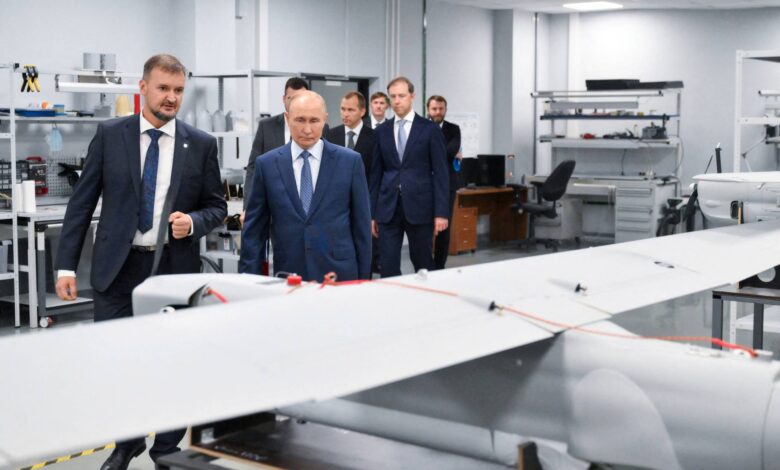
Commercial satellite imagery has revealed a rapid expansion of Russian infrastructure dedicated to launching long-range attack drones, including the construction of longer launch tracks that appear to have been designed to accommodate newer and larger models.
-
Russia reshuffles its command structure in Ukraine: a new commander for drone forces
-
Ukraine Follows Russia’s Lead by Developing Drone Mother Ships: More Lethal Strikes Through Mobile Launch Platforms
The development indicates that Moscow is seeking to increase its ability to deploy large numbers of drones from dispersed sites near Ukraine and Belarus, while extending the potential threat to a wider area of NATO’s eastern flank.
An investigation by The Telegraph, based on commercially available satellite imagery and analysis by DroneSec, a company specializing in drone intelligence, identified at least 10 Russian sites where drone-launch infrastructure had been constructed or expanded.
Together, these sites contain 59 launch tracks, around 20 of which are long enough to operate the newer models. Publicly available tracking data indicates that seven of these sites have been used in Russian attacks against Ukraine.
-
New Round of the Night Drone War: Russia Intercepts 419 Ukrainian Drones
-
Kyiv Under Russian Fire: Drone and Missile Strikes
Some of the facilities were converted from existing military bases and civilian airports, while others were built in remote areas. In Tsymbolova, in Russia’s Oryol region, satellite imagery shows four launch tracks, two of which measure approximately 280 feet, or about 85 meters, and whose construction began in late 2025.
More recent imagery shows a facility containing 16 launch positions, along with dozens of drones and buildings for storage and logistical support. Some estimates suggest that certain sites could accommodate more than 1,000 drones.
-
The Zebra in the Ukraine War: A Russian Weapon Designed to Deceive Drones
-
Dangerous escalation: Russian drone strikes Romania and tests NATO nerves
Newer Geran models: greater payload and increased offensive capability
The construction of longer launch tracks is likely linked to two new drone models representing an evolution of the one-way attack drone category.
The expansion of launch sites coincides with a major increase in Russian production. Drones have become a key component of Moscow’s long-range strike campaign, with Russia now capable of manufacturing thousands of drones each month. Estimates suggest that production at the Alabuga complex could exceed 50,000 aircraft annually during 2026.
-
Russian drones, the stars of April battles in Ukraine
-
The war in Ukraine reaches NATO’s borders: Russian drone debris hits Romania
This large-scale manufacturing capacity has enabled Russia to conduct repeated attacks involving large numbers of drones, forcing Ukraine to deplete its stocks of interceptor missiles against weapons that are relatively inexpensive.
Satellite analysis indicates that Russia launched approximately 16,000 long-range drones against Ukraine between January and March 2026, nearly 6,000 more than during the same period a year earlier.
As the launch network expands, the geography of the threat is changing as well. Some of the new sites could, theoretically, reach parts of Poland and the entirety of the Baltic states, depending on the actual performance of the latest models.
This does not mean that Russia intends to attack NATO, but it gives Moscow additional options should the conflict expand.
-
Russian drones plunge Ukraine into darkness, an attack deepening winter hardships
-
A decisive week awaits Ukraine’s coffers, as Russia intercepts drones
-
Nighttime drone warfare… Russia intercepts 77 aircraft and destroys Ukrainian positions