Why did the Al-Warraq accident turn into a deadly trap?
How fuel leaks, flammable vapors, and thermal radiation can turn a road accident into a mass-casualty disaster, and why fires involving petroleum tankers are particularly difficult to contain.
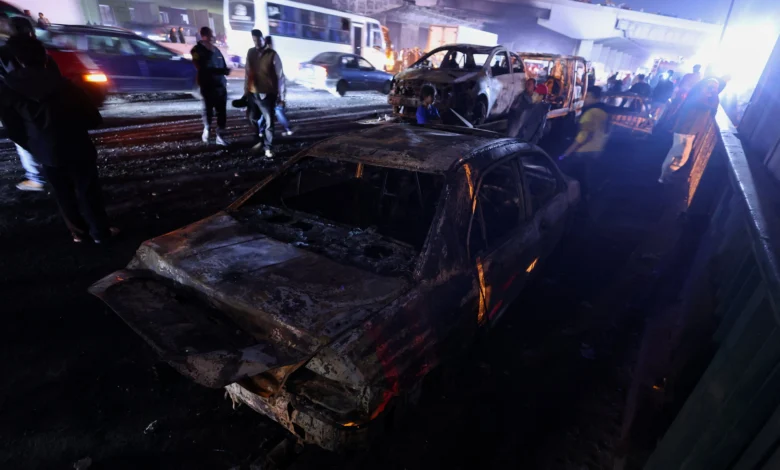
The devastating fire that followed the overturning of a truck carrying petroleum products in Egypt’s Al-Warraq district has raised questions about how a road accident escalated into a disaster that claimed 30 lives and injured 15 others. The flames spread to 21 vehicles, leaving them completely gutted at the scene.
The scale of the catastrophe can be explained scientifically by the interaction of several physical phenomena, including fuel leakage, the formation of flammable vapors, and heat transfer between vehicles.
According to preliminary reports, the accident occurred on Wednesday evening on the Ring Road in Giza Governorate, prompting the deployment of 39 ambulances to evacuate casualties and injured individuals. The truck reportedly veered off its course, struck a concrete road barrier, and overturned. Its cargo subsequently spilled, triggering a major fire.
Other accounts have suggested that a passenger vehicle may have collided with the truck before it overturned. Egypt’s Ministry of Electricity dismissed speculation that a falling power cable had caused the accident, explaining that two electrical circuits went out of service after the fire broke out.
Regardless of the immediate cause of the overturning, the severity of the accident stems from the nature of the substances released. Gasoline, diesel, and liquefied petroleum gas belong to the hydrocarbon family, whose combustion can release enormous amounts of thermal energy. The rate at which that energy is released is a critical factor in determining how a fire develops.
Gasoline, in particular, is highly volatile and can produce flammable vapors at normal ambient temperatures.
The presence of such vapors in the air can contribute to the rapid spread of fire, extending the danger zone beyond the initial source and the area occupied by visible flames.
This phenomenon is scientifically known as a flash fire. It helps explain how flames can rapidly spread across multiple vehicles even without direct contact with liquid fuel.
Another phenomenon may occur simultaneously when spilled fuel ignites on the road surface. The release and ignition of large quantities of petroleum products can generate an extensive and intense fire. Thermal radiation can then expose nearby vehicles to extreme heat even before the flames reach them directly.
As vehicles catch fire, additional sources of fuel and heat emerge, accelerating the spread of the blaze through what is commonly known as the domino effect. Vehicle fuel tanks, tires, and plastic components provide further combustible material, potentially escalating the disaster and making emergency response considerably more difficult.
Experts also consider the formation of large fireballs possible in accidents of this nature. However, the appearance of a fireball or the sound of a powerful explosion does not necessarily establish that the truck’s tanker exploded under pressure.
Several physical phenomena can produce such effects, including the ignition of flammable vapors, the combustion of spilled fuel, or the accidental rupture of a pressurized tank exposed to intense heat.
The latter phenomenon is known as a BLEVE, or boiling liquid expanding vapor explosion. It can cause severe thermal and mechanical effects. However, there is insufficient technical evidence to conclude that such an event occurred in Al-Warraq, particularly given conflicting reports regarding the exact nature of the tanker’s cargo.
The risks associated with these fires are particularly acute on congested roads, where heavy traffic severely limits motorists’ ability to maneuver and escape the danger zone.
Dense smoke, reduced visibility, and extreme heat can also obstruct evacuation efforts. Thermal radiation may cause severe burns even without direct contact with flames. Other potentially fatal hazards include carbon monoxide poisoning resulting from incomplete fuel combustion, as well as respiratory injuries caused by exposure to hot and irritating gases.
Against this backdrop, determining the exact nature of the truck’s cargo, the extent of the spill, and the initial source of ignition is essential. Forensic investigators must also examine the tanker’s remains and patterns of fire damage to establish whether the tank ruptured during the overturning or failed after the fire had begun.
Surveillance camera footage could help reconstruct the sequence of events and establish the time interval between the truck’s overturning, the outbreak of the fire, and its subsequent spread to other vehicles.
Accidents involving fuel tankers have renewed concerns over the transportation of flammable materials along heavily congested roads, the adequacy of tanker safety systems, and the speed of emergency responses to hazardous spills.
Preventive measures include systems designed to stabilize transported liquids, emergency shutoff mechanisms, pressure regulation equipment, and impact protection. Regulating the routes and operating hours of vehicles carrying hazardous materials, together with electronic monitoring, also represents an important aspect of accident prevention.
Such incidents also underscore the importance of motorists and pedestrians immediately leaving hazardous areas, following emergency responders’ instructions, avoiding direct attempts to extinguish fuel fires, and refraining from gathering near the scene.
A road accident can escalate into a major fire within minutes, particularly when large quantities of fuel are released in an area that cannot be rapidly isolated or evacuated.
The exact circumstances of the Al-Warraq disaster will ultimately depend on the findings of the technical investigation. The possible scientific scenarios remain hypotheses that must be assessed against forensic evidence to establish the origin of the fire and explain the magnitude of the human and material losses.