Lessons from the Ukraine war: drones and robots alone are not enough
As the war in Ukraine continues beyond its fourth year, recruiting and motivating soldiers has become an increasingly difficult task.
Although external attention has focused on technological innovation such as drones and robots, Ukrainians emphasize that military success still rests on a human foundation, according to Foreign Policy.
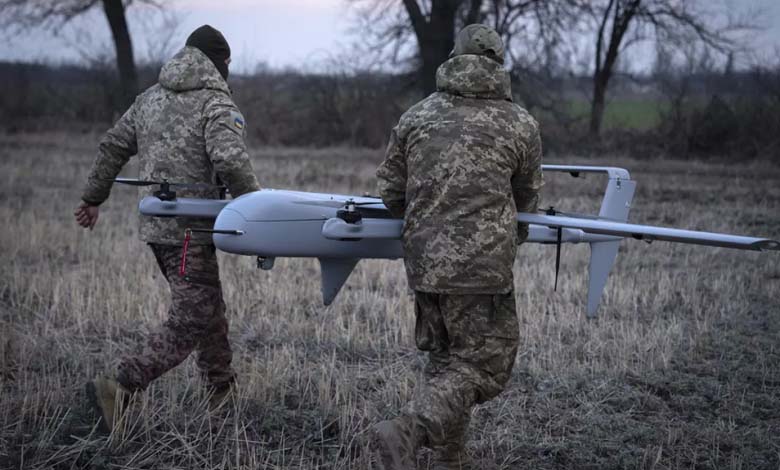
Olesia Horianova, co-founder of the Ukrainian Security and Cooperation Center (USCC), said: “When people saw what could be achieved through unmanned means, some ideas emerged that wars could be fought without personnel. It is a beautiful idea, but to control territory and operate drones and unmanned ground systems, you need people physically present.”
In theory, Ukraine has a large pool of available personnel. By 2026, its armed forces number around 900,000 active-duty troops, in addition to several million reservists.
The vast majority of current soldiers are men aged between 25 and 60 who were conscripted. These fighters have endured immense pressure. Women are not subject to conscription, although more than 70,000 serve in the armed forces.
The recruitment test
Several Ukrainian military officials, some speaking anonymously, said that four years of war have affected national morale and created tensions between civilians and the armed forces, including doubts about the recruitment process — a serious issue for a country in need of fighters. Their advice to countries that have the luxury of rebuilding their armies in peacetime is simple: willing recruits make better soldiers.
Pavlo Zaichenko, head of the communications unit of the 59th Brigade, said that even among volunteers, “there is concern about being reassigned to different roles within the army and not being allowed to serve in the role they chose.”
He added that joining the armed forces for many means “leaving their familiar lives for an indefinite period,” abandoning family, work, and stable living conditions. In peacetime, conscription is naturally limited, but in wartime this changes.
According to Zaichenko, “when there is no clear understanding of where one will serve, the nature of the service, or its duration, this becomes a major obstacle for potential volunteers.”
Maxym Horbunov, a naval commander with the rank of captain and head of naval recruitment, said: “Everyone has different motivations. I come from a region that saw heavy fighting, so I simply wanted to protect my home.”
“The armed forces have now become the largest employer in Ukraine. With all the uncertainty about the post-war period, it makes sense for people to understand their career path and the benefits they might receive,” he added.
Recruitment officials noted that these issues are often not clearly addressed from the outset.
Declining morale
Most of those interviewed confirmed that the relationship between civilians and the armed forces has become strained, and that combat motivation sometimes declines, as reflected in recent reports of desertions and unauthorized absences. Although official figures are hard to obtain, PBS reported that up to 150,000 soldiers may be absent from their units.
Soldiers cite several reasons, including growing war fatigue due to the prolonged conflict.
Zaichenko said: “Sometimes a single personal story is worth more than dozens of carefully crafted professional media messages.”
The Ukrainian lesson
The lesson Ukrainians want allies to learn is that mobilization, reserve building, and recruitment campaigns must be conducted in peacetime, not only when war breaks out. People should be told the truth from the start about the nature of service: they may be sent to dangerous places and assigned roles they did not choose, but they will receive care, good pay, benefits, and the opportunity to build a real career based on their skills, according to Foreign Policy.
In such uncertainty, this becomes highly valuable: the most motivated soldiers make better armies, and it is always preferable to fight alongside people who want to be there rather than those who are only compelled for a short time.
There is a real possibility that European armies will expand in the coming years, both in regular forces and reserves. Peacetime offers the advantage of transparency and planning under more autonomous conditions.