The South Korean Black Panther Tank: Exceptional Capabilities and Political Challenges
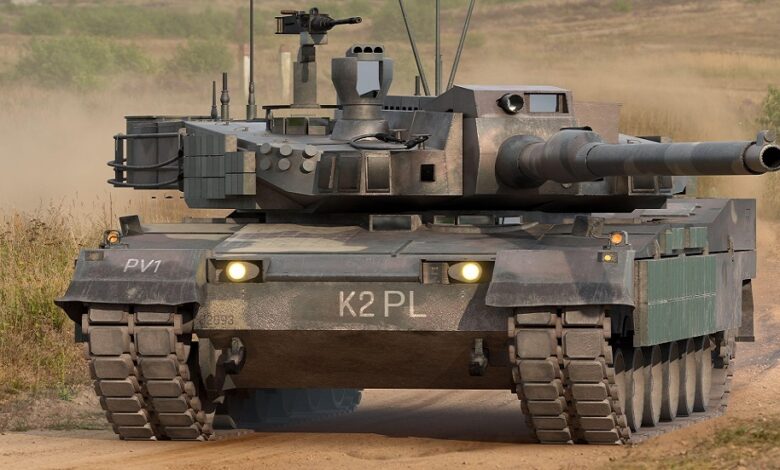
South Korea’s K2 Black Panther tank is opening new markets, particularly in South America, at the expense of German and American main battle tanks.
The technical analysis committee of Peru’s Ministry of Defense has recommended the South Korean K2 Black Panther as the preferred option for the next generation of main battle tanks for the Peruvian Army.
The recommendation followed a comprehensive evaluation that demonstrated the K2’s superiority over competing offers from Germany’s Leopard 2 and the American Abrams, despite the three tanks having relatively similar costs, according to Military Watch magazine.
The designs of the American Abrams and the German Leopard 2 date back to the 1970s, making them nearly forty years older than the K2. This generational gap has given the South Korean tank significant advantages in modernization and efficiency, in addition to a lighter weight and a 25 percent reduction in crew size.
The K2 also stands out because of its South Korean active protection system, which relies on sensors and countermeasures capable of detecting and intercepting guided missiles and RPG projectiles before impact—an innovation in which South Korea outpaced Western countries by several decades.
The tank is further distinguished by its hydropneumatic suspension system, which allows adjustments to its height and angle, thereby enhancing the effectiveness of its main gun on rugged terrain. The system enables the vehicle to lower its front section, increasing the gun’s depression angle and allowing it to engage targets hidden behind slopes while minimizing exposure—an essential advantage in mountainous environments such as those found in Peru.
Exceptional combat capabilities and logistical flexibility
The K2 possesses a unique indirect-fire capability. Its advanced fire-control system can engage targets beyond the direct line of sight using calculated ballistic solutions, providing limited artillery functionality and reflecting a broader trend toward expanding the versatility of armored vehicles through digital targeting and battlefield networks.
Weighing approximately fifty-five tons—significantly less than most Western tanks—the K2 offers a decisive advantage for Peru, whose military operations extend across deserts, the Andes Mountains, and tropical rainforests. Its lighter weight reduces ground pressure, allows operations on weaker bridges and narrow roads, and simplifies strategic transportation.
Its mobility is further enhanced by an impressive power-to-weight ratio, with a 1,500-horsepower engine providing faster acceleration and exceptional maneuverability across difficult terrain.
Political considerations and a comprehensive technology-transfer package
Despite the Norwegian Army’s favorable assessment of the K2, Norway ultimately selected the Leopard 2 under German pressure and in order to maintain interoperability with neighboring European countries. This decision highlights the political challenges facing the South Korean model in the markets of the North Atlantic Treaty Organization (NATO).
These challenges are expected to intensify with the introduction of the new M1A3 Abrams in the 2030s. The vehicle is being designed to compete with China’s Type 100 tank, which is considered among the world’s top-performing armored platforms, although it is not available for export because of Western pressure.