Iran escalates by targeting energy facilities in five Gulf states
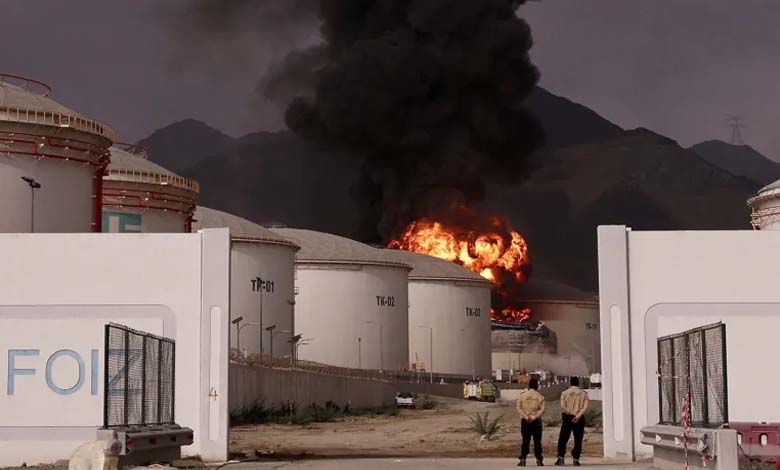
Saudi Arabia, Qatar, the United Arab Emirates, Kuwait, and Bahrain announced on Thursday that oil and gas facilities had been targeted by new Iranian missile and drone attacks, with a large number of projectiles intercepted.
The five countries stated that they had come under attacks launched from Tehran, as the U.S.-Israeli war against Iran entered its twentieth day, despite warnings issued by U.S. President Donald Trump. Iran has described these strikes as a response to what it considers ongoing U.S.-Israeli aggression since February 28.
The Saudi Ministry of Defense reported in separate statements that 27 drones had been intercepted and destroyed since early Thursday in the Riyadh and Eastern regions, adding that two ballistic missiles aimed at the Eastern Province had also been neutralized.
Saudi Arabia’s General Directorate of Civil Defense issued two early warnings during the morning, one regarding a threat in the Eastern Province and another concerning the governorate of Yanbu in the west of the country.
QatarEnergy stated in a communiqué that several of its liquefied natural gas facilities had been targeted by missile attacks early Thursday, causing fires and significant damage.
Hours earlier, Qatar’s Ministry of Defense had announced that the country had been subjected to a ballistic missile attack from Iran targeting the Ras Laffan Industrial City, a key hub for the country’s gas industry, resulting in material damage.
The Ministry of Interior confirmed that civil defense teams had “brought all fires in the Ras Laffan Industrial City under control without any casualties,” while cooling and securing operations continued, and explosive ordnance units handled hazardous remnants.
The Kuwait Petroleum Corporation reported that an operational unit at the Mina Al-Ahmadi refinery, operated by the Kuwait National Petroleum Company, had been targeted by a drone, causing a limited fire.
It added that the attack resulted in no casualties and that the fire was contained in accordance with the highest safety standards.
The Kuwaiti National Guard stated that its forces had shot down five drones at dawn on Thursday in areas under their responsibility, as part of ongoing efforts to enhance security and protect vital facilities, urging the public to adhere to official safety instructions.
The Kuwaiti military also confirmed that its air defenses had intercepted hostile missiles and drones, noting that the explosions heard were the result of interception operations.
The Ministry of Defense stated that air defense systems had engaged incoming missile and drone attacks from Iran, adding that the sounds heard across various regions were due to the interception of ballistic missiles and the engagement of fighter aircraft against drones and aerial threats.
The Ministry of Interior announced the activation of warning sirens, calling on citizens and residents to remain calm, proceed to the nearest safe locations, and follow official information channels.
Since February 28, Iran has carried out attacks against what it describes as U.S. bases and interests in Arab countries, some of which have caused casualties and damage to civilian infrastructure, prompting condemnation and calls from these states for the attacks to cease.
Over an 18-day period, Iran has launched at least 4,192 missiles and drones against these countries, in addition to an attack involving two fighter jets, according to figures based on official data up to Wednesday evening.
The United Arab Emirates has been the most targeted, followed by Kuwait, then Bahrain, Qatar, Saudi Arabia, and Jordan, while the Sultanate of Oman has been the least affected.
Tehran frames these attacks as a response to the U.S.-Israeli offensive, which has reportedly resulted in at least 1,332 deaths, including 202 children, 223 women, and Supreme Leader Ali Khamenei, as well as more than 15,000 injured.
Iran has also launched missiles and drones toward Israel, resulting in at least 16 deaths and 3,727 injuries, in addition to attacks that killed 13 U.S. service members and wounded 200 others.
These developments occur despite progress in negotiations between Iran and the United States over the nuclear program. It marks the second time Israel has disrupted the negotiation process, the first having led to the June 2025 war.