The United States Tightens Its Siege on Cuba with the Nimitz, Sky Spies, and an Indictment
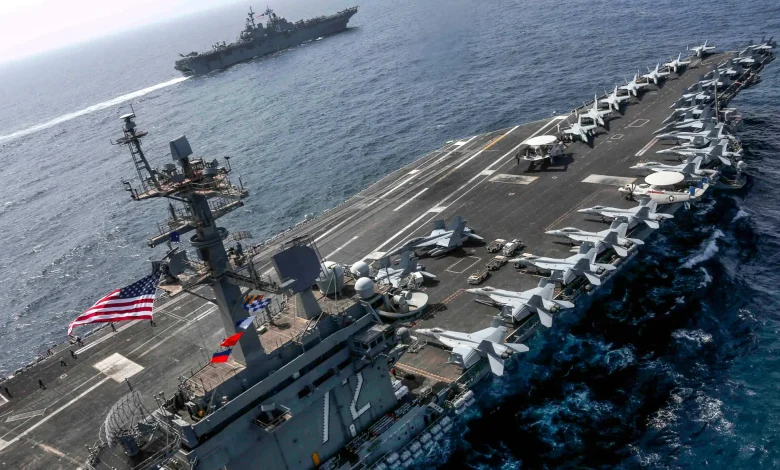
Washington has escalated pressure on Havana with the aircraft carrier “Nimitz” and “sky spies,” alongside an unprecedented indictment.
The deployment of the carrier strike group near Cuba comes amid increasing U.S. military surveillance flights off the Cuban coast.
CNN reported that drones and manned aircraft had been spotted operating near Havana.
-
The U.S. military will remain around Iran to ensure enforcement of the truce agreement
-
U.S. military destroys a drone engine production factory in Iran
The network explained that “the positions of military aircraft and drones were detected by open-source tracking systems off the coast of Cuba, in a noticeable escalation since the beginning of last February.”
These aircraft are equipped with specialized sensors designed to collect acoustic signals, gather electronic intelligence, and capture radar imagery in order to monitor foreign military operations and potential threats.
This military activity coincided with an unprecedented legal move in the United States through the issuance of an indictment against former Cuban President Raúl Castro over the downing of a civilian aircraft in 1996, a step that effectively eliminates any remaining opportunity to reach an agreement aimed at avoiding armed conflict between the two countries, according to CNN.
-
Drone theft from a U.S. military base raises fears of a potential Iranian response
-
Continuous U.S. military buildup in Israel in preparation for an attack on Iran
Former U.S. diplomat Ricardo Zúñiga said that indicting Castro as a means of pressuring the Cuban government into reaching an agreement could backfire.
He added: “Frustration on both sides could ultimately lead to conflict simply because Washington is cutting off communication channels with the Cuban government through this indictment.”
However, many exiles believe that the revolution founded by Fidel and Raúl Castro is collapsing, and that additional pressure is all that is needed to accelerate what they see as its inevitable downfall.
-
U.S. military signals imminent operation against Tehran
-
Operations for Weeks Against Iran … U.S. Military on Alert Awaiting Trump’s Decision
Congresswoman María Elvira Salazar, a Cuban-American, stated during a press conference on Tuesday: “The Castro era is over.”
While Trump repeatedly points to his popularity among Cuban-American voters, he has not ruled out the possibility of reaching a deal that could avoid a U.S. attack on the communist island.
Trump told reporters on Tuesday: “I can make a deal whether you change the regime or not. It has been an oppressive regime, and it has killed many people.”
He added: “But it is a country desperately in need of help. They cannot provide electricity, and they cannot get food. We do not want to see this situation.”
-
In Anticipation of a Potential Attack on Iran: U.S. Military Reinforcements to the Middle East
-
Errors or an exhausted system? The puzzle behind the rise in U.S. military aircraft accidents
U.S. Secretary of State Marco Rubio, who is Cuban-American and a fierce opponent of the Castro family, stated that Cuba’s top leadership must leave power.
American officials said that the unusual visit made last week to Cuba by CIA Director John Ratcliffe served as a warning to the Cuban government that “its opportunity to make concessions is shrinking.”
On Monday, the U.S. State Department announced a new round of economic sanctions against senior Cuban officials.
Cuban President Miguel Díaz-Canel rejected the measures, saying that no Cuban official had “assets to protect under U.S. jurisdiction.”
-
B-52… an old bird indispensable to the U.S. military
-
Trump and the Insurrection Act: Why Deploying the U.S. Military at Home Deepens Division
However, the indictment of Raúl Castro, who was commanding the Cuban military at the time the aircraft was shot down, raises tensions between the two rivals to a level not seen in decades.
The charges also pave the way for a possible U.S. military operation aimed at securing his surrender, similar to what happened with Venezuelan President Nicolás Maduro, Cuba’s close ally.
The Cuban military is already preparing to repel a potential U.S. attack, while Díaz-Canel warned that “a bloodbath awaits any invading force.”
-
Drone Revolution: The Ukraine War Reshapes U.S. Military Priorities
-
A U.S. senator: an imminent military strike on Iran is highly likely
-
Military Operation in Western Somalia Against Al-Shabaab… ATMIS Under U.S. Criticism
-
U.S. wants to lead the military exercises with the Greek