Terrorism in the Sahel enters a phase of influence management through an increasingly exposed Mali
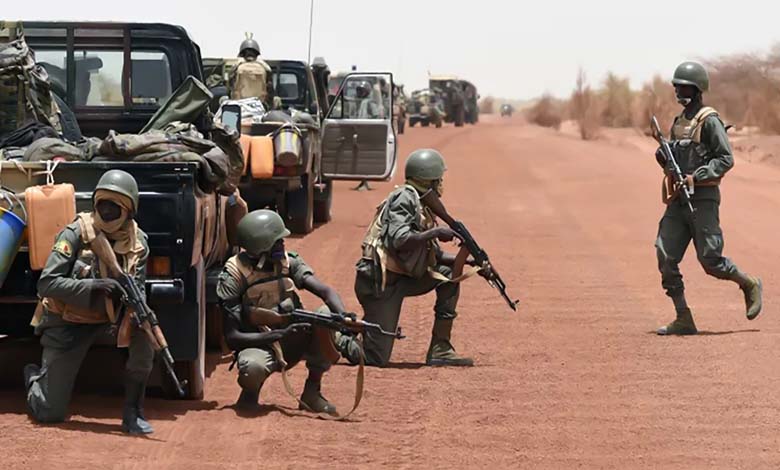
Political experts believe that Mali is entering an extremely dangerous phase, marked by an unprecedented escalation in armed attacks and the growing overlap of local and international actors in the conflict.
These large-scale attacks threaten to trigger a widespread security collapse across the entire Sahel region, particularly following the assassination of Mali’s Minister of Defense.
The Malian Minister of Defense, one of the leaders of the ruling military council since 2020, was killed in an attack targeting his residence on Saturday, carried out by a group affiliated with Al-Qaeda in the Sahel, according to the French newspaper Le Figaro, citing his family as well as government and military sources.
A major strategic blow
French political researcher Ivan Guichaoua, a specialist in security governance in the Sahel, said that the killing of the defense minister represents “a major strategic blow” to Mali’s military regime, as the security apparatus relies heavily on central figures in managing the conflict.
He added: “The attack reveals a deep security breach within the capital and its surroundings,” noting that coordination between Tuareg groups and terrorist organizations reflects a dangerous tactical alliance.
Guichaoua explained that the display of force by terrorist groups indicates a shift in their strategy from direct confrontation to influence management, which could lead to a reconfiguration of the balance of power in the region.
He warned that Mali could enter a phase of “gradual state disintegration” if such attacks continue at the same pace, especially given the weakness of civilian institutions.
An incentive to intensify operations
For her part, Malian researcher Nikagali Bagayoko said that what is happening in Mali is not merely a security escalation but a redrawing of the Sahel’s geopolitical map.
She explained that the killing of the defense minister represents a major shock within the structure of the military regime, particularly since the ruling system since 2020 relies on a narrow network of security and military leaders.
She indicated that this event could lead to a reshuffling of power balances within the military council and potentially open the door to hidden internal struggles between centers of influence.
She also warned that this incident exposes the fragility of the security system, which could encourage armed groups to intensify their operations and increase the likelihood of a security collapse, particularly in vulnerable areas outside the capital.
Coordination between terrorists and Tuaregs
She confirmed that this coordination reflects a significant strategic shift in the nature of the conflict, which is no longer a simple confrontation between the state and scattered groups, but is becoming closer to flexible alliances bringing together different actors (terrorists and separatists) based on shared tactical interests.
She noted that this development greatly complicates the situation, as it combines ideological objectives with political-separatist goals, making the conflict more difficult to contain.
Implications of international intervention
The researcher believes that international intervention, particularly through paramilitary forces, has added a new dimension to the crisis without achieving real stability, but rather contributing to further militarization of the conflict.
She explained that the presence of multiple international actors increases the complexity of the balance of power and creates indirect competition between major powers within Mali.
She warned that this situation could lead to the expansion of the conflict into neighboring Sahel countries, given the ease with which armed groups move across borders, raising the risk of the crisis turning into an open regional conflict.
A pivotal phase
The situation in Mali is heading toward greater complexity, with escalating military operations and the intertwining of local and international forces, placing the country at a critical juncture that may determine the future stability of the entire Sahel region.
In another development, Tuareg rebels announced on Sunday that they had reached an “agreement” with members of the “Africa Corps,” who support the Malian army in Kidal and had been entrenched in a former United Nations camp.
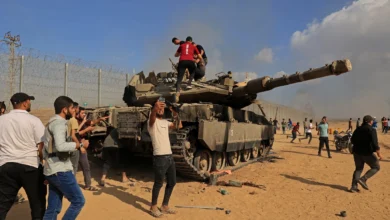
Clashes resumed in the northern city on the same day, while new fighting broke out in Kati, the military town near the capital Bamako.
One Tuareg rebel leader told the French channel TV5 Monde that “an agreement was reached allowing the army and its allies from the Africa Corps to leave Camp No. 2, where they had been entrenched since Saturday.” He added that the northern city was now “under full control” of the Azawad Liberation Front.
A resident of Kidal said: “We saw a military convoy leaving, but we do not know the details of the situation. Fighters from armed movements are now controlling the streets.”
A spokesperson for the Tuareg rebels confirmed on Sunday morning that fighting had resumed in Kidal, noting that the objective is to “expel the last fighters who had taken refuge in one of the camps.” These rebels, allied with the Group for the Support of Islam and Muslims affiliated with Al-Qaeda, are fighting the Malian army, which was initially supported by paramilitary forces.
Renewed fighting in Kati
New clashes also broke out in Kati between the Malian army and terrorist groups. The city hosts the army’s general headquarters and the residence of the transitional president, General Assimi Goïta.
A resident said: “Fighting has resumed in several areas, with terrorists positioned near the hills overlooking the city,” adding that military aviation also intervened.
The city had been attacked on Saturday by the Group for the Support of Islam and Muslims and Tuareg rebels.
Control of Kidal and expansion of fighting
The Azawad Liberation Front, a separatist movement seeking an independent region in northern Mali, announced that it had taken control of the city of Kidal, which the Malian army had recaptured in November 2023 with the support of Wagner Group fighters. The movement also confirmed its control over other positions in the Gao region in the north of the country.
The Malian government stated that the clashes resulted in 16 injuries among civilians and military personnel, with “limited material damage,” noting that “the situation is under control” in all targeted areas.
An unprecedented escalation since 2012
Security analyst Charlie Werb stated that “Mali is facing a nationwide coordinated attack, the largest since 2012, when the government lost control of half of the country.”
Since that year, Mali has been suffering from a deep security crisis due to terrorist groups affiliated with Al-Qaeda and the Islamic State, as well as criminal and separatist groups.
United Nations Secretary-General António Guterres condemned “violent extremism,” calling for coordinated international support to combat terrorism in the Sahel region. The European Union also condemned the attacks, reaffirming its commitment to supporting security and stability in Mali and the region.