The American deterrence legend refuses to retire: Washington searches for the heir to the B-52
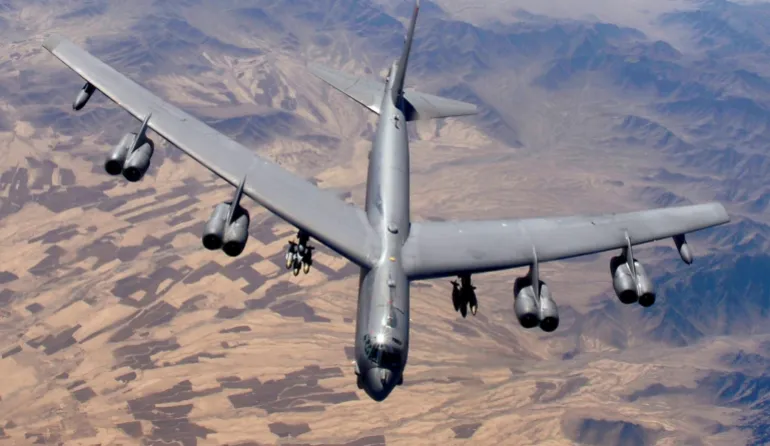
The American strategic bomber B-52 Stratofortress, which for decades has formed the backbone of the U.S. Air Force’s long-range deterrence capabilities, is approaching an unprecedented milestone in the history of military aviation.
Washington plans to keep it in operational service for nearly a full century before retiring it.
While this legendary aircraft continues to perform its vital roles, the Department of Defense has begun practical steps to anticipate the era that will follow it by studying the concept of a “new heavy bomber” expected to carry its strategic legacy into the future, according to The National Interest magazine.
This direction coincides with the U.S. Air Force’s ongoing comprehensive modernization program for the B-52 fleet, designed to keep it effective into the late 2040s or early 2050s. The complete replacement of its original engines represents the most significant upgrade, described as the most important in decades, due to the major improvements it brings to operational efficiency, range, and reliability.
Major upgrades
This development is expected to culminate this year with the delivery of the first upgraded versions designated B-52J, marking the first official change in the aircraft’s designation in more than six decades and occurring 64 years after the closure of its final production line in 1962.
According to long-term U.S. plans, the B-52 will operate alongside the modern stealth bomber B-21 Raider by the late 2030s as part of a comprehensive restructuring of the American strategic bomber fleet.
During this phase, the B-1B Lancer and B-2 Spirit bombers are expected to be gradually retired, despite interim upgrades aimed at extending their operational lifespans for several additional years.
Under this new operational distribution, the B-21 will undertake deep penetration missions into hostile airspace thanks to its advanced stealth capabilities, while the B-52 will continue to serve as a long-range launch platform capable of carrying large quantities of munitions and missiles.
The question now arising within the Pentagon concerns the identity of the bomber that will eventually succeed the Stratofortress. Internal budget justification documents reveal that the U.S. Air Force intends to begin next year an “analysis of alternatives for a new heavy bomber,” a step aimed at defining the core criteria for the future strategic bombing platform in terms of performance, operational capabilities, and structural design.
The inclusion of this project within B-52 modernization programs indicates that the strategic objective is to ensure a smooth transition from the Stratofortress era to a new generation of heavy bombers, particularly since previous attempts to replace it did not achieve the desired success.
In the 1970s, the B-1B Lancer was developed as a supersonic alternative capable of low-altitude penetration, but its production remained limited.
As for the B-2 Spirit, designed to be the primary nuclear bomber, its extremely high cost collided with the geopolitical changes following the collapse of the Soviet Union, reducing the planned fleet from 132 aircraft to only 21.
Today, as a decisive moment approaches, a new dilemma emerges: the B-21’s limited internal payload compared to the vast capacity provided by the B-52. This may push Washington toward one of two strategic options: either developing an entirely new heavy bomber to fill this gap or relying solely on modern stealth platforms and bringing the era of traditional heavy bombers to a definitive end.
Until the path becomes clearer, the bet remains on the ability of the B-52J fleet — currently comprising 58 aircraft in active service, 18 in reserve, along with a number of stored airframes — to continue flying for additional decades, thereby writing the final chapter of an exceptional career that places it among the most enduring and influential weapons systems in modern military history.
B-52 Stratofortress specifications
Year of entry into service: 1955
Number built: 744 aircraft (all variants); approximately 76 B-52H airframes remain in service with the U.S. Air Force.
Length: 48.5 meters
Wingspan: 56.4 meters
Empty weight: approximately 84,000 kg
Maximum takeoff weight: 221,000 kg
Maximum speed: 1,046 km/h (approximately Mach 0.86 at high altitude)
Combat radius: mission- and load-dependent; typical operational radii vary widely (approximately 3,000 to 7,000 km depending on payload, flight profile, and aerial refueling).
Service ceiling: 15,240 meters; varies by payload.
Weapons payload: 31,500 kg of assorted munitions.
Crew: 5 members (pilot, co-pilot, weapons systems officer, navigator, electronic warfare officer); may vary depending on mission and load.