The root of terrorism in the world: the Trump 2026 strategy opens a war against the Muslim Brotherhood
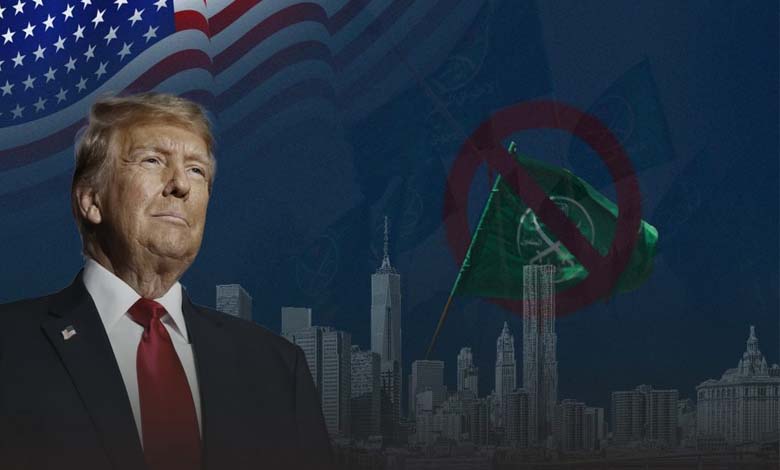
In the new American vision, the Muslim Brotherhood is no longer seen as merely a political movement raising religious slogans or operating under preaching banners; it is now presented in decision-making circles as the “founding mind” of transnational chaos and the incubator from which the most violent and extremist organizations have emerged.
In a sharp shift reflecting a profound change in U.S. counterterrorism doctrine, the 2026 U.S. strategy, places the Muslim Brotherhood at the center of the confrontation, describing it as the ideological root that has nourished organizations such as al-Qaeda, ISIS, and Hamas, and that has entrenched a culture of violence, excommunication, and the instrumentalization of religion to build transnational networks aimed at dismantling the concept of the nation-state and reviving the project of a “caliphate” in more radical and organized forms.
The U.S. document does not describe the Muslim Brotherhood as a conventional political opponent, but as a complex system combining ideology, organization, financing, and institutional infiltration, operating through multiple fronts ranging from partisan and media activities to recruitment networks and logistical support. In the American conception, this makes it more dangerous than a mere transient armed organization because it represents the “structure that produces” extremism itself.
Accordingly, the U.S. confrontation is no longer limited to pursuing armed cells or conducting security strikes, but has expanded to target the dismantling of the ideological and organizational environment that regenerates terrorism and to dry up its financial, media, and political networks, within a new doctrine that sees eliminating the threat as beginning with striking the “root” rather than merely chasing the branches.
The Muslim Brotherhood at the core of the U.S. strategy
The document “America First in Counterterrorism 2026” reveals a radical change in how Washington deals with the movement. The U.S. administration no longer separates political Islam from armed terrorist organizations, considering that the Muslim Brotherhood provided the intellectual and organizational foundation that paved the way for the emergence of modern extremist movements.
According to the document, the Muslim Brotherhood represents “the root of modern Islamist terrorism based on re-establishing the Islamic caliphate and killing or enslaving non-Muslims,” an unprecedented characterization that places the movement beyond the traditional political framework and frames it as a global ideological and security threat.
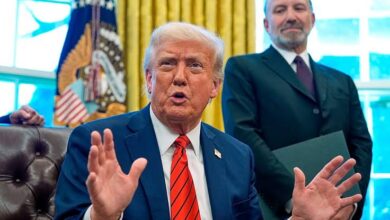
In this context, the strategy indicates that U.S. President Donald Trump announced the designation of the original Egyptian branch, as well as the Jordanian and Lebanese branches, as foreign terrorist organizations, with confirmation that other branches will be added later.
The document goes beyond designation and clearly refers to continuing efforts to “crush the organization wherever it operates,” by targeting its financial, media, and organizational networks and pursuing its transnational activities.
From “endless wars” to dismantling networks
The U.S. strategy reflects a harsh reassessment of previous policies which, in the current administration’s view, focused on pursuing armed organizations without addressing the ideological and organizational structure that produces them.
Washington now sees counterterrorism not as limited to traditional military operations, but as a broader model based on dismantling networks linked to extremism, drying up their sources of funding, and penetrating their logistical, media, and economic structures.
Among the tools mentioned in the document are:
- imposing expanded financial sanctions,
- pursuing transnational financing networks,
- targeting “shadow fleets” used to circumvent sanctions,
- conducting cyber and intelligence operations,
- drying up recruitment and mobilization platforms,
- using terrorist designations to suffocate institutions linked to extremist organizations.
The document also emphasizes that the United States will continue to pressure the “global jihadist movement” until institutions linked to the Muslim Brotherhood are no longer able to “recruit and finance terrorism against the United States.”
The Muslim Brotherhood and global extremism networks
The strategy does not view the movement as an isolated entity, but as part of an interconnected system where ideology, financing, and logistical and military support intersect.
The document directly links the Muslim Brotherhood to organizations such as al-Qaeda, ISIS, and Hamas, arguing that the movement played the role of an “intellectual umbrella” legitimizing transnational violence and the use of religion as a means to gain power or impose influence.
It also expands the link between terrorism and organized crime, discussing the relationship between extremist networks and transnational cartels, and arguing that smuggling, money laundering, and drug trafficking have become major sources of funding for extremist groups.
In this framework, Washington treats terrorism as a “hybrid network” in which ideological organizations intertwine with illicit economic interests, explaining the shift from a war against the “organization” to a war against the “system.”
The Middle East as the center of the new battle
Despite references to reducing involvement in “endless wars,” the Middle East remains central to the new U.S. strategy.
In this context, Washington places the Muslim Brotherhood within a broader environment of transnational movements that, in the American view, contribute to producing chaos, extremism, and the weakening of nation-states.
From security to a “battle of identity”
The document goes beyond military and security dimensions and presents a clear ideological and cultural vision linking counterterrorism to the defense of “American identity” and “Western civilization.”
The strategy criticizes “open border” policies and uncontrolled immigration, arguing that they have allowed extremist networks to expand within the United States and Europe. It also calls on European allies to directly confront “Islamism” and strengthen policies against extremism and uncontrolled migration.
The new U.S. strategy thus reveals a major shift in the concept of the war on terror: Washington no longer sees the danger solely in armed organizations, but in the ideological and organizational structure that produces and recycles them.
At the heart of this vision, the Muslim Brotherhood is presented, under the new American doctrine, as the “foundational source” of transnational extremism and the primary target of a battle through which Washington seeks to redraw the global map of the fight against terrorism.