From institutional Brotherhoodization to shadow governance… Yemen’s liberated provinces in a Brotherhood nightmare
The threat of state erosion in Yemen is no longer confined to the Houthi coup in Sanaa; it is now being replicated in parallel in the so-called “liberated” areas, where Yemen’s Muslim Brotherhood, through networks of political and military influence, has reproduced a model of a state captured from within.
Instead of restoring state institutions after years of war, some provinces have become arenas of influence for armed groups and partisan power centres that divide security, military, and economic decision-making among themselves.
In cities such as Taëz, recurring assassinations, armed clashes, and the domination of partisan factions over institutions reveal the extent of the deterioration of state authority. Public service is no longer a tool for serving the nation but has become a means of partisan empowerment and subordinating sovereign decision-making to organizational loyalty.
Observers argue that the movement’s policies, based on the “Brotherhoodization” of public administration and the control of military and security decision-making, have plunged the liberated provinces into a dark tunnel of insecurity and systematic assassinations.
Taëz and security chaos
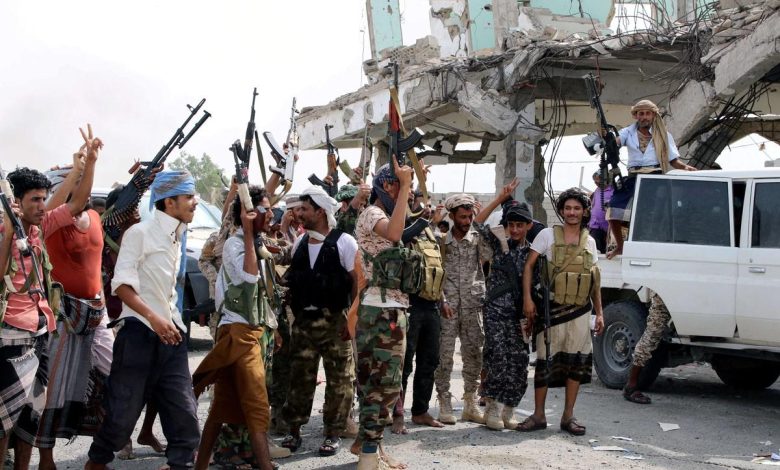
The city of Taëz stands as the clearest example of the collapse of state institutions. A city that fought intense battles against Houthi militias has now seen large parts of its liberated areas turn into a stage for score-settling and security chaos led by armed groups affiliated with the Muslim Brotherhood.
According to local statistics and human rights reports covering recent years, more than 380 assassination operations and attempts have been recorded, targeting soldiers and officers in the army and security forces, as well as civilian, political, and military figures opposed to the movement’s policies.
Among the most notable cases is the assassination of the commander of the 35th Armoured Brigade, Brigadier General Adnan al-Hammadi, in late 2019, a figure regarded as a pillar of state stability and one of the founders of a Yemeni army built outside partisan polarization.
The figures do not end there: security data indicate that armed clashes between Brotherhood-affiliated factions have resulted in the deaths and injuries of more than 450 civilians over the past three years.
All of these victims fell as a result of disputes over illegal taxation, land control, and market revenues, reflecting a complete absence of military discipline.
Institutional Brotherhoodization
In this context, Yemeni political analysts and researchers believe that the danger of the Muslim Brotherhood’s approach in Yemen lies in the “partisan nationalization of public service, its Brotherhoodization, and the militarization of society to serve the party’s agenda rather than the state’s.”
Media and political sources report that the Brotherhood, through its influence within the internationally recognized authorities, has placed unqualified partisan figures in sensitive military and security positions, thereby emptying state institutions of their professional substance.
They argue that when a soldier’s loyalty shifts from the nation to allegiance to Brotherhood leadership, state authority collapses automatically, and crime becomes a political tool for liquidation, as seen in Taëz, Marib, Wadi Hadramout, and more recently in the south, where the Brotherhood is racing to “Brotherhoodize” institutions.
Loss of state authority
Political analyst Ammar Ali, meanwhile, argues that the security incidents and assassinations targeting soldiers in Taëz were not random, but the direct result of weakening official intelligence agencies and the creation of parallel security structures.
He explains that dismantling security agencies in areas controlled by the Brotherhood has effectively undermined state authority and the rule of law, turning killers into individuals shielded by their military or partisan affiliation, and reducing state institutions to a mere façade behind which partisan influence operates.
He adds that Taëz has become a model of chaos, with 60% of government buildings in the city still controlled by armed groups linked to the Brotherhood who refuse to hand them over or allow the rebuilding of state institutions.
He concludes that the Brotherhood has sought to erode the rule of law, deepen structural corruption, cripple public services, fragment the state’s monopoly on force, and entrench a system of quotas, politicized public employment, and shadow governance in which Brotherhood figures ultimately control military and security decisions.