The Houthis’ Bloody Provocations Ignite Confrontations with Tribal Groups
Checkpoints in Al-Jawf have increasingly become recurring flashpoints of tension as a result of escalating violations and incidents involving the targeting of travelers and tribal members by the Houthis.
Violent armed clashes broke out on Saturday evening between the Dahm tribes and the Houthi militia in the Bart Al-Anan district of Al-Jawf province, northern Yemen, following the killing of three members of the Al-Jaïd tribe and the wounding of several others by gunfire from Houthi personnel stationed at a checkpoint in the Al-Mahir area. The incident highlights the extent of popular resentment, which could erupt at any moment as a result of the Houthis’ aggressive practices and their disregard for the lives of Yemenis.
Local sources said the incident triggered widespread anger among the Dahm tribes, which mobilized armed men to attack Houthi-controlled checkpoints in the area. The ensuing clashes resulted in the deaths of four members of the group, although no final and confirmed casualty figures were immediately available.
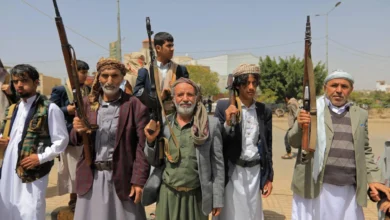
The Dahm tribes in Al-Jawf had previously declared their support for the state and its armed forces in confronting what they described as “an outlaw faction in which the interests of murderers and bandits have converged under the banner of what is known as the Houthi movement.”
In a statement previously issued by the expanded coalition of members of the Dahm tribes, the tribes said the province had endured immense suffering because of Houthi supporters, whose abuses had spread across most districts through killings, raids, incitement of discord, and restrictions on civilian movement by establishing armed checkpoints on public roads. According to the statement, these practices had left local residents facing difficult choices, with taking up arms being the least harmful option.
The statement said this situation had prompted the Dahm tribes to unite their ranks in confronting the aggression alongside the state, under the leadership of local officials, district administrators, and security commanders.
Sources reported that Houthi militia members stationed at the Al-Mahir checkpoint in the Afay area opened fire directly on several members of the Al-Jaïd tribe following a verbal altercation. The incident resulted in the deaths of Hamad Raqman, Hamad Musfar Shannan, and Mubarak Abdullah Shannan, while two others were wounded, one of them critically. The militia subsequently detained the two wounded men and transferred them to an undisclosed location.
According to the sources, the tribal members had been returning from a tribal gathering in the Al-Rayyan area. Their interception by personnel at the checkpoint quickly escalated into a verbal confrontation, followed by direct gunfire.
The sources said the Dahm tribes responded swiftly by launching an armed attack on the Al-Mahir checkpoint. Fierce clashes subsequently erupted, ending with the tribes taking control of the checkpoint and four Houthi militia members being killed. The development reflects the growing intensity of tribal tensions and the widening scope of confrontations with the militia. The sources added that the fighting was still ongoing, with no final figures available regarding the human losses suffered by either side.
They further stated that the Al-Mahir checkpoint had recently become a recurring flashpoint due to escalating violations and incidents involving the targeting of travelers and tribal members by the Houthis, further intensifying popular and tribal resentment toward these practices.
The escalating violations and incidents involving the targeting of travelers and tribal members by the Houthis have consequently deepened popular and tribal anger over these practices.
These developments come as tribal members continue to gather at the Al-Rayyan tribal assembly site in eastern Al-Jawf province, amid accusations that the militia is continuing its policies of repression and violations against tribal communities. The situation raises fears of further escalation and an expansion of the area of confrontation.
For several weeks, Al-Jawf province, where the Houthis control most of the territory, has witnessed severe tensions between tribal groups and the Houthi movement, with the situation liable to erupt at any moment. This comes as tribes from various Yemeni provinces continue to mobilize east of Al-Hazm, the provincial capital.
The escalation followed a call for a “tribal nakaf,” a traditional form of tribal mobilization, issued by Sheikh Hamad bin Fadgham, who fled Houthi-controlled areas after reportedly being detained along with the alleged daughter of the late Iraqi President Saddam Hussein, who had sought refuge with him after her home in Sanaa was seized by Fares Manaa, a businessman close to the Houthis.
On Saturday, warplanes also carried out several airstrikes targeting positions and reinforcements belonging to Houthi fighters in three Yemeni provinces: Marib, Al-Jawf, and Taiz, located in central, northern, and southern Yemen, respectively.