Marital disputes expose a Hezbollah weapons depot in Beirut
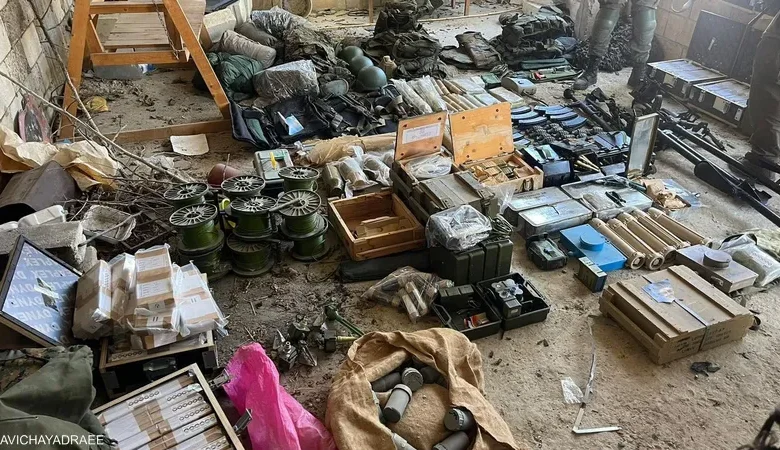
Family tensions accompanied by gunfire led to the discovery of a large weapons depot in the heart of Beirut, with Hezbollah emerging as the main suspect.
The domestic altercation prompted a police search operation in the Ras el-Nabeh district of Beirut, resulting in the seizure of a warehouse containing a substantial cache of weapons, ammunition, explosives, and maps.
According to local Lebanese media reports, preliminary findings suggest that the case may be linked to Hezbollah.
-
Salam to Hezbollah: We Will Not Yield to Blackmail or Threats of Civil War
-
Among Them Al-Qard Al-Hassan and Bayt Al-Mal: New Sanctions Target Hezbollah’s Financial Lifelines
The investigation is being supervised by the Prosecutor General at the Court of Cassation, Judge Ahmad Rami Al-Hajj, while the Internal Security Forces’ intelligence branch continues its inquiries following the discovery of the weapons depot in Ras el-Nabeh.
According to the reports, the case began in the early hours of Thursday after a domestic dispute broke out between a Hezbollah member and his wife. The confrontation involved gunfire, prompting the intervention of a Beirut police patrol.
-
Road Blockades and Stone-Throwing at the Army: Hezbollah Responds to the Southern Agreement with a Strategy of Disorder
-
A Tour Inside a Hezbollah Tunnel Reveals Iranian Fingerprints: Drones with a 200-km Range and Eight Tons of Explosives
During the search of the Hezbollah member’s residence and a tire shop he owns, security forces discovered a large quantity of weapons and military ammunition, in addition to explosives, maps of Beirut, electronic devices, and party membership cards.
Sources close to the investigation stated that the judge ordered the suspect’s arrest and referred the case file to the Beirut Court of Appeal’s public prosecutor’s office.
He also instructed the intelligence branch to continue the investigation, under his supervision, into the seized weapons depot.
-
Eroding Influence and Shrinking Support Base: Public Rejection of Hezbollah in Syria and Lebanon
-
Salam: Hezbollah Has Lost Its Remaining Margin of Independence Following Nasrallah’s Departure
The discovery of the arms cache in Beirut comes amid mounting domestic and international pressure on Hezbollah regarding the future of its weapons arsenal, following the significant losses suffered by its military capabilities during confrontations with Israel and the growing calls for the Lebanese state to maintain exclusive control over all weapons.
Hezbollah possesses a military arsenal that includes short-, medium-, and long-range missiles, as well as drones and anti-tank systems. The group also maintains a network of storage facilities and logistical infrastructure throughout its areas of influence.
-
Escalation Continues Between Hezbollah and Israel Despite a U.S. Proposal for De-escalation
-
New Israeli tactic to Trap Hezbollah drones
-
Israel threatens to strike Beirut in response to Hezbollah drones