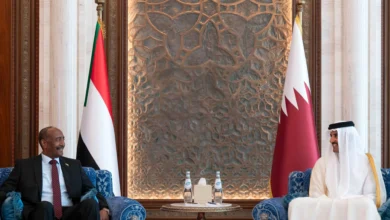
Al-Burhan Opens Sudan’s Doors to Erdoğan in Exchange for Weapons and Influence
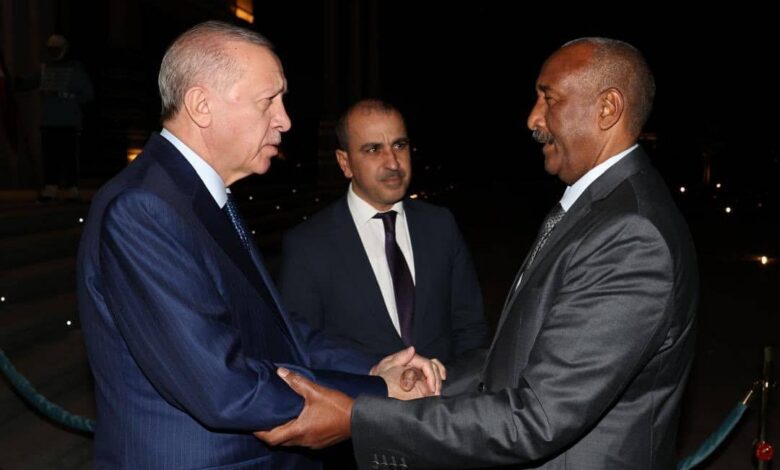
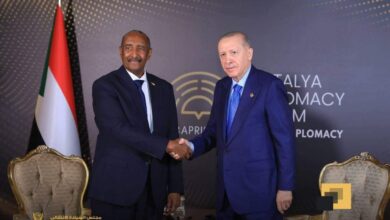
The relationship between Abdel Fattah al-Burhan and Turkish President Recep Tayyip Erdoğan can no longer be viewed as an ordinary diplomatic relationship between two states with shared commercial interests and historical ties. Developments during Sudan’s war, revelations about deals involving Turkish weapons and drones, and discussions of investment opportunities in ports and mining raise serious questions about the nature of the understandings between the two sides. They also raise the question of whether Sudan’s military leadership has brought the country’s resources and assets into its calculations for obtaining external support.
To say that al-Burhan “sold Sudan to Erdoğan” is to make a sharp political accusation. It also condenses a broader question: how is the military leadership managing foreign relations during the war, and how willing is it to grant economic and strategic concessions in exchange for strengthening its military position? Establishing that sovereignty has actually been ceded or that a specific exchange has taken place requires access to the contracts, agreements and their terms. Nevertheless, published information about arms deals and Turkish interest in resources and ports provides grounds for serious political scrutiny of the authorities in power.
Historically, Turkey has sought to expand its presence in Sudan, drawing on political, commercial and religious ties, as well as the country’s location on the Red Sea and near the Horn of Africa. During Erdoğan’s visit to Sudan in December 2017, the two countries signed agreements and memoranda of understanding across several sectors as part of an effort to deepen their partnership. Turkey’s Ministry of Foreign Affairs states that Sudan occupies an important place in Ankara’s relations with Africa and that bilateral cooperation spans economic, development and commercial fields.
A relationship established in peacetime, however, has different implications when a country enters a devastating war and its military authorities urgently need weapons, financing and technical support. The balance of bargaining power then changes: the two sides are no longer necessarily negotiating as equals. A party in urgent need of equipment may be willing to offer facilities, concessions or long-term commitments that do not receive the same level of public scrutiny possible under normal circumstances.
This is where al-Burhan bears responsibility for clarifying the nature of the relationship with Ankara. Sudan does not belong to the military establishment, and no leadership has the right to treat its strategic resources as private property to be used in securing military support. Sudanese people have a right to know whether arms deals are linked to economic commitments, whether there are obligations concerning ports, mines, land or infrastructure, and whether those agreements contain terms that affect independent national decision-making.
In March 2025, The Washington Post reported, on the basis of documents and correspondence it said it had partially verified, a deal worth approximately $120 million between Turkish company Baykar and the defence industry complex linked to the Sudanese army. The newspaper said the agreement included drones, munitions, control stations and technical support. Its investigation also reported that Sudanese officials had discussed potential opportunities for Turkish companies in mining and the Abu Amama port project with company representatives.
These facts do not, on their own, prove the existence of a secret agreement placing Sudanese resources under Turkish control. They do, however, raise questions that should not be ignored. Why do urgent military needs coincide with strategic economic offers? What is the nature of the understandings reached behind closed doors? Were the long-term gains and losses for the Sudanese state assessed, or was the priority to obtain weapons as quickly as possible?
One of the greatest dangers in countries at war is that a military crisis becomes an opening for the redistribution of wealth and privileges beyond public scrutiny. Under normal circumstances, major contracts should be subject to feasibility studies, competitive processes, legal procedures and financial review. During war, security considerations may take precedence over transparency, making it easier to push agreements through under the pretext of secrecy or necessity, even though their effects may last for decades after the fighting ends.
The Abu Amama port is particularly important in this context because of its location on the Red Sea coast and its economic and strategic potential. Ports are more than commercial facilities: they are gateways to global trade, potential sources of revenue and instruments of geopolitical influence. Whoever obtains the right to manage or develop them may gain influence beyond direct profits, particularly if a project is connected to a network of logistics contracts, investments and security agreements.
The same applies to mining. Sudan possesses significant mineral resources, but ensuring that the country benefits from them requires institutions capable of protecting public revenue, preventing monopolies and guaranteeing local communities a fair share of returns. If foreign companies enter these sectors during a war and amid institutional division, a lack of transparency can make it more difficult to assess contracts and monitor their implementation.
The issue should therefore not be reduced to rejecting Turkish investment or all economic cooperation with Ankara. Balanced economic relations can serve Sudan, create jobs and support reconstruction. The concern lies in the possibility that these relationships may be shaped by exceptional circumstances that give the foreign party a bargaining advantage, or that national resources may become an undisclosed consideration for political and military support.
Nor does al-Burhan’s receipt of military support necessarily mean that Sudan gains equivalent strategic benefits. Weapons may help the military leadership improve its position in battle, but they do not remedy economic collapse, return millions of displaced people to their homes or replace destroyed facilities. If their cost includes long-term economic commitments, Sudanese society may bear that burden after the war, while the leaders who signed the agreements may have left office.
Turkey, for its part, benefits from expanding its relationship with a country in an important position on the Red Sea, strengthening the presence of its defence industry in a growing African market and gaining opportunities to enter strategic sectors. This does not mean that every Turkish initiative is driven exclusively by a desire for control. It does mean, however, that Turkish interests are strongly present and must be addressed through balanced negotiations, transparency and the protection of Sudanese national interests.
The contrast becomes more apparent when Ankara speaks of protecting Sudan’s sovereignty and territorial integrity while the details of some military and economic deals remain open to question. Sovereignty is not a diplomatic slogan. It is the actual ability to make independent decisions, manage resources transparently and avoid becoming dependent on a single arms supplier or foreign partner.
The more politically precise formulation, therefore, is not to assert without conclusive documents that al-Burhan sold Sudan. It is to say that his growing relationship with Erdoğan exposes him to a serious allegation: the possible surrender of national interests. That allegation can be dispelled only by disclosing the contracts, commitments and guarantees governing cooperation between the two sides.
What is needed now is the publication of the details of military and economic agreements that can be disclosed, independent oversight of strategic contracts and assurance that Sudanese wealth is not used to finance arrangements whose terms are unknown to the public. Any future agreements concerning ports or mining should also be open to review under the law and include clear protections for national rights and environmental and economic interests.
Sudan, which is enduring a war over control of power, must not find itself years from now facing another struggle to regain control over its economic decisions. If al-Burhan is confident that his relationship with Erdoğan serves the country, he should demonstrate it with figures, contracts and guarantees, not political statements alone.