Left Brain and Right Brain: Do They Really Determine How We Think?
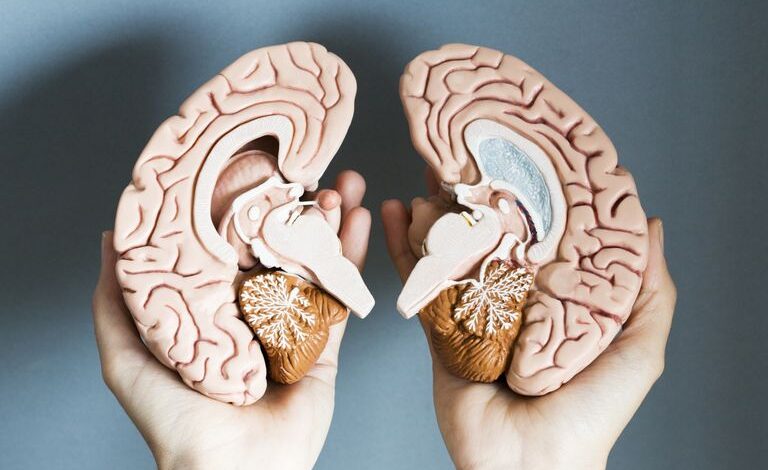
The idea that each person relies more heavily on one side of the brain than the other is widely popular. According to this theory, the left hemisphere is associated with logic, reasoning, and analytical skills, while the right hemisphere is responsible for creativity, intuition, and imagination. This distinction is often used to explain differences in personality and behaviour. However, it is far more simplistic than the way the human brain actually works.
Two hemispheres with complementary functions
The human brain consists of two hemispheres, left and right, connected by a structure known as the corpus callosum. This connection allows both sides to communicate continuously and coordinate their activities.
Certain brain functions are indeed lateralised. In most people, for example, the main regions involved in language processing are located in the left hemisphere. The right hemisphere plays an important role in aspects of spatial processing, facial recognition and interpreting emotional elements of communication.
However, this division does not mean that the two hemispheres operate independently. Most everyday activities rely on brain networks distributed across both sides.
Is logical thinking exclusive to the left hemisphere?
One of the most common assumptions is that the left side of the brain is responsible for logic and analytical thinking. In reality, solving problems, making decisions and organising complex thoughts require cooperation between several brain regions.
Reasoning involves networks responsible for memory, attention, impulse control and information assessment. These networks can extend across both hemispheres.
Creativity is equally unlikely to be confined to the right hemisphere. Coming up with an original idea, writing a story, or finding an unexpected solution involves memory, association, and reasoning processes that engage multiple areas of the brain.
Why does the left-brain/right-brain theory remain so popular?
The distinction between left-brained and right-brained personalities is appealing because it offers a simple explanation for complex human differences. It divides people into two broad categories: those considered rational and methodical, and those viewed as intuitive and creative.
This classification is sometimes used in education, personal development and management. However, there is no strong scientific evidence to support the claim that individuals have personalities dominated by one cerebral hemisphere.
Neuroscience research instead suggests that cognitive abilities emerge from interactions between multiple brain networks. Individual differences are real, but they cannot be explained by a simple opposition between the two sides of the brain.
Brain lateralisation exists, but it does not define personality
It is important to distinguish the specialisation of certain brain functions from the idea that one hemisphere dominates a person’s overall abilities or personality. The fact that a particular function is more strongly represented on one side does not mean that this hemisphere independently controls that ability or personality trait.
Hand preference, for example, is related to certain aspects of brain organisation, but it does not determine whether someone is more logical or creative. Similarly, being particularly talented in mathematics, music or the arts does not mean that one hemisphere consistently dominates the other.
Thinking involves the whole brain
The reality is therefore much more complex than the familiar image of a logical left brain and a creative right brain. Both hemispheres have specialised functions, but they work together to support language, memory, emotions, decision-making and imagination.
Rather than trying to identify which side of the brain dominates our personality, it is more accurate to understand that our thinking patterns emerge from complex networks that constantly interact. Human abilities and individual differences cannot be reduced to a simple division between two hemispheres.